Christmas Bedroom Decor Ideas: 15 Cozy Ideas That Still Let You Sleep
The short answer first
Here is the whole promise in one sentence: decorate the bed, the light, and the greenery — in that order — and make sure everything switches itself off before you fall asleep.
The bedroom is the one room where Christmas decor can go wrong in a way no other room can. A glittery garland at eye level catches the light every time you roll over. A real candle on the nightstand is a fire risk next to bedding. Fairy lights left on all night glow through your eyelids at 2 a.m. Pretty is not enough here — the room still has to do its job, which is sleep. Every one of these 15 Christmas bedroom decor ideas follows that rule: warm light at bed level, nothing that sparkles where you look when you lie down, lights on a timer, no real flames near fabric, and nothing that keeps you awake. If the room looks like a Christmas card at 7 p.m. and feels like a normal, dark, quiet bedroom at 11 p.m., you did it right.
The other thing to know before you start: a Christmas bedroom does not need a full makeover or a big budget. One bedding swap, one string of lights, one bit of greenery — that is already Christmas. The ideas are layered on purpose: start with the bed, add the light, then the greenery, then the small surfaces. Pick three or four and stop. Your bedroom will smell faintly of pine, glow warm for exactly as long as you want it to, and still let you sleep like a person who has to get up in the morning. And if your bedroom is on the small side, our small bedroom ideas use the same thinking — cozy, not crowded — for rooms where every inch counts.
1. Swap one bedding layer only — flannel sheets or a plaid duvet cover
Start with the bed, because the bed is the room. And you do not need a whole new bedding set — one layer is enough to make the whole room read as Christmas. Swap in flannel sheets, or pull a plaid duvet cover over the duvet you already own. That is the entire project, and it takes about ten minutes, most of which is wrestling the duvet cover on, which is a workout nobody asked for but everybody survives.
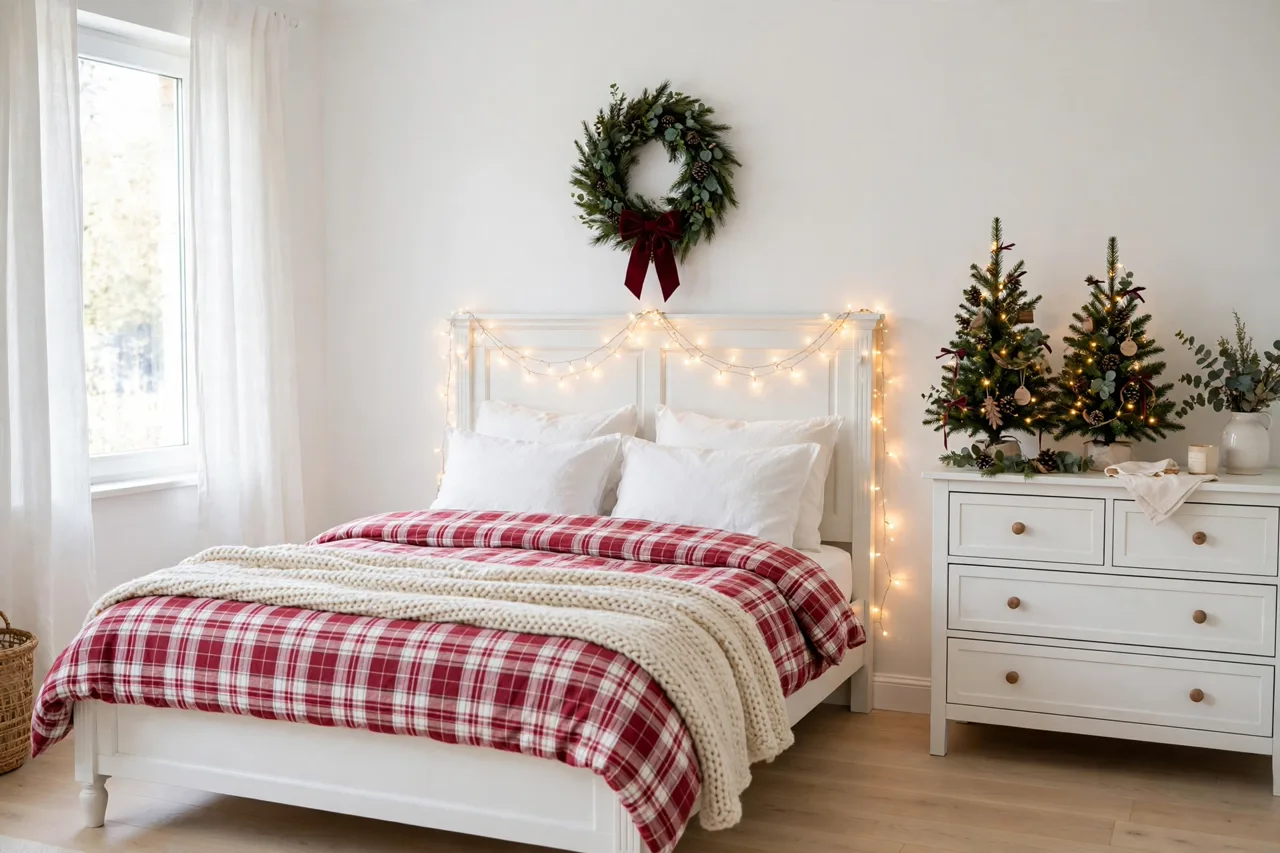
Flannel sheets run about $25 to $40 for a queen set, and a plaid duvet cover runs about $30 to $50 — and both of them are useful all winter, not just in December. Pick one pattern and let it be the only pattern on the bed. A red-and-white plaid or a deep green check does the whole job by itself; add a second pattern and the bed starts arguing with itself. Keep the rest of the bedding white or cream so the plaid has somewhere quiet to sit, and the room instantly feels warmer without a single decoration going on a wall.
This is also the warmest idea in the guide in the literal sense. Flannel sheets are genuinely warmer on a cold December night, which means the first idea on the list is also the one you will feel at 3 a.m. That is a good sign for the rest of the list.

2. The 2-2-1 pillow formula — two sleeping, two shams, one Christmas accent
Here is a formula that saves you from the two classic pillow mistakes: a bed with one sad flat pillow, and a bed with so many pillows you have to move a pile to the floor every night. Two sleeping pillows, two shams standing in front of them, one Christmas accent pillow in front of that. 2-2-1. That is the whole formula, and it works on every bed from a twin to a king.
The accent pillow is where the Christmas lives — one burgundy velvet pillow, one with a small embroidered tree, one in a cable-knit cover. Just one. The sleeping pillows and the shams stay white or cream, so the accent pillow is the star instead of one voice in a crowd. An accent pillow cover runs about $10 to $15, and if you already own a plain pillow, you only need the cover — the insert inside can be the one you have.
At night, the formula does something practical too: you take the accent pillow and the shams off, and you are left with exactly the two pillows you sleep on. No pile on the floor, no pillow avalanche at midnight, no wondering where the good pillow went. A bed that looks finished at 7 p.m. and sleeps properly at 11 p.m. — that is the whole point of this guide, and this idea is the clearest version of it.

3. A chunky knit throw folded at the foot of the bed
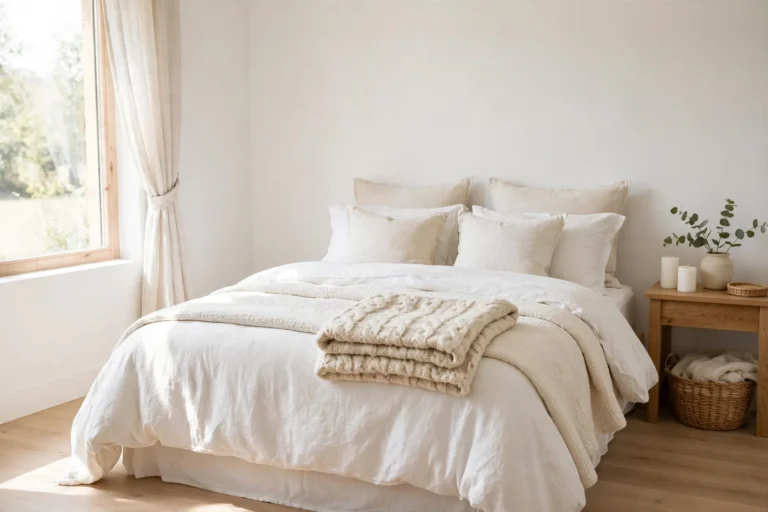
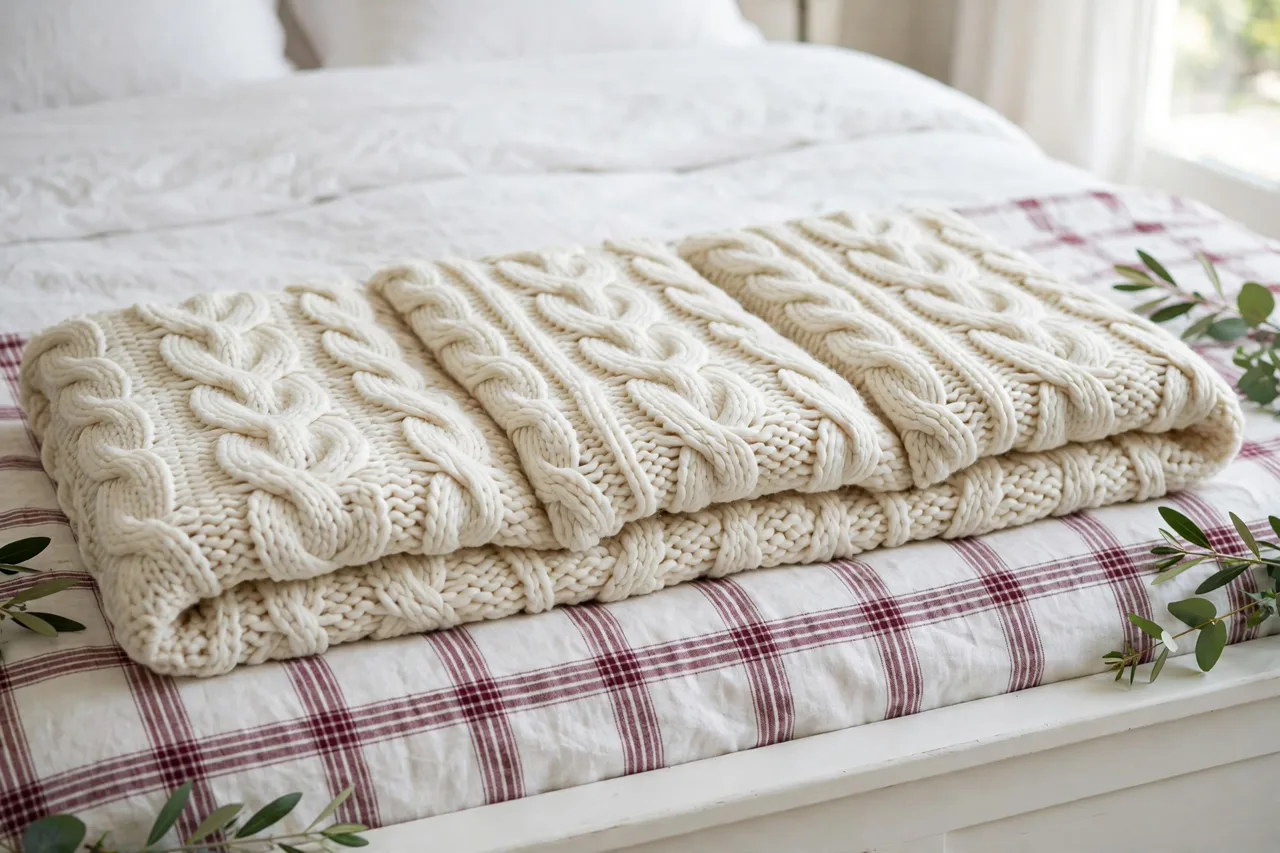
A chunky knit throw is the fastest cozy in the whole guide. Fold it in thirds, lay it across the foot of the bed, and the room looks like a cabin in a Christmas movie — no other decorating required. It takes about fifteen seconds, and it is the first thing guests notice when they walk in, because texture is what the eye finds first in a white room.
Pick a throw in cream, oatmeal, or soft gray — not red, because the bedding already has the color job — and make it genuinely chunky, the kind with thick braided cables you can see from the door. A good one runs about $25 to $40, and it earns its keep all winter: it is the blanket you actually reach for when you read in bed, which means it is decor that gets used every single night. That is the best kind of decor, the kind that does not just sit there looking pretty.
Fold it neatly, not draped in a heap. A folded throw says someone lives here and cares; a heap says someone gave up halfway through. And if your bedroom leans toward the soft, slow, candlelit feeling our hygge bedroom ideas are built around, this throw is the same idea in one purchase — warmth you can touch, in the room where you spend a third of your life.
4. Pick one palette and commit — two colors plus one metal
This is the idea that makes all the other ideas work, and it costs nothing. Pick two colors and one metal, and use only those for the whole room. Red and white with gold. Deep green and cream with brass. Cream and taupe with silver. Two colors, one metal, done — everything you buy, borrow, or pull out of the decoration box has to pass that test, or it stays in the box.
The reason this matters is that a bedroom is a small room, and a small room shows every stray color. One red pillow, one green garland, one gold star, one silver candle, one blue ornament someone gave you in 2019 — together that is not Christmas, that is a yard sale. But red and white with gold, repeated in the bedding, the pillow, the ribbon, and the wreath bow, looks like a designer did it. It looks expensive. It cost the same as the yard-sale version.
Write your palette on a sticky note and put it on the decoration box before you start shopping. It sounds silly and it saves real money, because it stops you buying the pretty thing that does not match anything. Two colors, one metal. Commit, and the whole room will thank you for it every morning in December.

5. A faux-fur runner across the foot of the bed
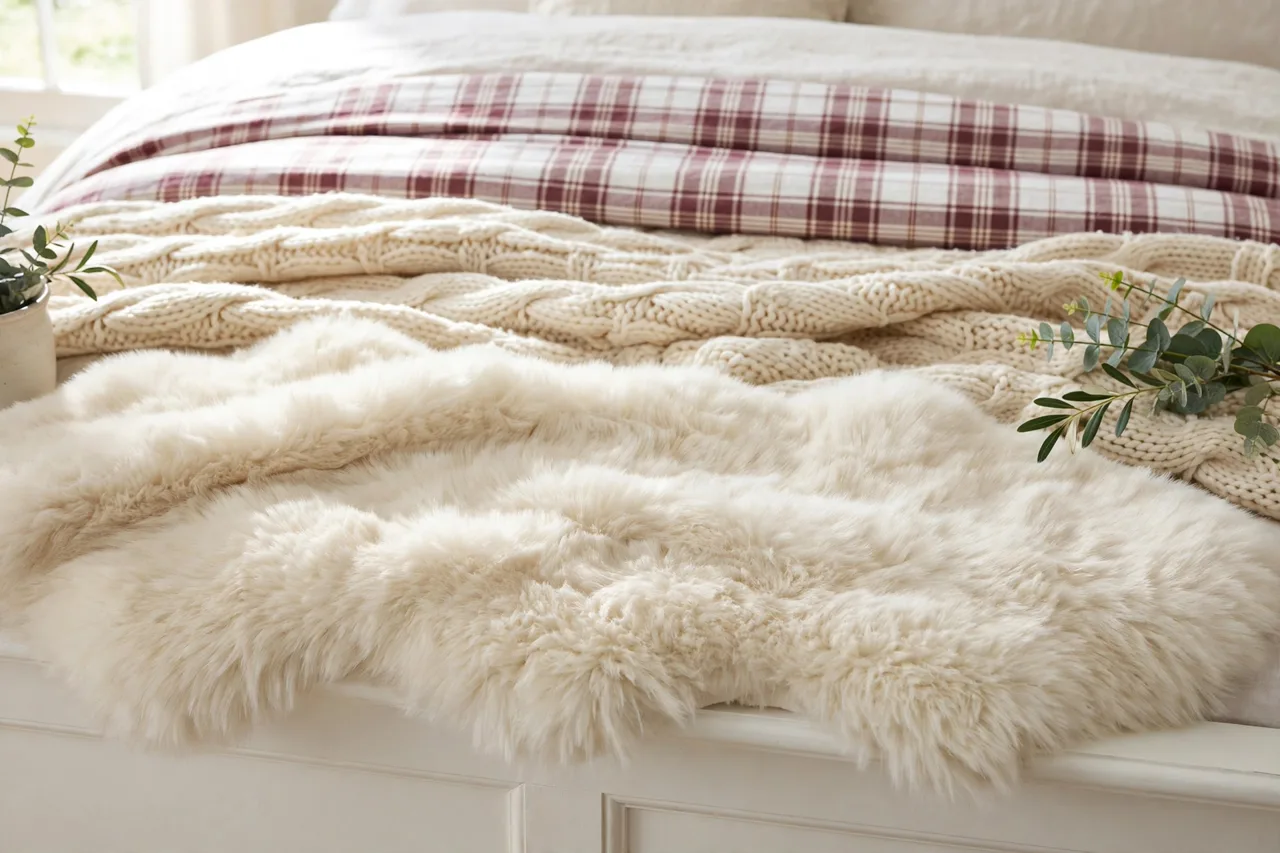
If the knit throw is the cozy idea, the faux-fur runner is the luxury idea — and it is the one that works long after Christmas is over. Lay a faux-fur runner across the foot of the bed, over the throw or instead of it, and the bed suddenly looks like a hotel room in a ski town. A runner about 60 inches (about 150 cm) long runs about $20 to $35, and unlike most Christmas decor, it does not go back in the box in January. It stays out all winter, because fur — fake fur, obviously — is a winter texture, not a Christmas one.
Keep it cream or white, not dyed red or green, for exactly that reason: a cream runner works with the Christmas palette in December and with plain white bedding in February. It also hides the end of the bed, which is where the duvet always looks a little messy, and it gives you something soft to sit on when you put your shoes on in the morning. Small thing, daily use.
One warning, learned the hard way by many: shake it outside before you put it on the bed the first time, and keep it away from anything sticky. Faux fur collects everything — glitter, pine needles, cookie crumbs — and it does not let go easily. But on a white bed in a white room, with one burgundy pillow above it, it is the single most luxurious-looking twenty-five dollars in this guide.
6. Warm-white fairy lights over the headboard — battery plus timer
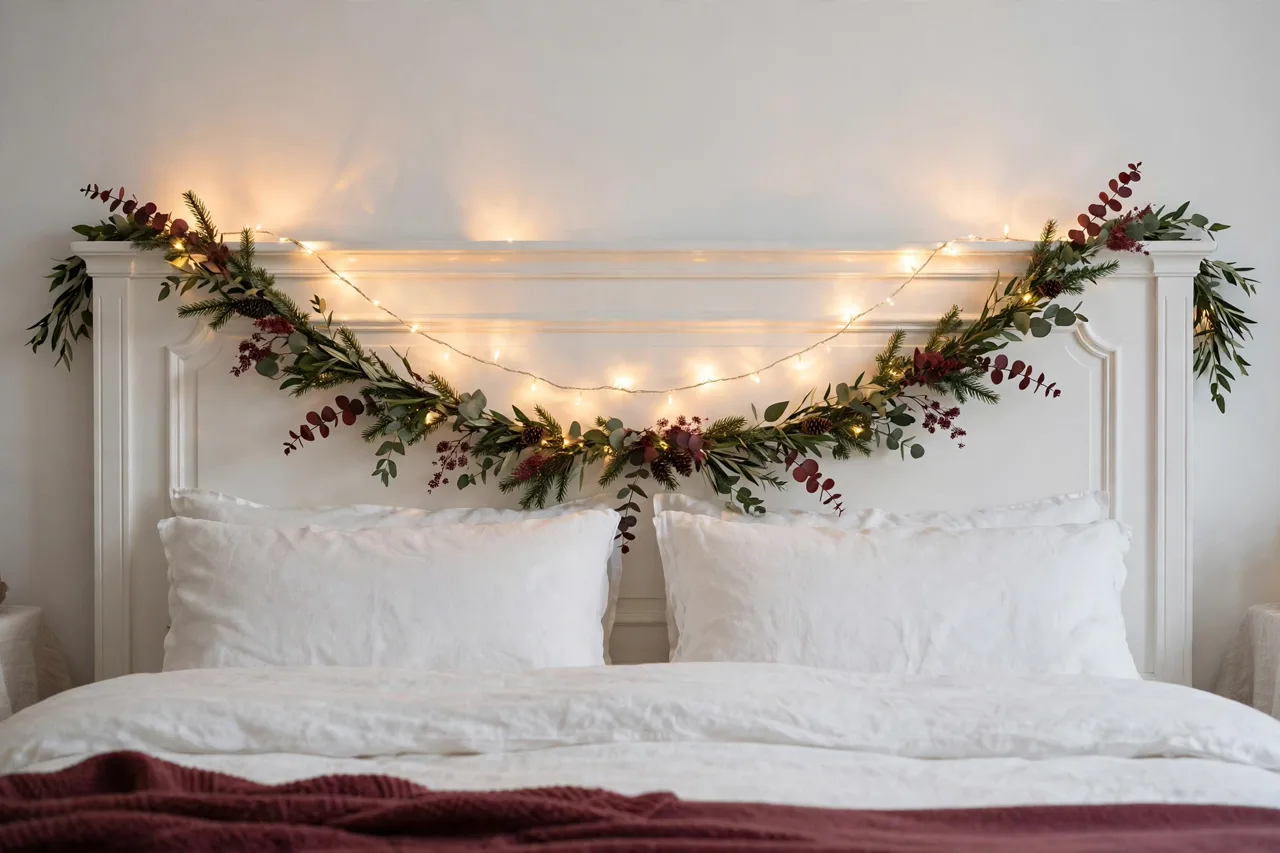
This is the light idea that changes the whole room after dark, and it has two non-negotiable rules: warm white, and a timer. Warm white — not cool white, which makes a bedroom look like a hospital corridor, and not multicolor, which makes it look like a carnival. Warm white is the color of candlelight and late-afternoon sun, and it is the only color that makes a bedroom feel sleepy instead of awake.
Run one string, about 10 feet (3 m), in a soft swag across the top of the headboard, held by small clear removable hooks. A battery string costs about $6 to $10, has no cord trailing to an outlet, and — this is the important part — most battery strings now come with a built-in timer: six hours on, eighteen hours off. Switch it on at 5 p.m., and it turns itself off at 11 p.m. while you are already asleep. No getting up, no glowing through your eyelids, no 2 a.m. realization that the room is still lit up like a shop window.
Keep the lights above eye level when you are lying down. That is the whole sleep rule for this idea: if you can see the bulbs from your pillow, they are too low. Over the headboard, up high, they glow on the wall instead of in your eyes — and the wall does the work of spreading the light. Ten dollars, ten minutes, and your bedroom glows like the inside of a snow globe until exactly bedtime.
7. A flameless candle trio on the nightstand — three heights, timer models
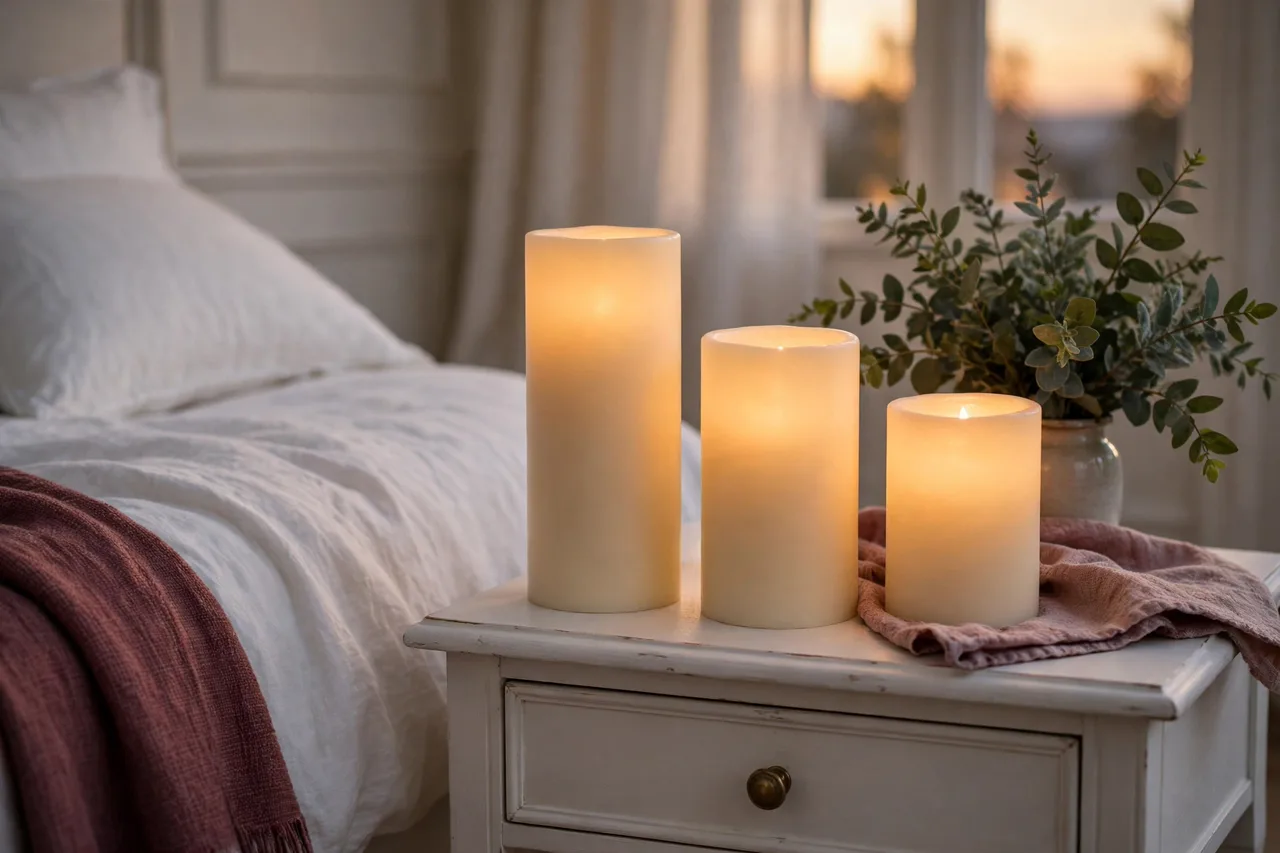
Real candles and bedrooms do not mix. Bedding, curtains, books, a sleeve catching the edge of the nightstand at midnight — a real flame next to all of that is a risk nobody needs, and it is the one Christmas tradition worth leaving in the living room. Flameless candles give you the whole look with none of the worry: the same warm flicker, the same glow on the wall, and you can fall asleep with them on because they are LED.
Buy a trio in three heights — roughly 4, 6, and 8 inches (10, 15, and 20 cm) — in cream or ivory, and group them tight on the nightstand so they read as one arrangement instead of three separate objects. A set of three with a remote and a timer runs about $12 to $20, and the timer is the whole point: set it for four or six hours, and the candles switch themselves off after you are asleep. Some sets even come with a remote you can use from bed, which is the kind of small luxury December deserves.
Keep the trio on the far side of the nightstand, away from the edge where a book or a glass of water lives, and put them on a small tray or a folded linen napkin so the wax-colored plastic does not slide on a polished surface. At 9 p.m. they make the nightstand look like a Christmas card. At 11 p.m. they are off, and the room is dark, the way a bedroom should be.
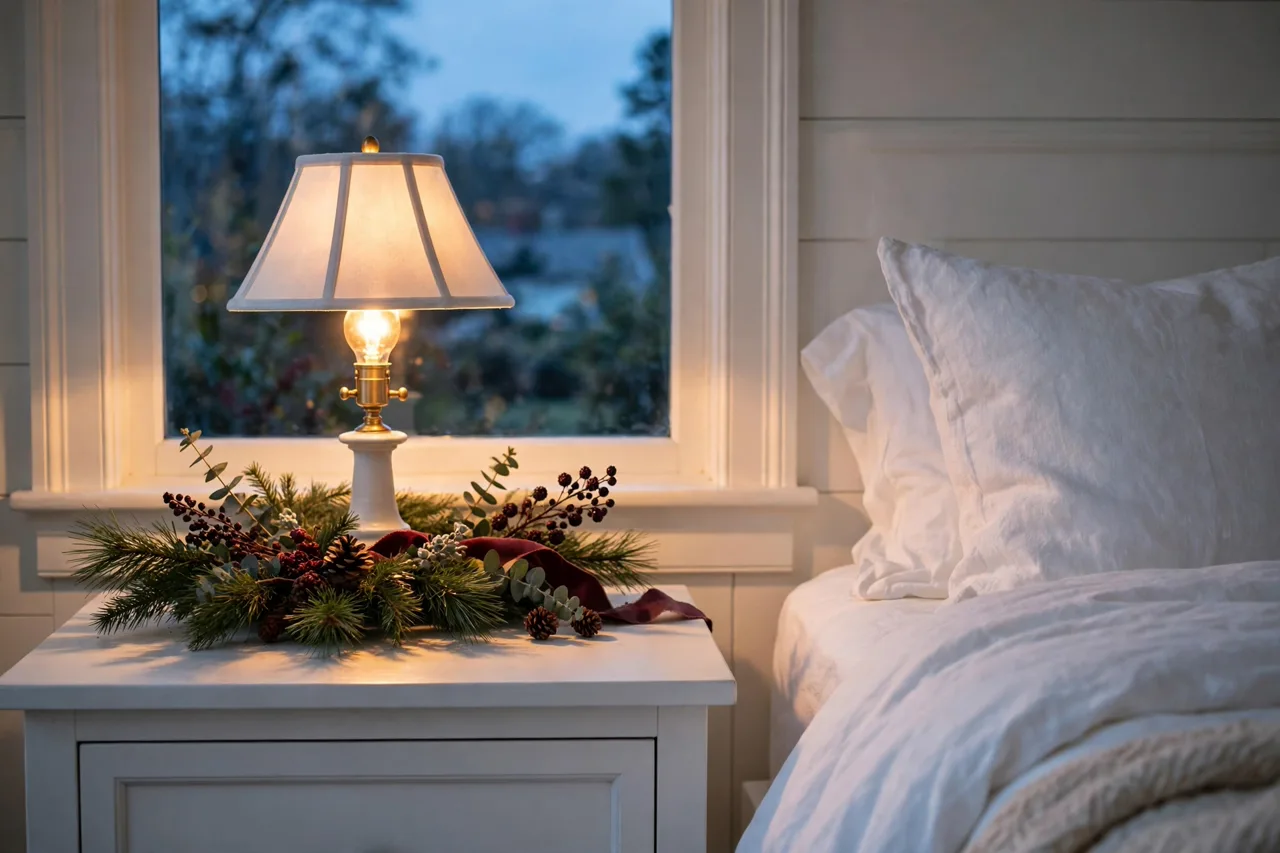
8. One low lamp swap — a warm bulb (2700K) in the bedside lamp
This is the cheapest idea in the guide and possibly the most effective, because it changes the light in the room every single night. Swap the bulb in your bedside lamp for a warm one — 2700K on the box, which is the number to look for — and the whole bedroom drops half a shade warmer, like someone turned the sun down a notch. A warm LED bulb costs about $3 to $5, takes thirty seconds to change, and you will feel the difference the first night you read in bed.
The number matters more than the brand. Bulbs labeled “daylight” run about 5000K and make a bedroom feel like an office at noon. Bulbs labeled “soft white” or “warm white” at 2700K are the color of an old-fashioned light bulb, and in December that is exactly what you want: light that says evening, rest, slow down. If your lamp has a dimmer, even better — but the bulb swap alone does most of the work.
Do only one lamp, the one on your side of the bed, and leave the overhead light alone. The overhead light is for finding socks; the bedside lamp is for December. One warm bulb, and the fairy lights, the candles, and the bedding all look better — because warm light is the thing that ties them together, and now the room finally has it.
9. A slim garland swagged across the headboard — ribbon ties, no nails
If the fairy lights are the glow, the garland is the greenery — and the headboard is the place for it, because it is the one big blank surface in a bedroom that is not the bed itself. A slim garland, about 6 feet (about 1.8 m), swagged across the top of the headboard in one gentle dip, turns a plain headboard into the centerpiece of the room. Slim matters here: a fat, heavy garland overwhelms a headboard and sheds needles on your pillows. Slim, light, and mostly green, with a few pinecones or burgundy berries tucked in.
Hang it with ribbon, not nails. Loop a burgundy ribbon around the garland at two or three points, tie it to the top of the headboard or to small removable hooks behind it, and let the garland hang in a soft curve. Ribbon ties are the whole hanging system — no holes, no landlord conversation, nothing to fill in January. A good faux garland runs about $15 to $25 and comes out of the box every December for years, while a fresh one dries out above a warm bed in about a week and drops needles exactly where you sleep. Faux wins this one.
Keep the swag high and the ends tucked, so nothing dangles where your head goes. And if you already hung fairy lights on the headboard, weave the garland behind the lights or hang it just below them — greenery and glow together, one arrangement, not two things competing for the same six inches of wood.

10. One wreath dead-centre above the headboard
One wreath, dead centre, above the headboard. Not two, not a cluster, not a gallery wall of small wreaths — one, in the middle, where the eye lands the second you walk into the room. A wreath about 18 to 24 inches (45 to 60 cm) across, in plain greenery with a burgundy bow at the bottom, costs about $15 to $30, and it does the job of a whole headboard decoration by itself.
Centre it properly, because a wreath that is two inches off-centre will bother you every single morning, and you will know it is off-centre even if nobody else does. Measure from the edges of the headboard, mark the middle with a tiny pencil dot on the wall, and hang it from one removable hook rated for a few pounds. The bow goes at the bottom, not the top — a bow at the bottom makes the wreath look finished, like a present; a bow at the top makes it look like it is hanging from its own ribbon, which it is, but nobody needs to see the mechanics.
This is the idea that photographs best, which is why it is the one to do if you only do one thing on a wall in the whole room. One wreath, one bow, one hook, dead centre. And when January comes, the hook peels off the wall, the wreath goes back in its box, and the wall never knew it was there.

11. A mini tree cluster on the dresser — two small trees, different heights
A full tree belongs in the living room. A mini tree cluster belongs on the dresser — and the word cluster is doing real work here, because two small trees together look deliberate, while one small tree alone on a big dresser looks lost, like it wandered in from another room. Two trees, different heights — one about 18 inches (45 cm), one about 24 inches (60 cm) — in matching pots, set a few inches apart, and suddenly the dresser has a Christmas moment instead of a Christmas afterthought.
Decorate them lightly: a dozen tiny ornaments between the two of them, one short string of battery fairy lights, a ribbon star on the taller one only. A good pair of faux mini trees runs about $20 to $35 together, and a real potted pair costs about the same and can go outside or into the garden in January. Keep them at the back of the dresser, away from the edge, because a tree that gets knocked off a dresser at midnight is a tree that wakes the whole house.
This is also the idea that works hardest in a guest room — if someone is staying over for Christmas, a mini tree cluster on the dresser is the thing that tells them you thought about their room, not just the living room. Our guest bedroom ideas run on exactly that feeling: a room that says welcome before you say a word. Two little trees say it for about thirty dollars.

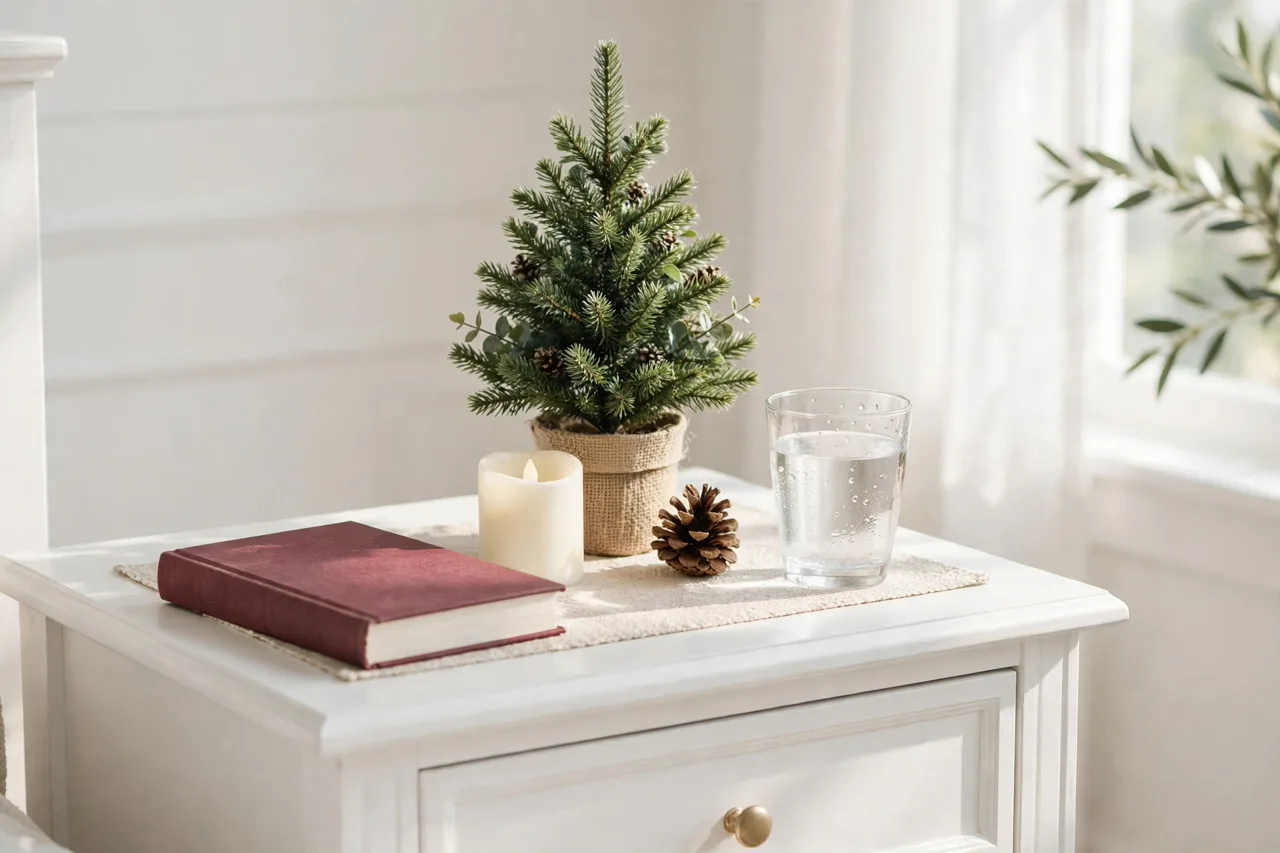
12. A nightstand vignette — one mini tree, one candle, one pinecone
A vignette is just a fancy word for a small arrangement, and the rule for a nightstand vignette is three things, no more. One mini tree, about 12 inches (30 cm) tall. One flameless candle. One pinecone. That is the whole arrangement, and it takes up less space than a paperback book — which matters, because the nightstand still has to hold a glass of water, a phone, and a book, and it is a nightstand, not a shop display.
The trick is the triangle: put the tallest thing at the back, the shortest at the front, and leave a little air between them so each one can be seen. The mini tree goes at the back, the candle in the middle, the pinecone at the front — and suddenly three ordinary objects look like someone arranged them on purpose, which someone did, in about forty seconds. A mini tree this size runs about $8 to $12, the candle you already bought for idea 7, and the pinecone is free if you know where a pine tree lives.
Do this on one nightstand only, not both, unless your nightstands are twins and your patience is endless. One styled nightstand and one plain one looks intentional. Two styled nightstands look like a hotel, and a hotel is not a home. And keep the pinecone away from the edge — pinecones roll, and a pinecone rolling off a nightstand at 3 a.m. sounds much bigger than it is.
13. Greenery and pinecones on the windowsill — with a battery candle behind
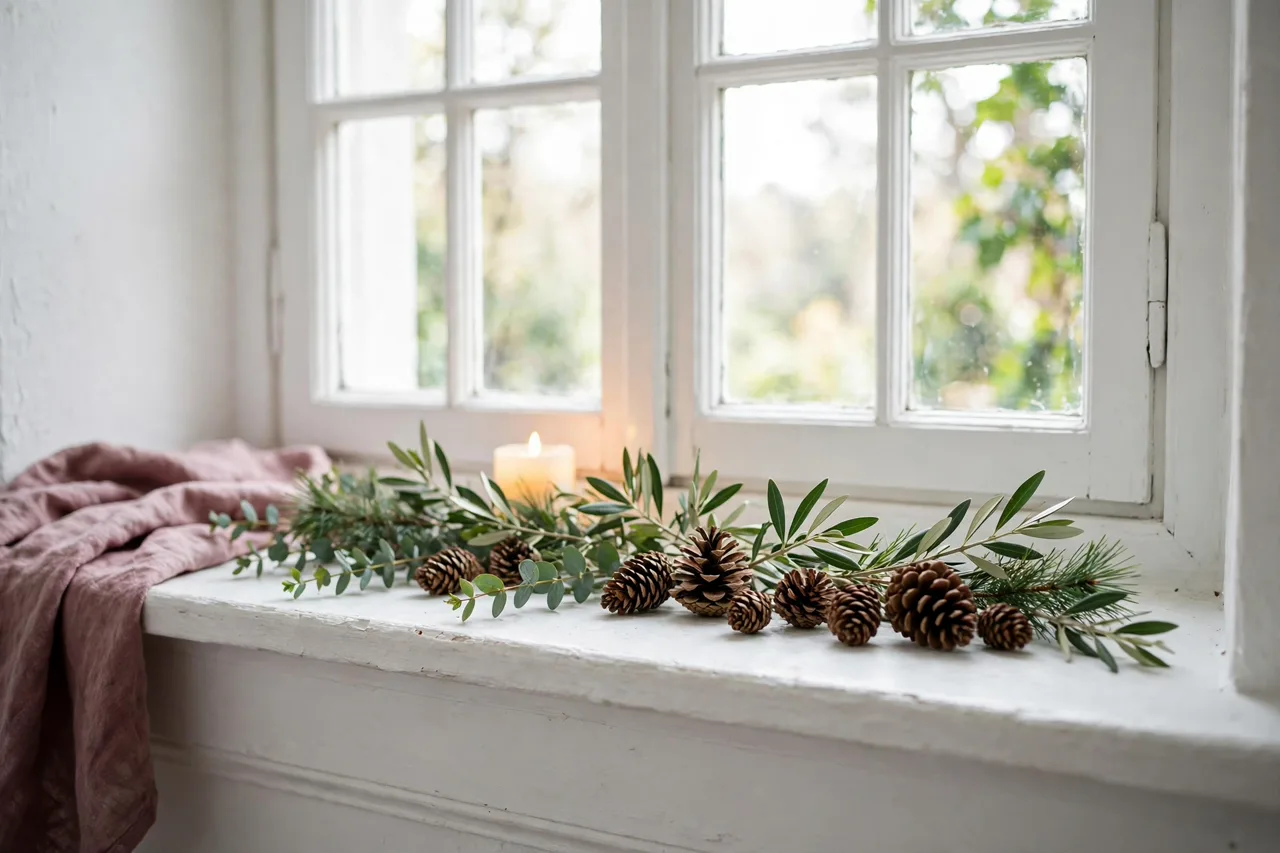
The windowsill is the most underused surface in a bedroom, and in December it is also the one that gets the most natural light — which means greenery on a windowsill looks better there than anywhere else in the room. Lay a few sprigs of faux greenery along the sill, tuck in three or four pinecones, and put one battery candle behind them so the light glows through the greenery in the evening. The whole thing costs about $5 to $10 if you already own the candle, and it takes five minutes.
Keep it low and flat. A windowsill arrangement that blocks the window blocks the light, and the light is the point. Greenery lying down, pinecones sitting still, one candle glowing behind — nothing tall, nothing that falls over when you open the window for air. If the sill is narrow, use a single sprig and two pinecones and stop. A narrow sill with too much on it looks like a shelf that lost a fight.
In the daytime this idea is green and quiet. At dusk, when the battery candle comes on behind the greenery, the window becomes the warmest-looking spot in the room — and from outside, it is the window that tells the street your house is ready for Christmas. That is a lot of Christmas for a windowsill that was holding dust yesterday.
14. Festive pillow covers instead of new pillows
Here is the money-saving idea of the whole guide: do not buy new pillows. Buy covers. A festive pillow cover — burgundy velvet, a small embroidered tree, a cream cable-knit — costs about $8 to $12, while a whole new decorative pillow costs $20 to $30, and you already own the pillows. The covers swap on in a minute, and in January they swap off again and go into a drawer until next year, while your normal pillows never left the bed.
Swap the covers on the two shams and the accent pillow from idea 2, and the whole bed changes its personality without a single new pillow entering the house. That is three covers for about $25 to $35, and it is the cheapest full-bed transformation in this guide. Buy the covers in your palette — remember idea 4, two colors plus one metal — so the burgundy covers match the burgundy bow on the wreath and the burgundy ribbon on the garland. One color, repeated three times, in three different places: that is what makes a room look designed instead of decorated.
One practical note: measure your pillows before you order, because a cover that is two inches too small is a wrestling match, and a cover that is two inches too big looks like a pillow wearing a borrowed coat. Standard sham covers are 20 by 26 inches (50 by 66 cm) for a standard pillow. Check the label, order the right size, and the swap takes a minute per pillow.

15. The one-evening, no-holes version — everything that comes down in January with no marks
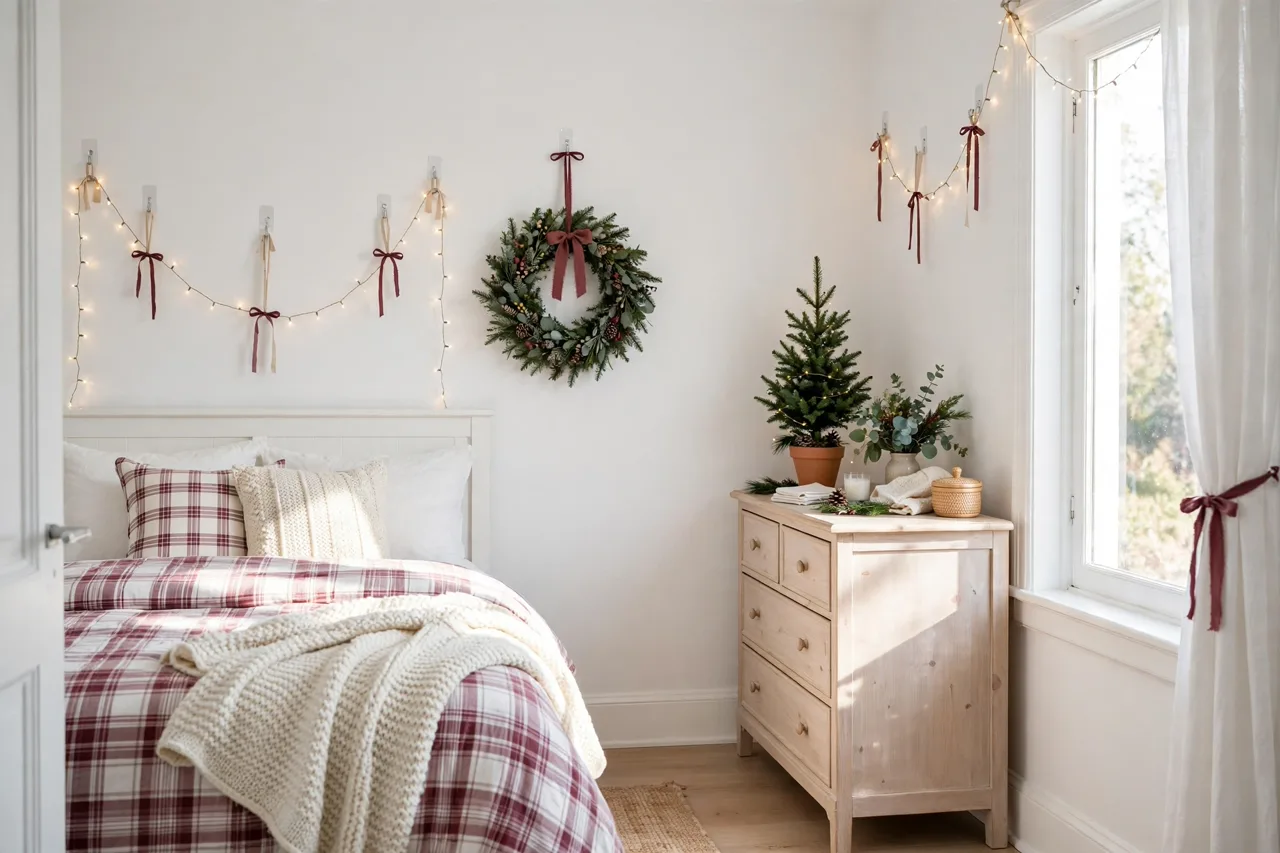
This is the idea for renters, for small bedrooms, and for anyone who has ever lost a deposit over a nail hole. Every idea in this guide can be done with no holes at all — and this is the checklist that proves it. Command hooks and removable strips for the lights, the garland, and the wreath. Ribbon ties instead of nails. Battery everything, so there are no cords and no outlets to fight over. No glitter at eye level, because glitter does not come off a wall in January no matter what the packaging promises. No real candles anywhere near bedding.
The whole room can be decorated in one evening — start at 7 p.m., finish by 9 p.m., and sleep in it the same night. Bedding swap, pillow covers, throw at the foot of the bed, lights on a timer, one wreath on a removable hook, one mini tree on the dresser. That is six ideas, one evening, and nothing in the room that cannot be undone in January in under an hour. The hooks peel off, the ribbon unties, the covers come off, the trees go back in their boxes, and the landlord never knows December happened.
If your bedroom is small, this is also the version to do — fewer things, each one doing more work, nothing on the floor, nothing blocking a door or a drawer. Our small bedroom ideas make the same point for the rest of the year: a small room does not need less decorating, it needs smarter decorating. One evening, no holes, no marks, and a bedroom that still lets you sleep. That is the whole guide, in one idea.
What it costs — the budget table
Most of these ideas are cheap on their own. The table below shows the rough cost of each one, so you can pick three or four and know the total before you start.
| Idea | Approx. cost | Where it goes |
|---|---|---|
| 1. One bedding layer swap | $25–$50 | The bed |
| 2. The 2-2-1 pillow formula | $10–$15 (accent cover) | The bed |
| 3. Chunky knit throw | $25–$40 | Foot of the bed |
| 4. Pick one palette | $0 | The whole room |
| 5. Faux-fur runner | $20–$35 | Foot of the bed |
| 6. Fairy lights + timer | $6–$10 | Over the headboard |
| 7. Flameless candle trio | $12–$20 | Nightstand |
| 8. Warm bulb swap (2700K) | $3–$5 | Bedside lamp |
| 9. Slim garland, ribbon ties | $15–$25 | Across the headboard |
| 10. One wreath, dead centre | $15–$30 | Wall above the headboard |
| 11. Mini tree cluster | $20–$35 | Dresser |
| 12. Nightstand vignette | $8–$12 | Nightstand |
| 13. Greenery + pinecones on the sill | $5–$10 | Windowsill |
| 14. Festive pillow covers | $25–$35 (set of 3) | The bed |
| 15. One-evening, no-holes version | $0 (uses the ideas above) | The whole room |
A starter version — ideas 1, 6, and 10, one bedding swap, one string of lights, one wreath — runs about $45 to $90 and already looks like Christmas. A full version with most of the list runs about $150 to $250, and most of it comes out of the box again next year, which is the real price of a Christmas bedroom: the first year costs, the next four years are nearly free.
Pick three ideas tonight and start with the bed. Swap the bedding, put the throw at the foot, hang the lights on a timer — and by 9 p.m. your bedroom will glow warm, smell faintly of pine, and switch itself off before you fall asleep. That is the whole trick with these Christmas bedroom decor ideas: a bedroom that looks like Christmas at 7 p.m. and sleeps like a bedroom at 11 p.m. And if the bedroom has you wanting the rest of the house to match, our Christmas decor ideas carry this same white base and burgundy touch into every room, one room at a time.
When should I decorate my bedroom for Christmas?
Late November is the sweet spot — after Thanksgiving in the US, and early enough to enjoy it for a full month. Do the bedding, lights, and wreath in the last week of November, and save the fresh greenery for the week of Christmas itself, when it looks its best.
Are fairy lights safe to leave on while sleeping?
No — fairy lights should never stay on all night. Use a battery string with a built-in timer (six hours on, then off), switch them on in the evening, and let the timer turn them off before bed. Keep the lights above eye level when you are lying down, and use LED strings, which stay cool to the touch.
How do I decorate a small Christmas bedroom?
Decorate the bed and the wall above it, and leave the floor alone. One bedding swap, one string of lights over the headboard, one wreath, and a mini tree on the dresser give a small bedroom the full Christmas feeling without a single thing on the floor. Skip the big garland and the extra trees — a small room needs fewer things, each one doing more work.
Can renters decorate a bedroom for Christmas?
Yes — every idea in this guide is renter-friendly. Lights, garlands, and wreaths hang from removable hooks and ribbon ties, nothing needs nails or holes, and everything comes down clean in January. The bedding swap, pillow covers, and throw need no hanging at all, and a battery candle is safer than a real one in any home.
How much does Christmas bedroom decor cost?
Very little to start. The three cheapest ideas — a warm bulb swap ($3–$5), fairy lights with a timer ($6–$10), and greenery with pinecones on the sill ($5–$10) — cost under $25 together. A starter look with a bedding swap, lights, and a wreath runs about $45 to $90, and most of it gets reused every year.
When should I take Christmas bedroom decor down?
Take it down in the first week of January, and do it in one go — an hour is enough. The bedding swap and pillow covers come off first, then the lights, garland, and wreath, then the trees. The faux-fur runner and the knit throw can stay out all winter, since they are winter textures, not Christmas ones. Everything else goes back in its box, ready for next December.