Winter Bedroom Decor Ideas: 16 That Make Cold Nights Feel Cozy
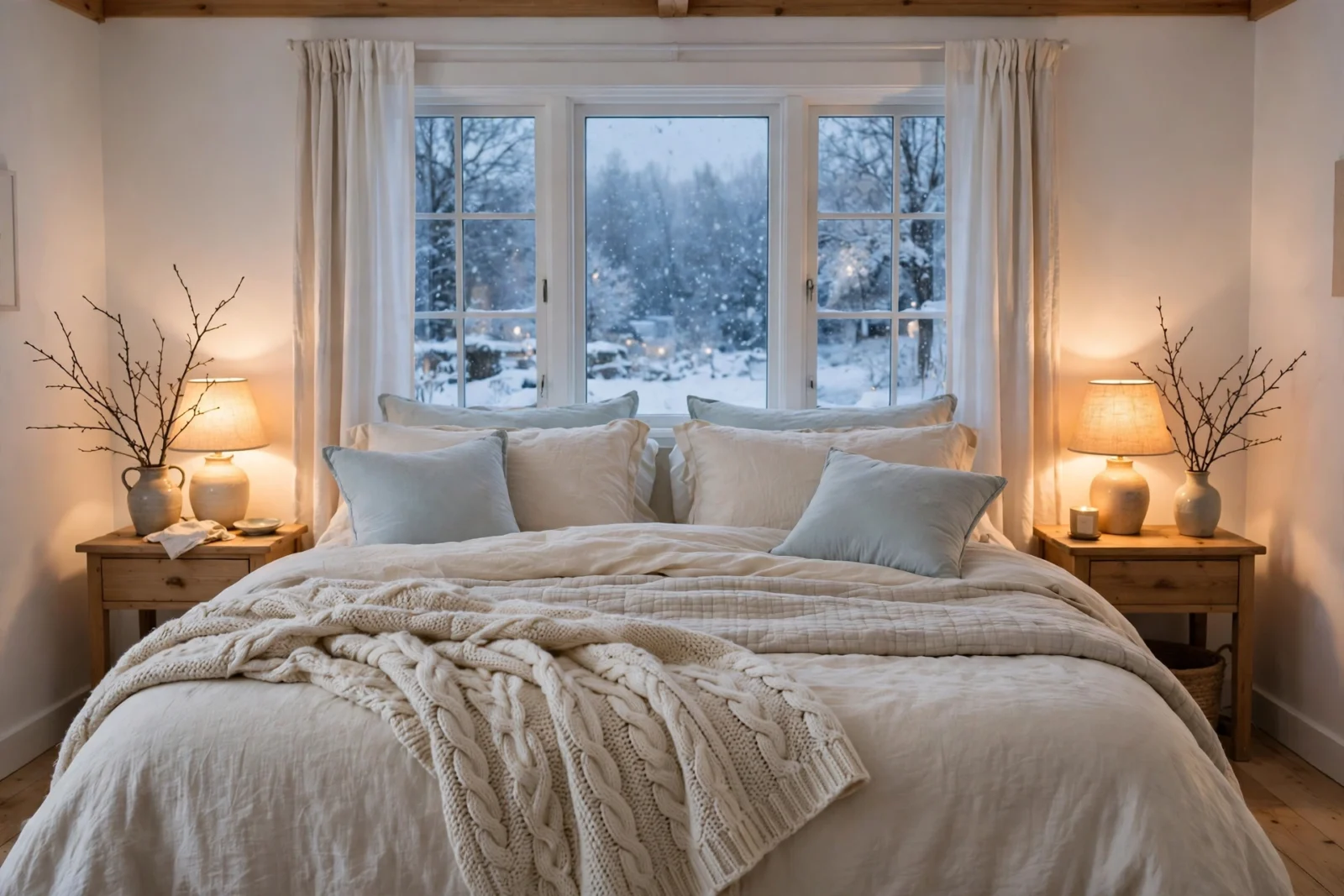
The short answer: strip the Christmas red, keep the plain greenery and the warm lights, and layer the bed — flannel sheets, a duvet, a quilt and a throw — with three warm lamps on timers (2700K). The whole reset costs under $85 and one weekend afternoon, and the room stays cozy until spring.
If you’re looking for winter bedroom decor ideas that work after Christmas is packed away — not another December list — you’re in the right place. The tree comes down, the red goes back in its box, and suddenly the bedroom looks… bare. But winter isn’t over: January, February and most of March are still cold, dark by five, and made for staying in — and the bedroom is where you feel it most, because it’s the room you wake up in. The good news is you don’t need to buy a whole new season of decor. The best winter bedrooms are built the HomelyNook way: a white base, plenty of texture, warm low light, and just one soft seasonal colour — this year, a pale blue-grey that feels like a snowy morning. Most of it you already own, nothing here needs a big shop, and every single idea still leaves the room usable, because a bedroom still has to hold real sleep. Here are 16 ideas that actually work in a real bedroom, in a real winter: warm, doable, and cheap enough to try this weekend. Our full winter living room decor ideas guide dresses the rest of the house the same way, if the bedroom makes you want the whole evening to match.
Some links in this guide may earn us a small commission at no extra cost to you — it keeps the warm lights on.
Winter rules — read this first, it saves every idea below.
Three rules for the whole article: 1. One palette only. White, oatmeal, pale blue-grey and natural wood — pick those four and repeat them from the throw to the last candle, so the room reads as one calm winter instead of sixteen different ones. 2. Keep the Christmas test. Hold up anything before it stays out and ask: would this look right on a snowy morning in February? If it only makes sense in December, it goes back in the box. 3. Sleep before stuff. A bedroom is for sleeping first — if an idea makes the bed harder to get into or the floor harder to cross at 3 a.m., it doesn’t belong here. How we test: every idea below was tried in a real bedroom first — we slept under the layers, walked the rug barefoot at 6 a.m., and timed the lamps — before it made this list.
Part 1 — The Reset: Christmas Comes Down
The reset is the first four ideas, and it costs nothing — it is just deciding what stays and what goes. Do this part first, on the day the tree comes down, and the rest of the article becomes easy.
1. Run the “Christmas or Winter?” Test on the Bedroom
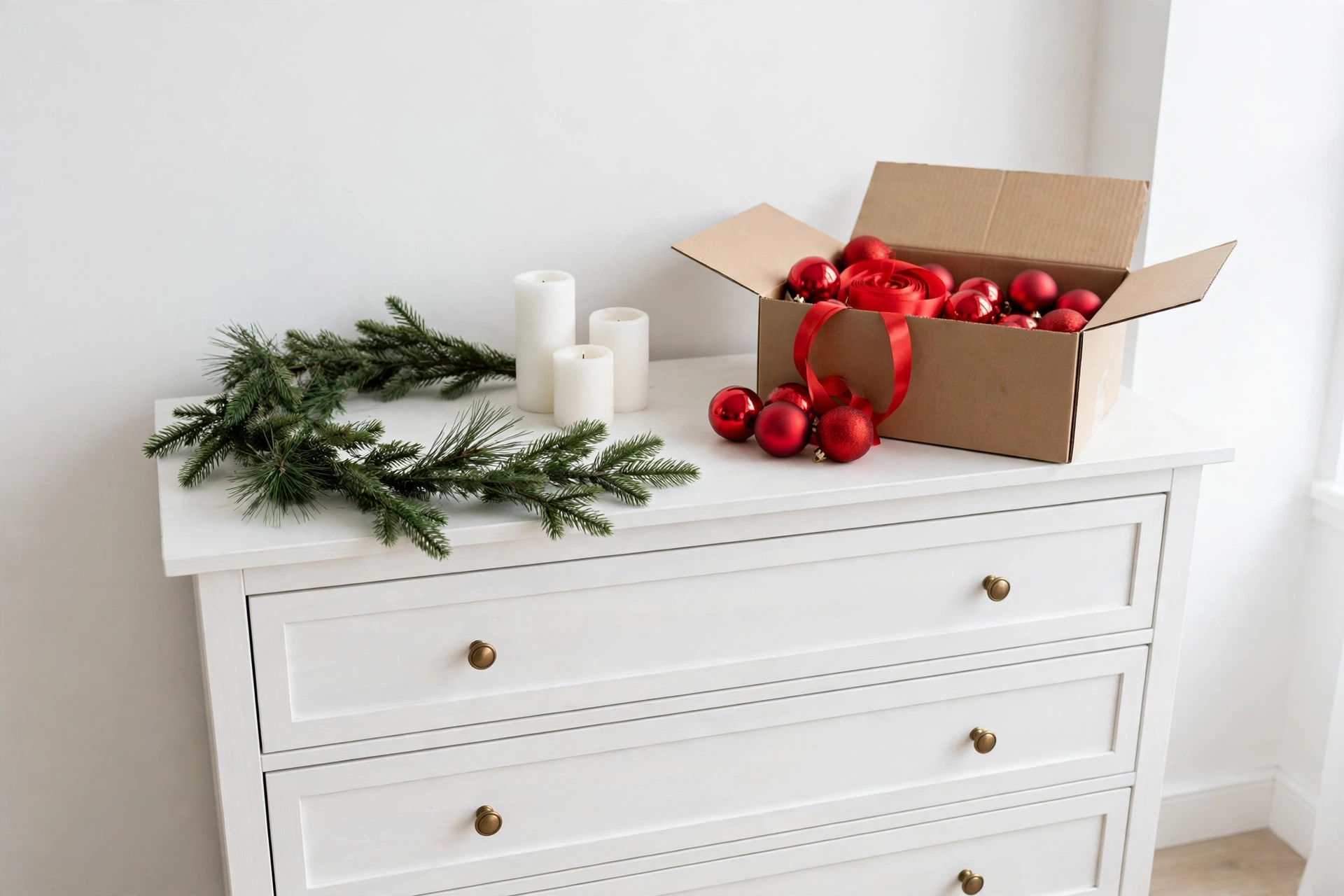
Hold up every decoration in the bedroom and ask one question: would this look right on a snowy morning in February? Red ribbon, ornaments, stockings and anything with Santa on it only make sense in December, so they go straight into a labelled box. Plain evergreen garland, pinecones, white candles, warm-white lights and wool throws belong to cold weather itself, so they stay right where they are. We tried this the day our own tree came down, and the bedroom test took about twenty minutes — one box for December, everything else already winter. The test is the only sorting you need — no second-guessing, no “maybe keep it” pile — and what survives it is your winter decor already, bought and paid for. Our Christmas bedroom decor ideas guide shows where all of it started, if you want to see the December version of this same room. You need: one labelled box and a free evening. Time: ~20 minutes.
2. Swap Red Bedding for Oatmeal, Cream and Pale Blue-Grey
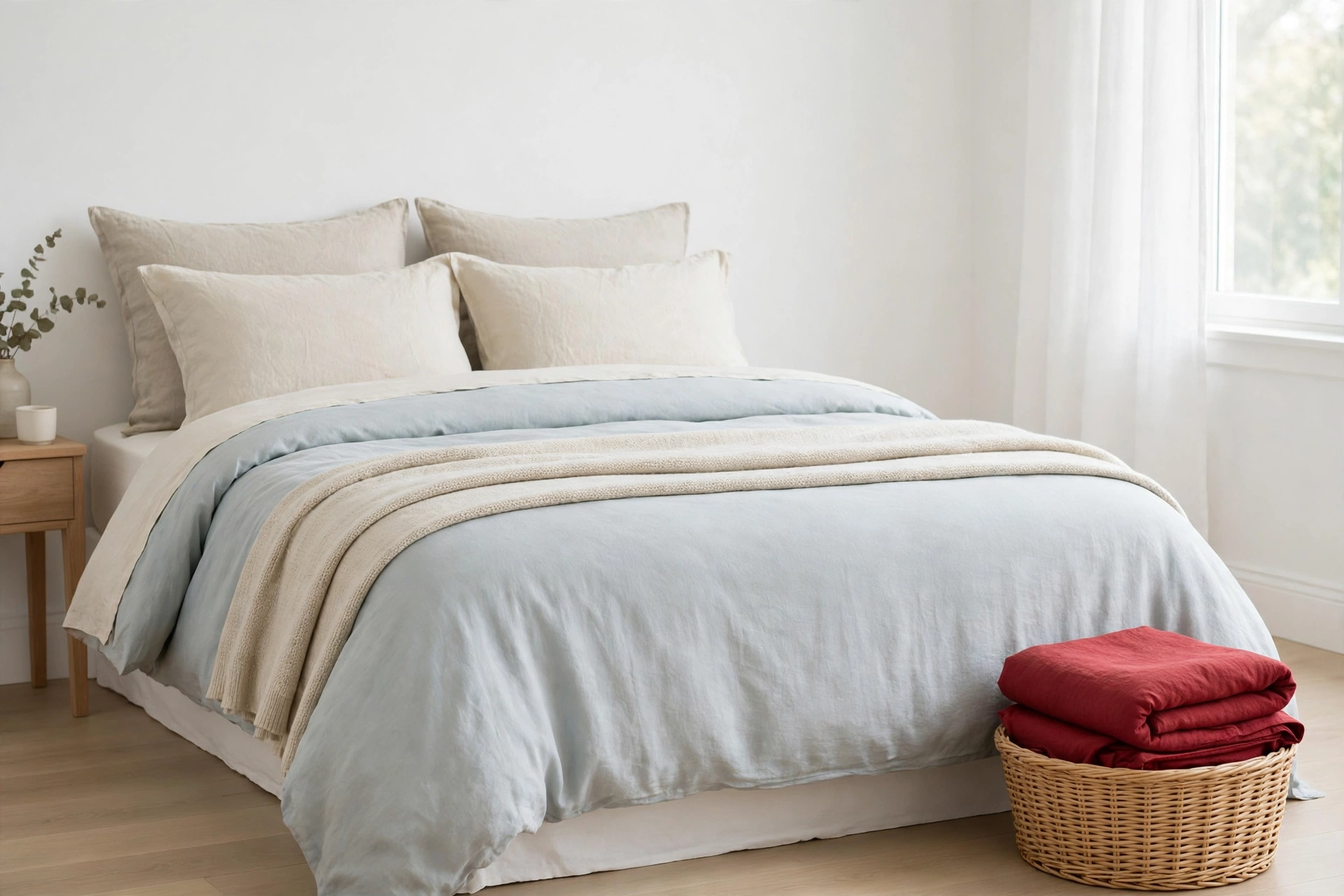
Red belongs to December; January belongs to oatmeal, cream and one pale blue-grey. Swap the duvet cover and the pillowcases — not the whole bedding, just the zip-off covers — and the whole bed changes in ten minutes. A duvet cover set costs about $20–30, which is a third of what new bedding costs, and the red set goes into a basket for next December instead of the bin. Pick one winter colour and repeat it in three places: a pale blue-grey cushion on the bed, a blue-grey book spine on the nightstand, a small blue-grey bowl on the dresser. A room with one winter accent looks intentional; a room with four looks like a clearance sale. Keep the covers folded flat when spring comes, and next winter they are free. You need: one duvet cover set + 2 pillowcases, about $20–30. Time: ~10 minutes.
3. Layer the Bed Like a Winter Nest
Layering is the single most important of all winter bedroom decor ideas, because the bed is where winter comfort matters most — and three thin layers trap more warm air than one thick blanket. Start with brushed flannel sheets, add a medium-weight duvet, then fold a quilt across the middle of the bed, and finish with a chunky knit throw at the foot. Each layer can be pushed aside or pulled up as the night warms or cools, so you never wake up too hot at 3 a.m. We tried this on the coldest night in January, and the difference was immediate: the bed felt warm before we got in, and stayed warm all night without turning the heating up. Flannel sheets cost about $20–30 for a set, and everything above them you probably already own. You need: flannel sheet set ($20–30), duvet, quilt, chunky throw. Time: ~15 minutes to make the bed.
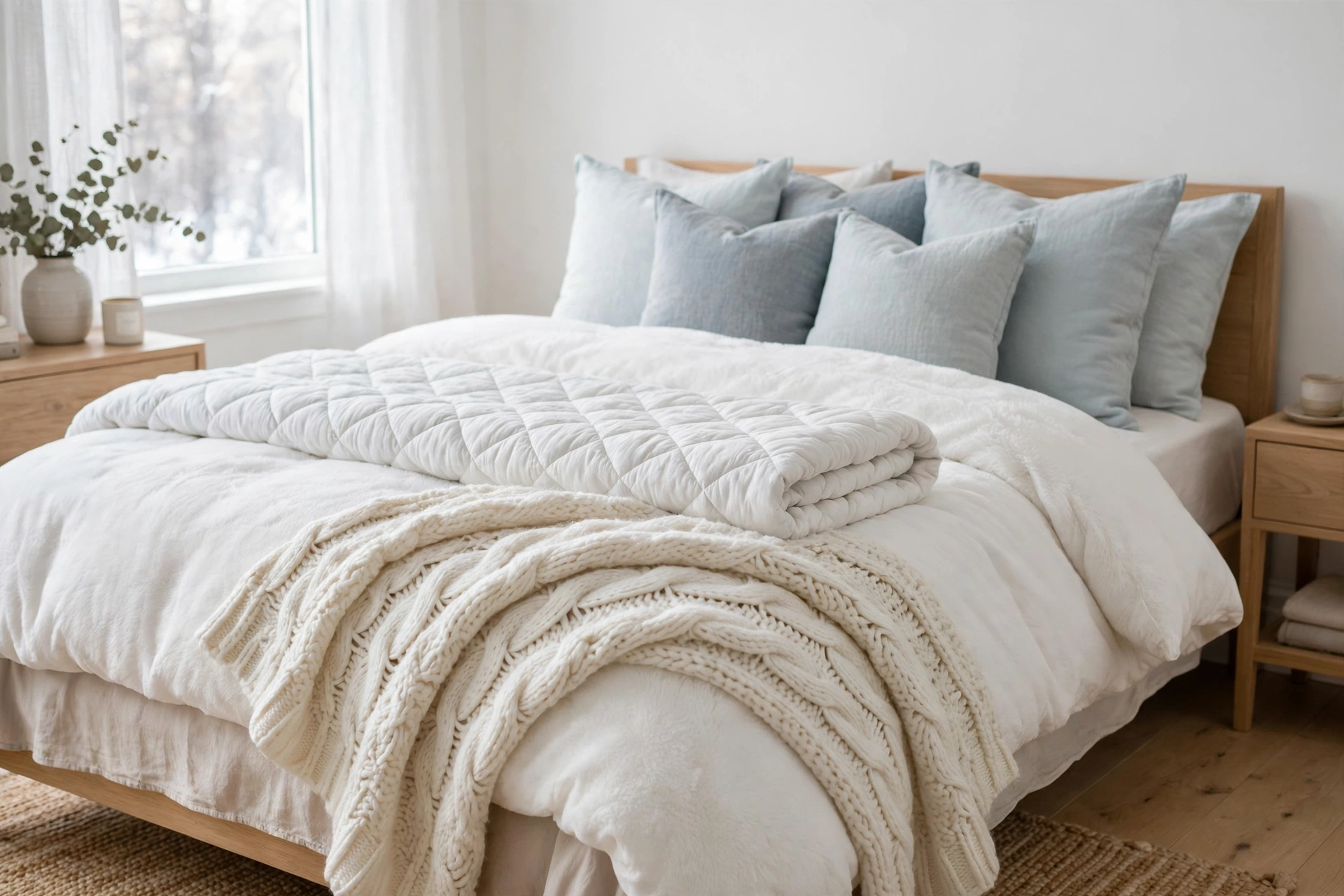
4. Add a Chunky Knit Throw at the Foot of the Bed
One heavy throw that stays on the bed is worth three decorative ones folded on a shelf. Choose a chunky cable-knit throw large enough to cover a seated person — roughly 50 by 60 inches — in a washable fabric, because a winter throw gets used every single day. Drape it across the foot of the bed, folded in thirds so it lands where cold feet end up, not at the tidy end nobody touches. If it slides off, fold it in half first: a doubled throw stays put, looks thicker, and is warmer. This is the cheapest idea in the article and the one you will feel tonight — about $15–25, five minutes, no tools. You need: one chunky knit throw, 50 × 60 inches, $15–25. Time: ~5 minutes.
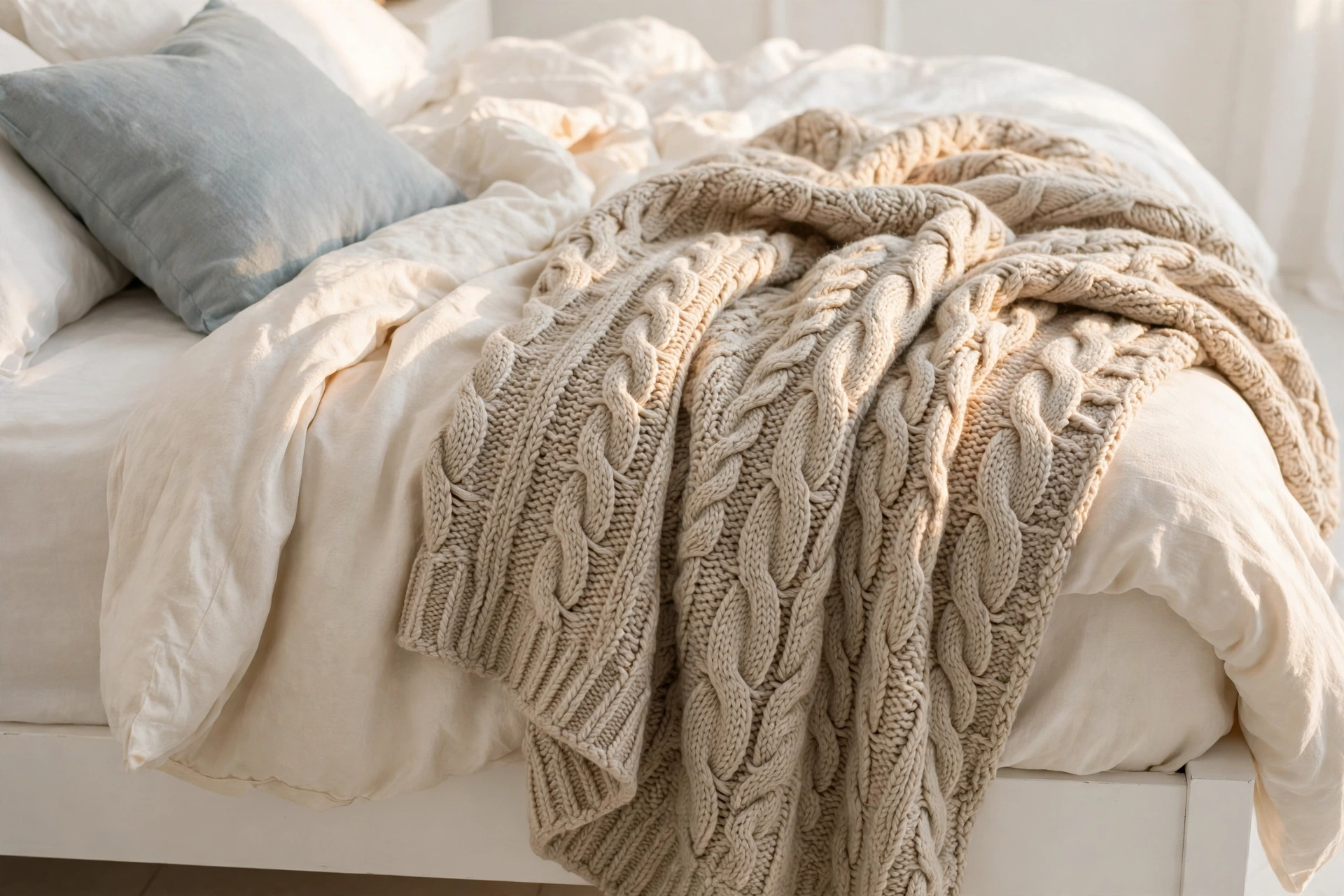
Part 2 — Warmth You Can Touch
Winter is felt before it is seen. If the bedroom looks warm but the bed feels cold at 3 a.m., nobody sleeps in it — so this part is all texture, and it is the part your feet and hands will thank you for.
5. Warm the Floor: A Thick Rug Beside the Bed
Cold floors undo every warm thing above them, so warm the floor first. Lay one thick rug beside the bed — a 5 by 7 foot rug slid a third under the bed, or a 2 by 6 foot runner on each side — wide enough for both feet to land on it at the same time. A thick pile rug in warm cream, with a rug pad underneath so it never slips, turns the first step of the morning into a soft landing instead of a shock. Two rugs sound like a lot; under bare feet in January it feels like the whole room got warmer, because it did — the wool holds the heat and the pad stops the cold floor showing through. If the rug floats where nobody’s feet touch, pull it toward the bed: a rug nobody steps on is decoration, and winter has no time for decoration that does no work. You need: one 5 × 7 ft thick rug (or two 2 × 6 ft runners) + rug pad, $30–45. Time: ~15 minutes.
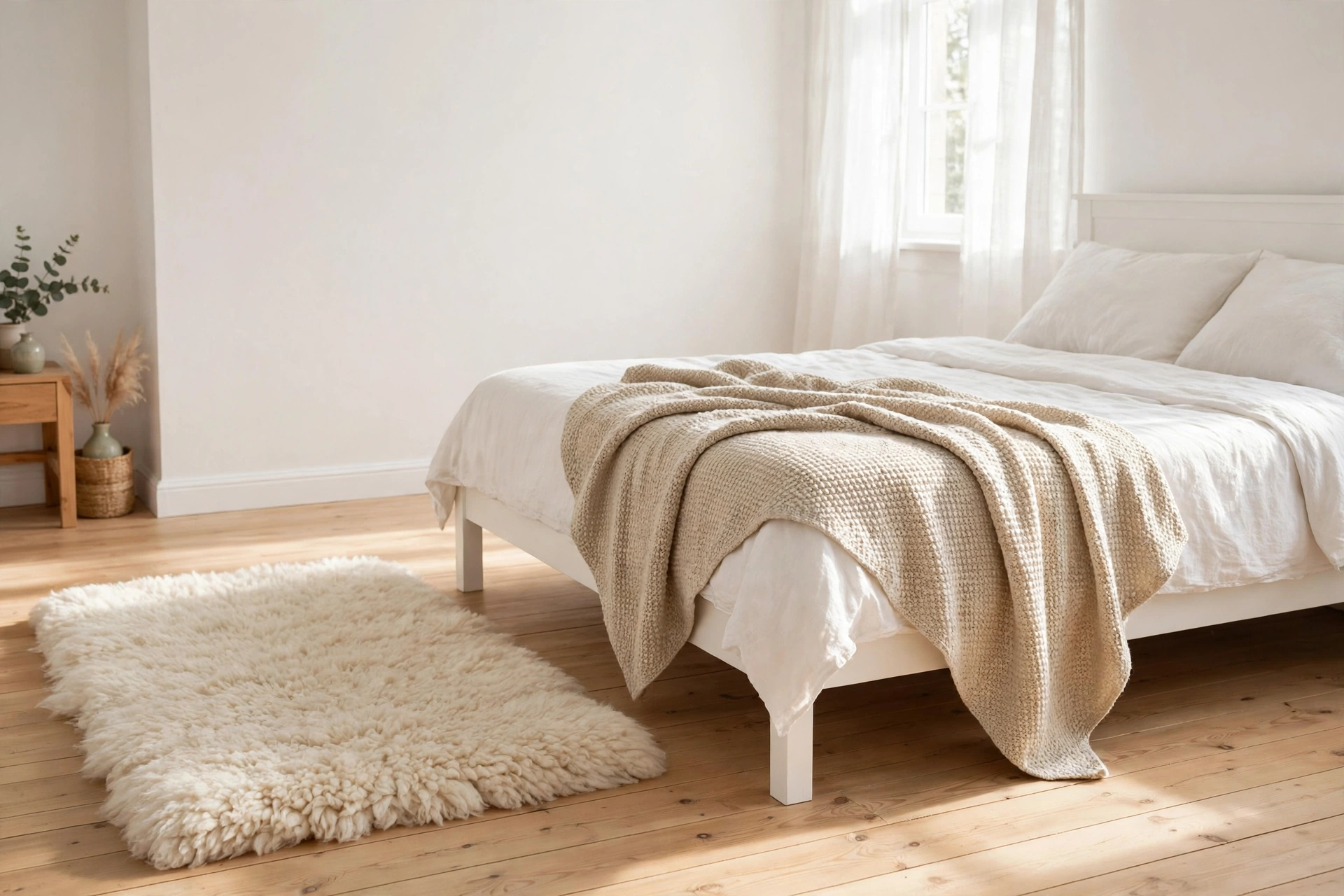
6. Hang Thermal-Lined Curtains
Hang thermal-lined curtains as close to the wall as the rod allows, so cold air stays trapped behind the fabric instead of pooling on the bedroom floor. Hang the rod 4 to 6 inches above the window frame, and make the curtains wide enough to cover the frame plus 3 inches on each side — a curtain that only just covers the glass leaks cold air around its edges. A curtain in wool or velvet, in warm cream or oatmeal, blocks the night draft and darkens the room for sleep at the same time. Open them every morning, because a room with heavy curtains that never open stays dark all day — and winter mornings need the light as much as winter nights need the warmth. A pair costs about $18–28. You need: one pair of thermal-lined curtains, $18–28. Time: ~20 minutes.
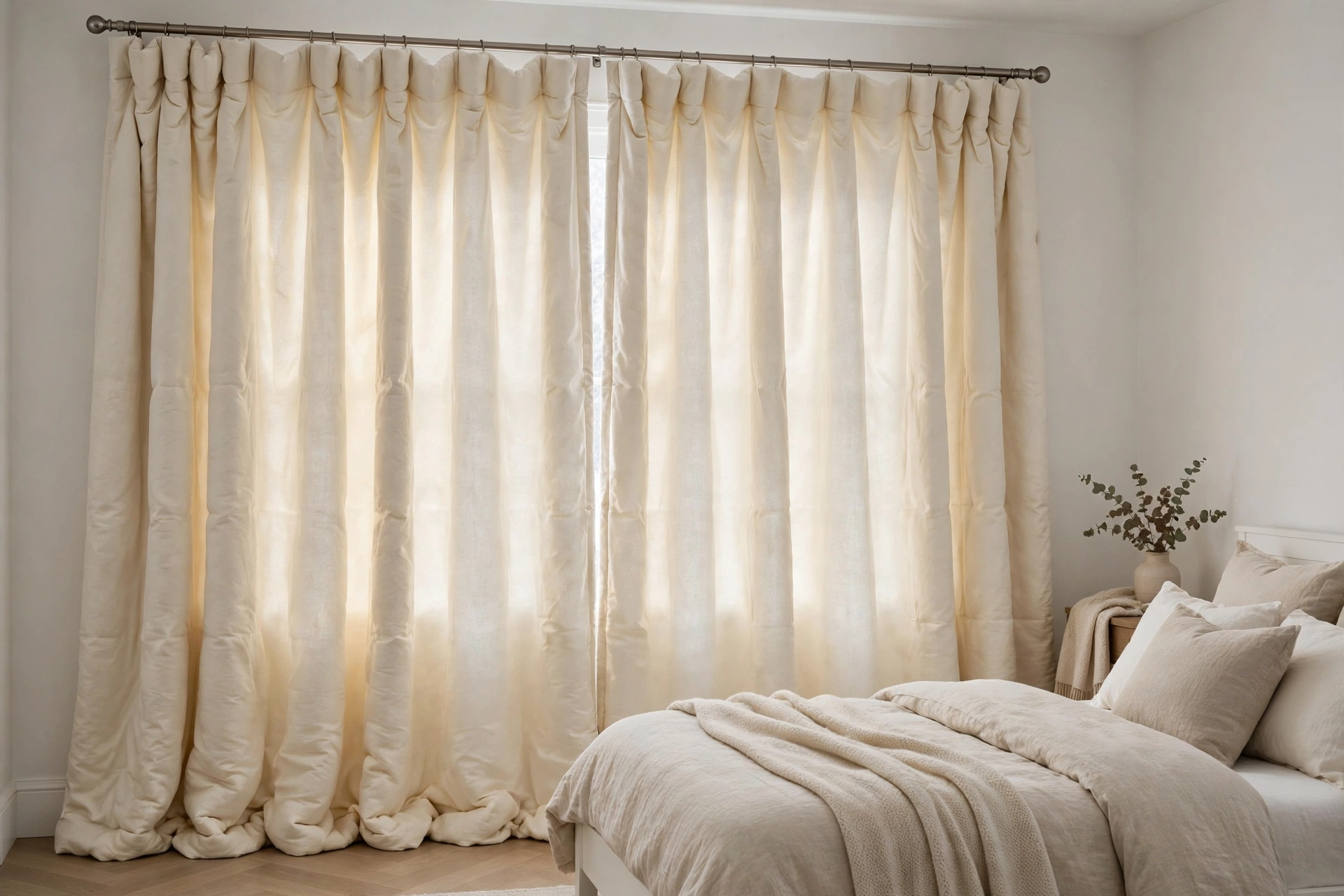
7. Add Faux Fur and Shearling in One Place Only
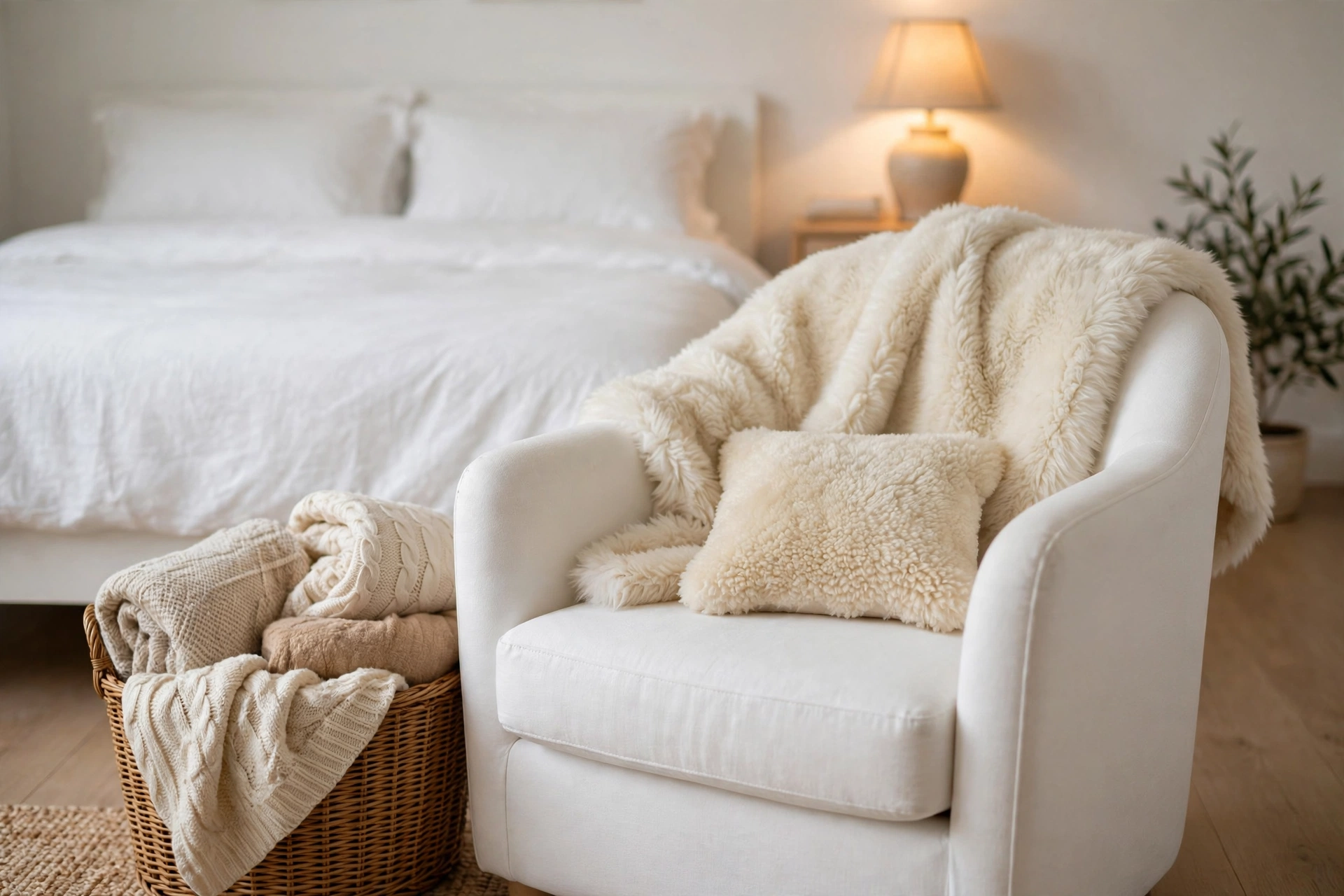
Faux fur is winter’s loudest texture, which is exactly why it works in one place and fails in five. Pick one chair — the reading chair, or the bench at the foot of the bed — and give it a cream faux fur throw and one small shearling cushion, then stop. Everywhere else stays linen, wool and cotton, so the fur reads as a treat instead of a theme park. It is the piece guests reach for first, it photographs beautifully in lamplight, and when it gets flat, a quick shake outside brings it back. One chair, one fur, done — about $20–30 for the pair, and five minutes to place them. You need: one faux fur throw + one shearling cushion, $20–30. Time: ~5 minutes.
8. Make a Reading Nook by the Window
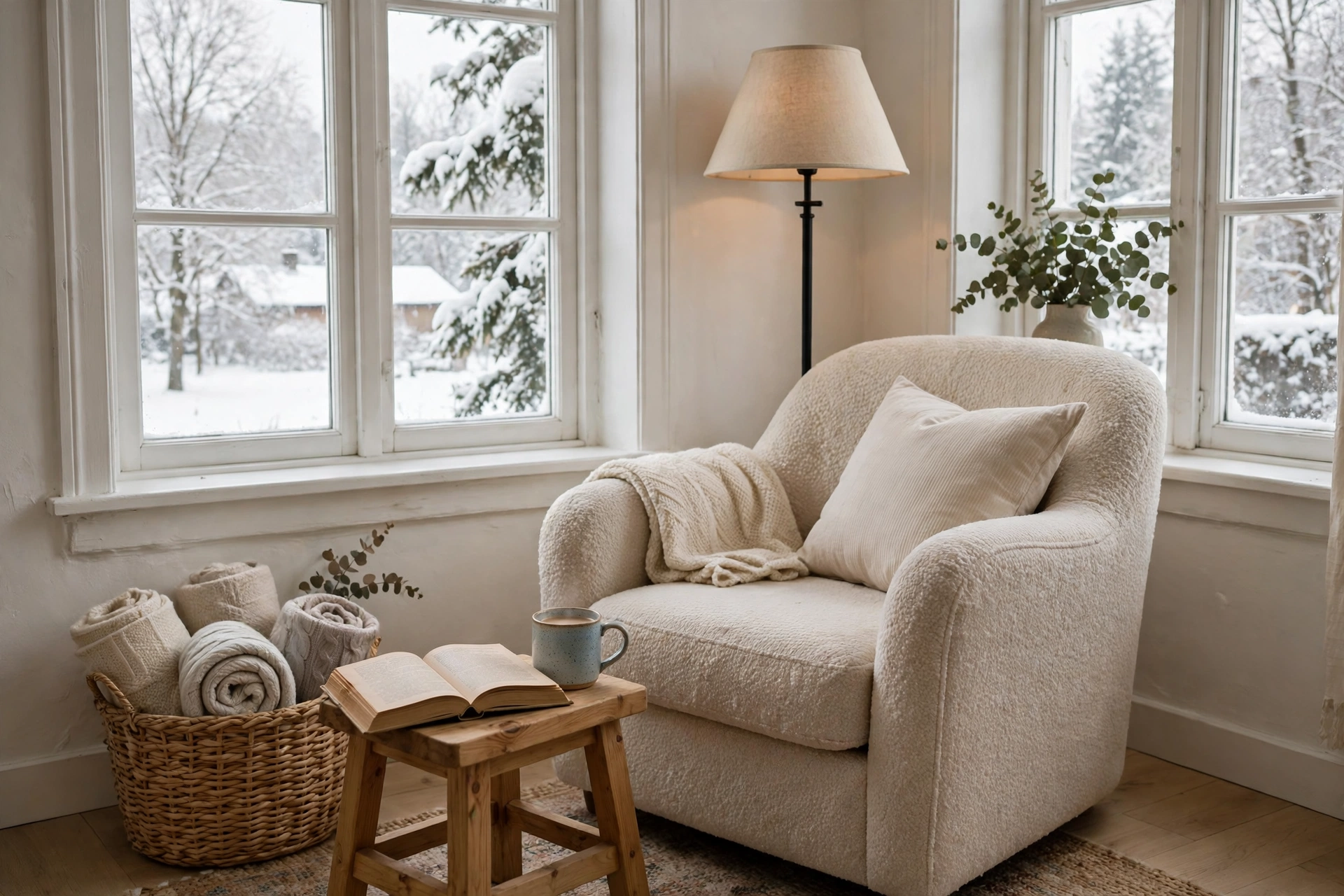
Every winter bedroom needs one seat that is not the bed — a chair angled toward the window, a floor lamp just behind your shoulder so the light falls on the page, and a throw within reach. Put a small stool beside it for a mug and a book, and keep a basket of rolled throws next to it so the nook is always ready. It costs nothing if the chair already lives in the room; you are only moving it three feet and giving it a job. By February this will be the most sat-in seat in the house, because winter afternoons belong to a window, a lamp and a warm blanket — and a bedroom nook means you never have to leave the warmest room to find them. You need: one chair, one floor lamp, one small stool, a basket of throws. Time: ~20 minutes.
Part 3 — Light for the Dark Evenings
By five o’clock in December it is dark, and in January it is darker still — so in winter, lighting does more decorating than anything you can buy. Get the light right and the bedroom is already half done.
9. Use Three Lamps at Three Heights — and Put Them on Timers
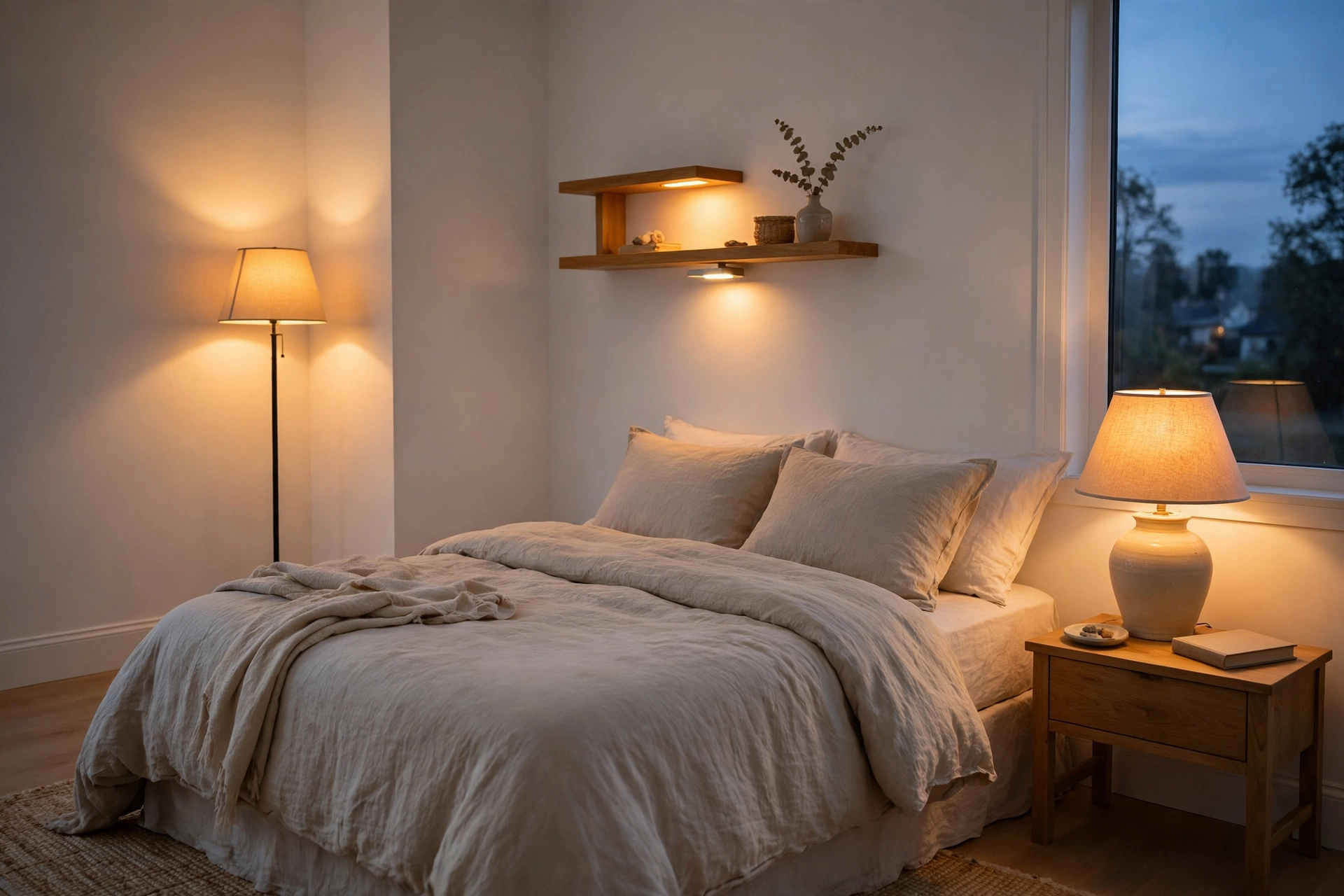
Turn off the ceiling light and use low lamps instead. One cool ceiling light makes a cozy bedroom feel like a waiting room; three warm low lights make even a plain room feel like evening. Put a floor lamp in the dark corner, a bedside lamp on the nightstand, and a small light on the dresser — all warm white, around 2700K — and put two of them on plug-in timers set for about half past four. You will come home to a glowing room instead of a dark one, and in February that matters more than any new pillow. Three heights, one warm colour, zero effort after the first day — and the whole set, three warm bulbs plus two timers, costs about $10–15. You need: 3 warm bulbs (2700K) + 2 plug-in timers, $10–15. Time: ~10 minutes.
10. Build a Candle Cluster on the Dresser
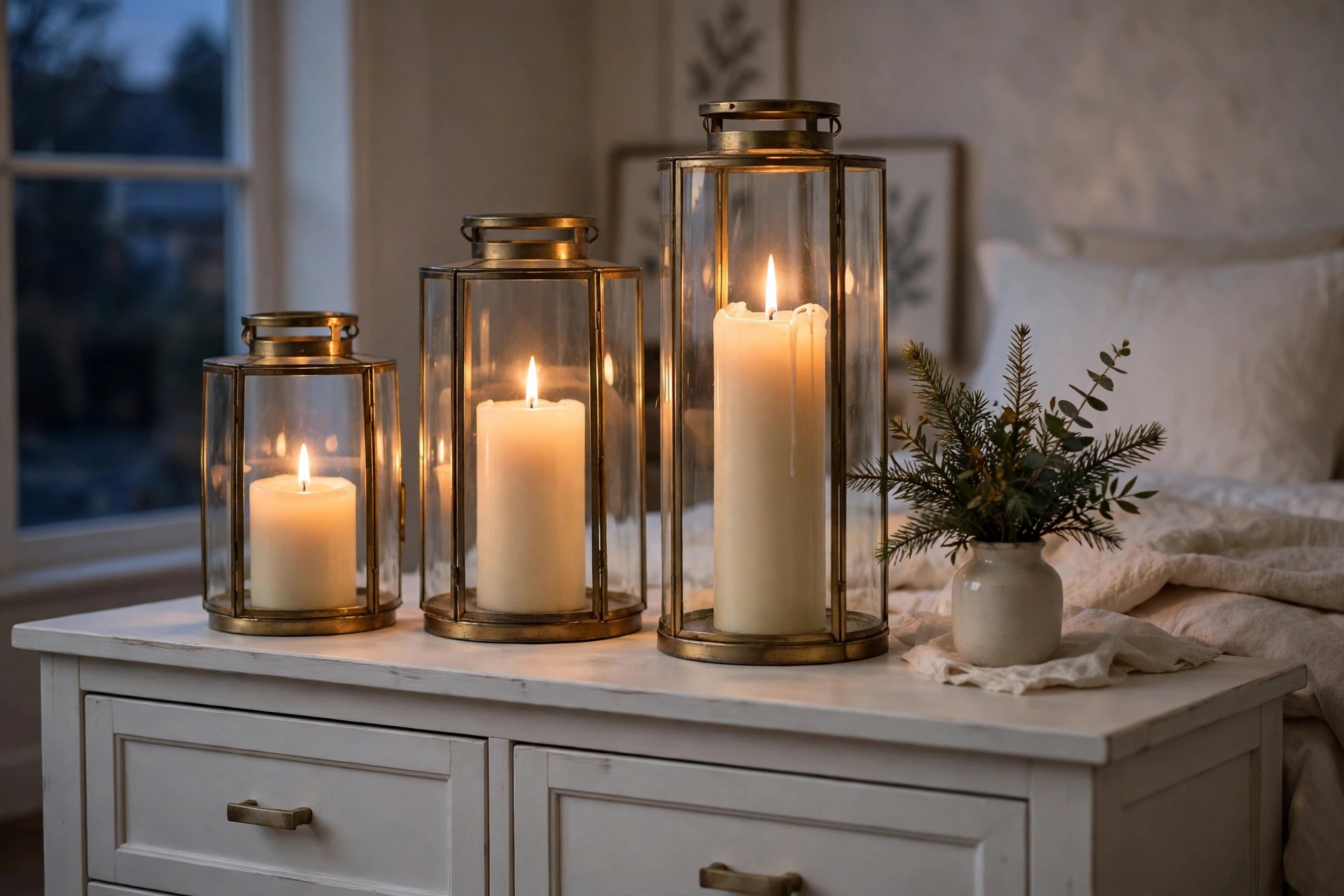
Three candles at three different heights, grouped tight in glass lanterns on the dresser, are the whole lighting story of a winter evening — and they are the detail guests actually notice when the room goes dim. Use flameless candles if throws and curtains are anywhere near them: they flicker like the real thing, they cost less than a takeaway, and nobody has to watch them. Cluster them close so they read as one glow instead of three small dots, and add a small vase of evergreen sprigs beside them for the winter smell. Light them at four, not at eight — winter light starts early, and so should the candles. The cluster costs about $5–12 and takes ten minutes to arrange. You need: 3 flameless candles + 2 glass lanterns, $5–12. Time: ~10 minutes.
11. Keep the Warm-White Fairy Lights Along the Headboard
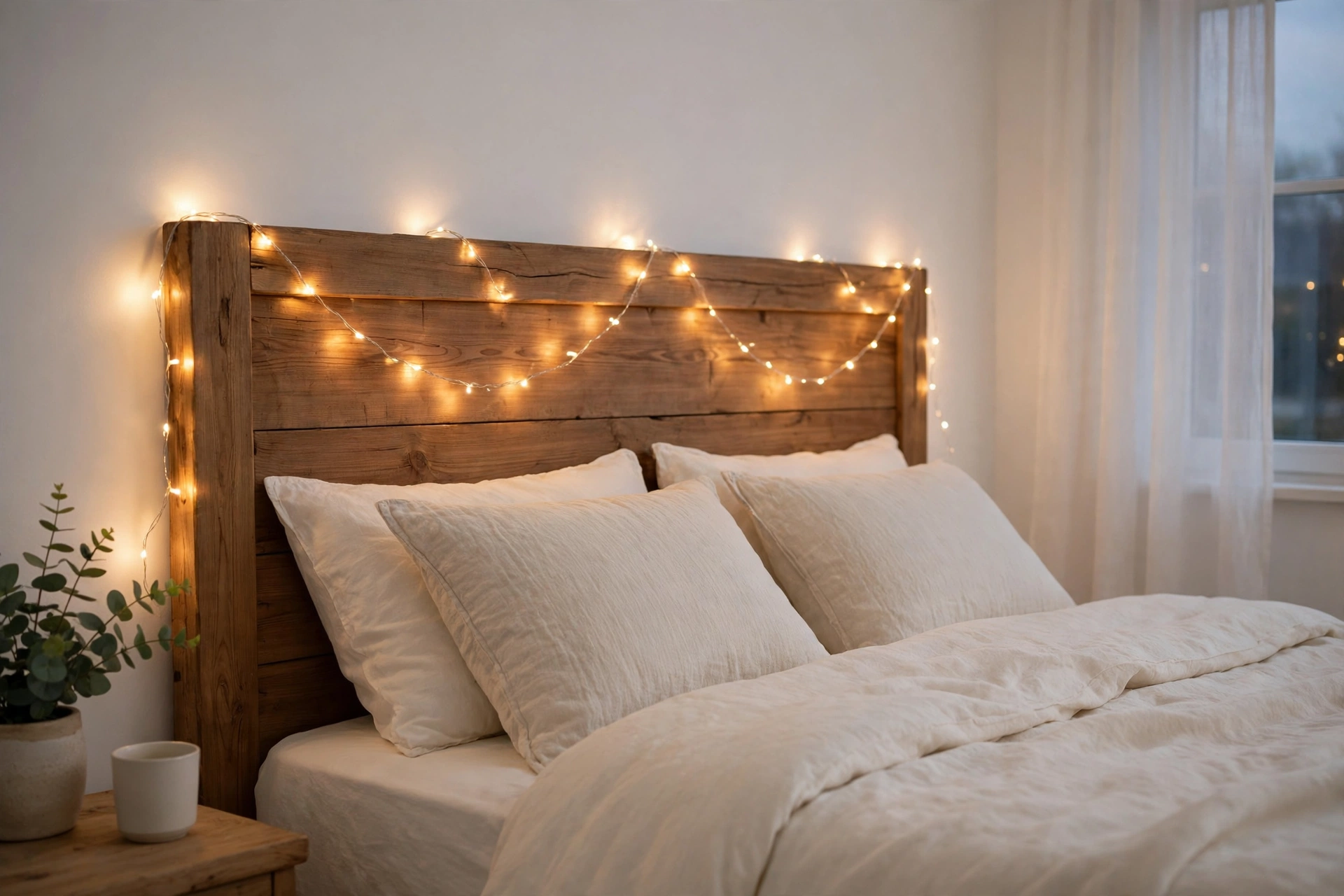
The fairy lights are not Christmas; the red bows on them are. Strip anything red, glittery or shaped like a bauble off the string, and the same warm-white lights stay up until March — draped along the headboard, where they give the bed a soft glow every evening without a single new purchase. Our Christmas window decor ideas guide hangs the same warm lights as a curtain on the glass, so if the windows make you want to dress every pane, start there. Keep one spare set of batteries in the nightstand drawer, because fairy lights always die at eleven — and in winter, eleven is still evening. You need: one warm-white fairy light string (already owned, or $8–12). Time: ~10 minutes.
12. Hang One Snowy Print Above the Bed
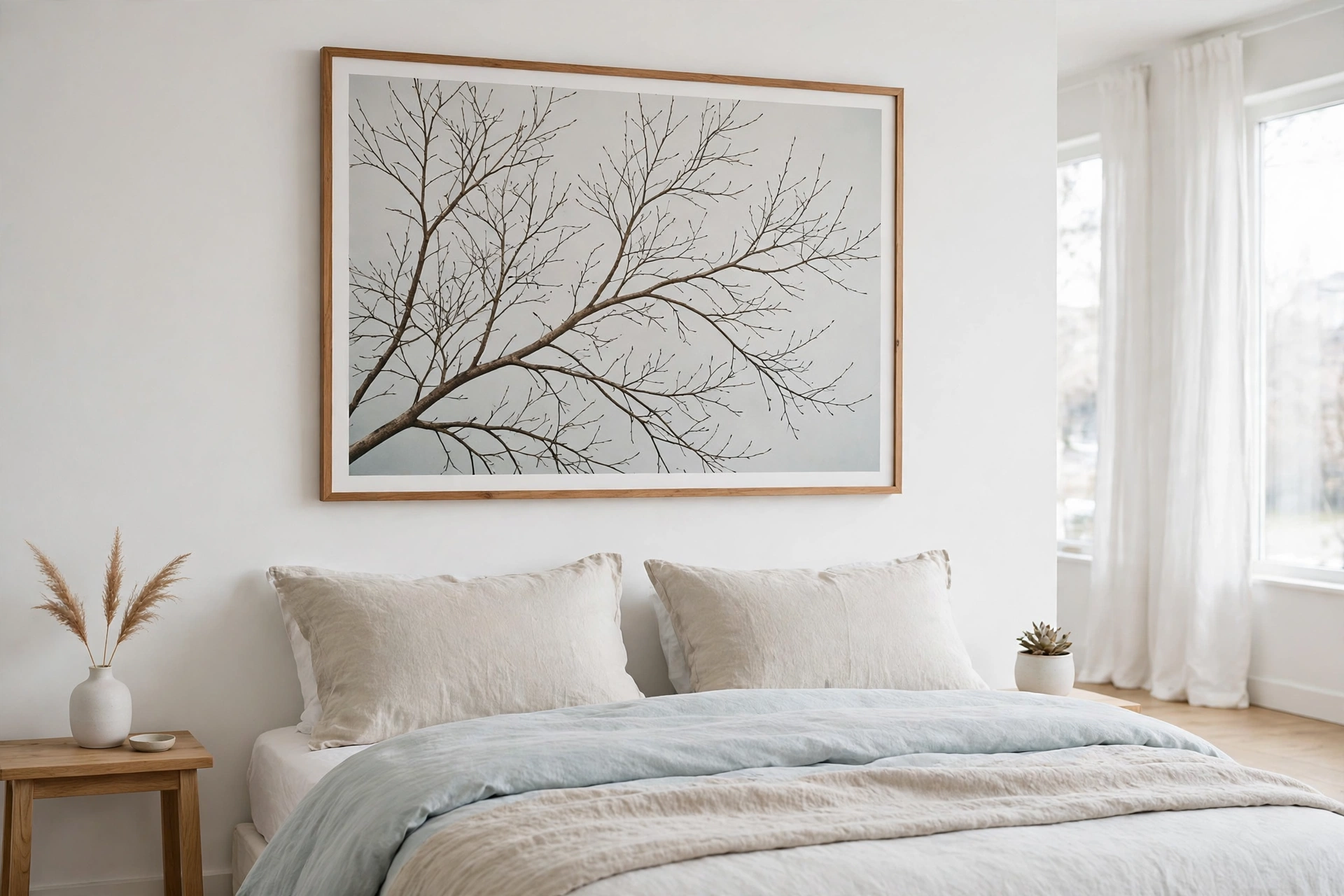
The wall above the bed is the bedroom’s biggest empty space once the Christmas cards come down, and one picture fills it better than five small ones. Hang a single large print of bare branches, a misty hill or a quiet snowy street — something that gives the room a winter view it does not have. A print costs less than a cushion, it takes thirty minutes with a frame you already own, and it sets the whole mood: guests look at it once and the room feels like winter, even before they sit down. Hang it so the bottom of the frame sits about 6 to 8 inches above the headboard — any higher and it floats away from the bed. Swap it back out in March, and the wall is ready for spring. You need: one large framed print, $12–20. Time: ~30 minutes.
Part 4 — Small Touches, Whole-Room Feel
The last four ideas are the finishing layer: the nightstand, the door, the bed before sleep, and the basket by the bed. Small, cheap, and the reason the room feels finished instead of just decorated.
13. Style the Nightstand Tray: Book + Candle + Water
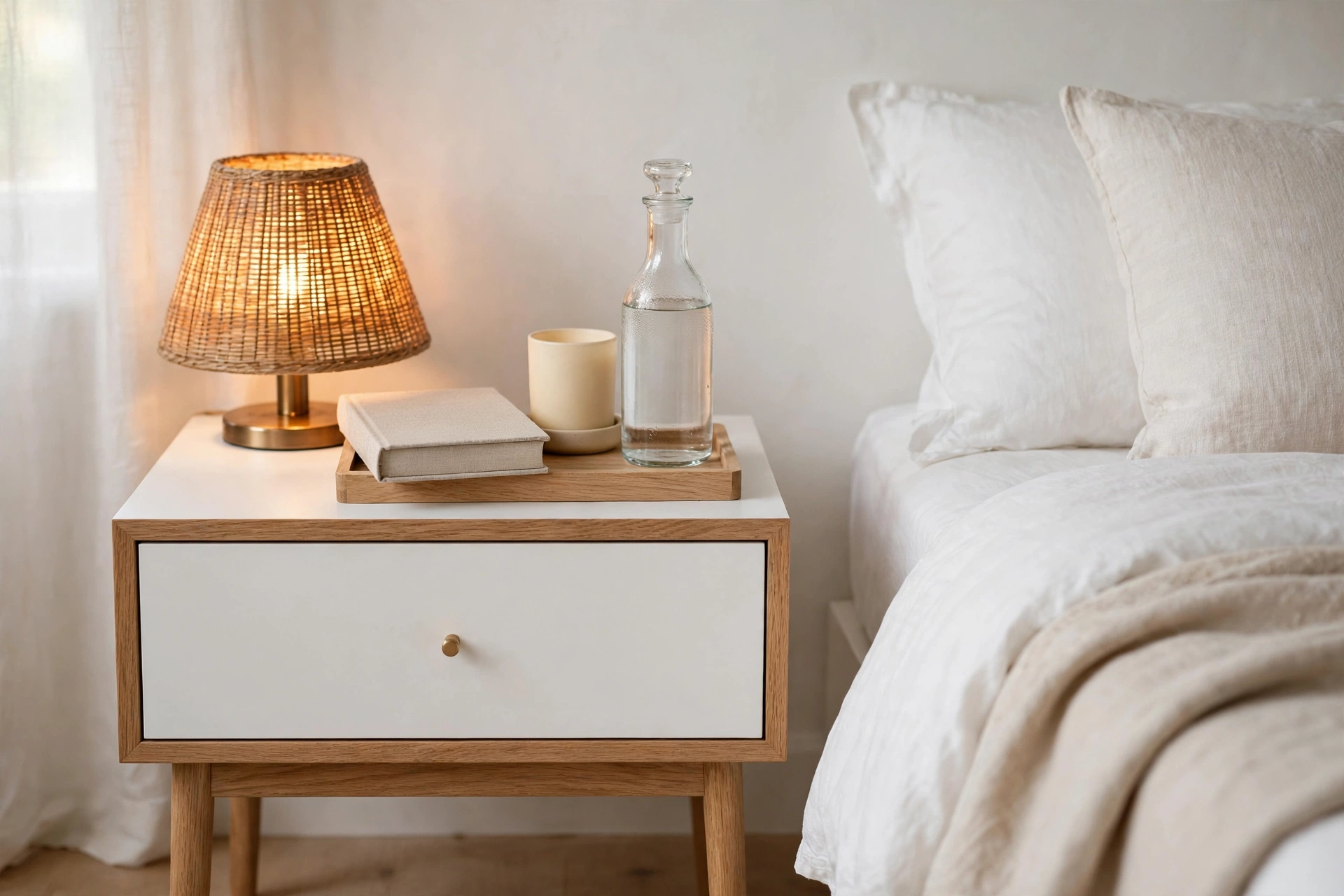
Seasonal nightstand styling is four things, always in this order: a tray, a book, nature, scent. Put a small natural wood tray down first so everything has one home; lay one book on it; park one small cream candle beside the book; and finish with a glass water carafe, so the 3 a.m. drink is already there. The tray means the whole scene lifts off in one move when you need the surface, and a nightstand that cannot be cleared is a nightstand nobody uses. Tuck the phone charger behind the tray so the cable never crosses the scene. Fifteen minutes, things you already own, and the nightstand looks styled all the way to March. You need: one small wood tray, a book, a candle, a glass carafe. Time: ~15 minutes.
14. Stop the Draft Under the Bedroom Door
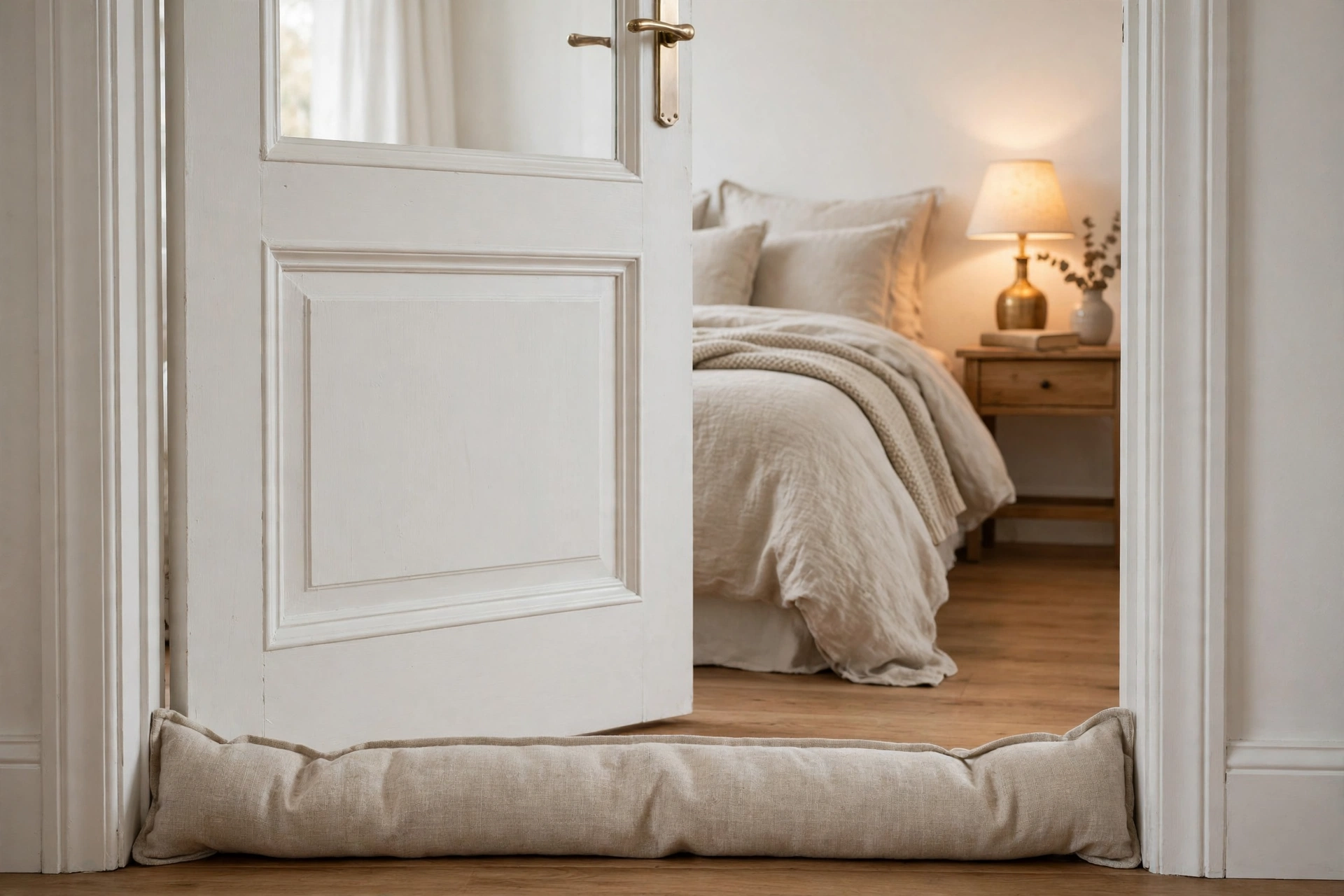
A draft stopper under the bedroom door keeps the cold air in the hallway from pooling on the bedroom floor, because the gap under the door is the biggest leak in most bedrooms. A fabric draft stopper laid against the inside of the door catches the air that slips through, and a door sweep screwed to the bottom closes the gap for good. Either one costs $8–12, takes ten minutes to fit, and pays for itself the first cold night — because a bedroom that loses its warm air under the door can never stay cozy, no matter how many throws are on the bed. Fit it on the inside, where you see it every night, and it becomes part of the room instead of a forgotten strip. You need: one fabric draft stopper ($8–12) or a door sweep ($6–10). Time: ~10 minutes.
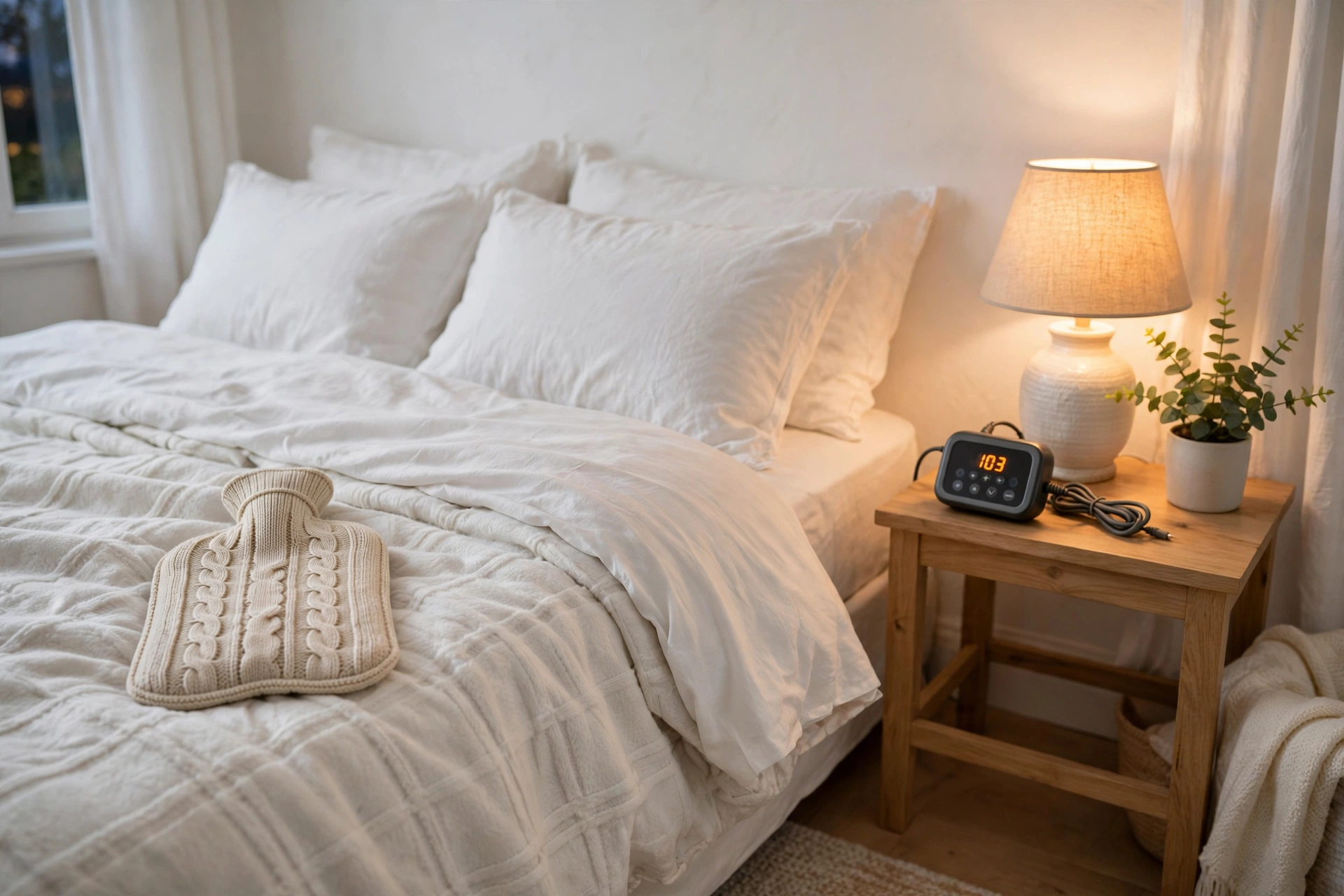
15. Warm the Bed Before You Get In
A warm bed starts warm, and the simplest way is a heated mattress pad fitted under the fitted sheet, set on a timer to warm the bed 30 minutes before sleep. It costs about $25–40, and it heats the bed instead of the whole room — which is why it costs pennies a night to run. We tried the hot water bottle first and it works — a $8–12 bottle laid on the bed an hour before sleep does the same job on the coldest nights — but the timer pad is the one we kept, because the bed is already warm when you get in and you never have to remember it. Either way, never use a heated pad folded or bunched up, and always switch it off when you get up. You need: one heated mattress pad ($25–40) or a hot water bottle ($8–12). Time: ~5 minutes to set up.
16. Keep a Basket of Warm Layers by the Bed
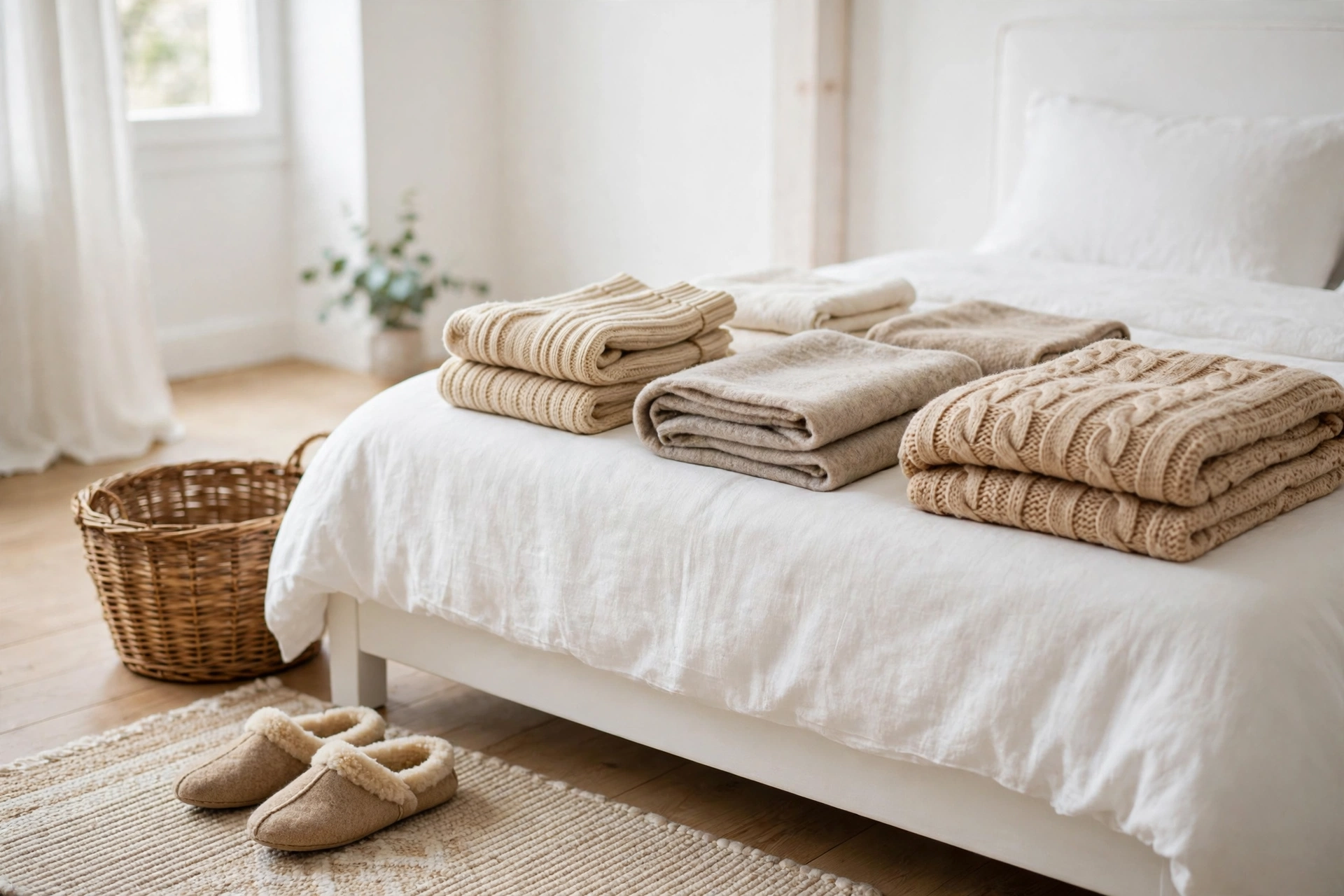
A basket of warm layers by the bed makes cold nights easy, because a thick pair of socks, a warm shawl and a soft throw sit within reach instead of in a cold closet across the room. Put a woven basket beside the bed — about 16 inches wide, big enough for the layers but small enough to fit the gap — and fill it with the things you actually reach for at 3 a.m.: socks first, then the shawl, then the throw on top. Refill it on Sunday night, the same time you change the sheets, and the basket never runs empty. It costs nothing if the basket and the layers already live in the house; you are only moving them three feet, to where cold hands can find them. You need: one woven basket (~16 in wide) + socks, shawl, throw you already own. Time: ~10 minutes.
Common Mistakes to Avoid
- Buying a whole new bedding set when swapping the duvet cover and pillowcases does the same job for a third of the price.
- One cold ceiling light plus a pile of new cushions — light first, cushions second, or the room still feels cold.
- Faux fur on the bed, the chair, the bench and the floor — one place only, or it stops looking like a treat.
- Thermal curtains that never open — open them every morning, or the room stays dark all day.
- Leaving “just one corner” of Christmas red up — it makes the whole room read as December, not winter.
If you do one thing tonight, layer the bed (idea 3). Flannel sheets, duvet, quilt, throw: four layers, about $20–30 if you only need the sheets, fifteen minutes to make the bed — and you feel it the first night you sleep in it. Everything else in this article makes the room look warmer; this one makes you warmer.
Winter Bedroom Budget: What Each Idea Costs
| What you need | Rough cost | Time it takes |
|---|---|---|
| Flannel sheet set | $20–30 | 15 minutes |
| Chunky knit throw, 50 × 60 in | $15–25 | 5 minutes |
| Thermal-lined curtains, pair | $18–28 | 20 minutes |
| Warm bulbs + plug-in timers | $10–15 | 10 minutes |
| Draft stopper | $8–12 | 10 minutes |
| Candle cluster (flameless) | $5–12 | 10 minutes |
| Whole reset, everything above | under $85 | one weekend afternoon |
Most of it you already own — the garland, the lights, the candles and the throws came out of the Christmas boxes. Buy only what the Christmas test left you missing.
Winter Bedroom Decor Ideas: Your Questions, Answered
How can I decorate my bedroom for winter without Christmas?
Pack away anything that only makes sense in December — ornaments, stockings, Santa figures, red ribbon and glitter — and keep what belongs to cold weather: plain evergreen, pinecones, white candles, warm-white lights, wool throws and faux fur. Then layer the bed, light with lamps at three heights, and one calm colour like pale blue-grey. That is winter decor, and it stays right until March.
How do I make my bedroom warmer in winter without turning up the heat?
Layer the bedding — flannel sheets, duvet, quilt and a throw trap more warm air than one thick blanket. Add a thick rug where your feet land, hang thermal-lined curtains, and stop the draft under the door with a fabric draft stopper. Those four moves warm the bed, the floor and the window without touching the thermostat.
What colours work for a winter bedroom after December?
Warm white, oatmeal, cream, natural wood, soft grey and one pale accent — icy blue, pale sage or dusty blue-grey — work from January to March. Pick one accent and repeat it in three places. Avoid bright red and glitter green after December; they read as Christmas, not winter.
How can I make my bedroom cozier on a budget?
Swap the duvet cover instead of buying new bedding, put a heavy throw at the foot of the bed, and move a lamp from another room. Those three moves cost under $40 and change the room more than any new decoration. Add warm bulbs on a timer and the room glows every evening for pennies.
How long can I keep winter decor up in the bedroom?
Plain winter decor — greenery, pinecones, candles, knits, bare branches and warm lights — stays right from early January until the end of February or early March. Take it down when the days get clearly longer and you start wanting lighter throws; that is spring knocking, not a deadline.
What is the easiest winter bedroom idea to start with?
The chunky knit throw. Drape one heavy, washable throw over the foot of the bed, switch one lamp to a warm bulb, and the room feels like winter tonight. Five minutes, no tools, no shopping trip.
Winter is the longest season in the house — longer than Christmas by two whole months — so it deserves more than an empty room waiting for spring. Start with the throw tonight, do the reset this weekend, and let the room earn its keep until March. And when the first pale morning of spring arrives, you will only have to swap the throws and put the branches away: the white base underneath was always the point. For the whole house — not just this room — our winter decor after Christmas guide does the same reset room by room.
About HomelyNook — The HomelyNook Team decorates real homes on real budgets: white walls, small rooms, and furniture that still has to be sat on. Every idea on this site was tried in a lived-in house first, priced honestly, and written so you can do it tonight — not someday. Read more about us.