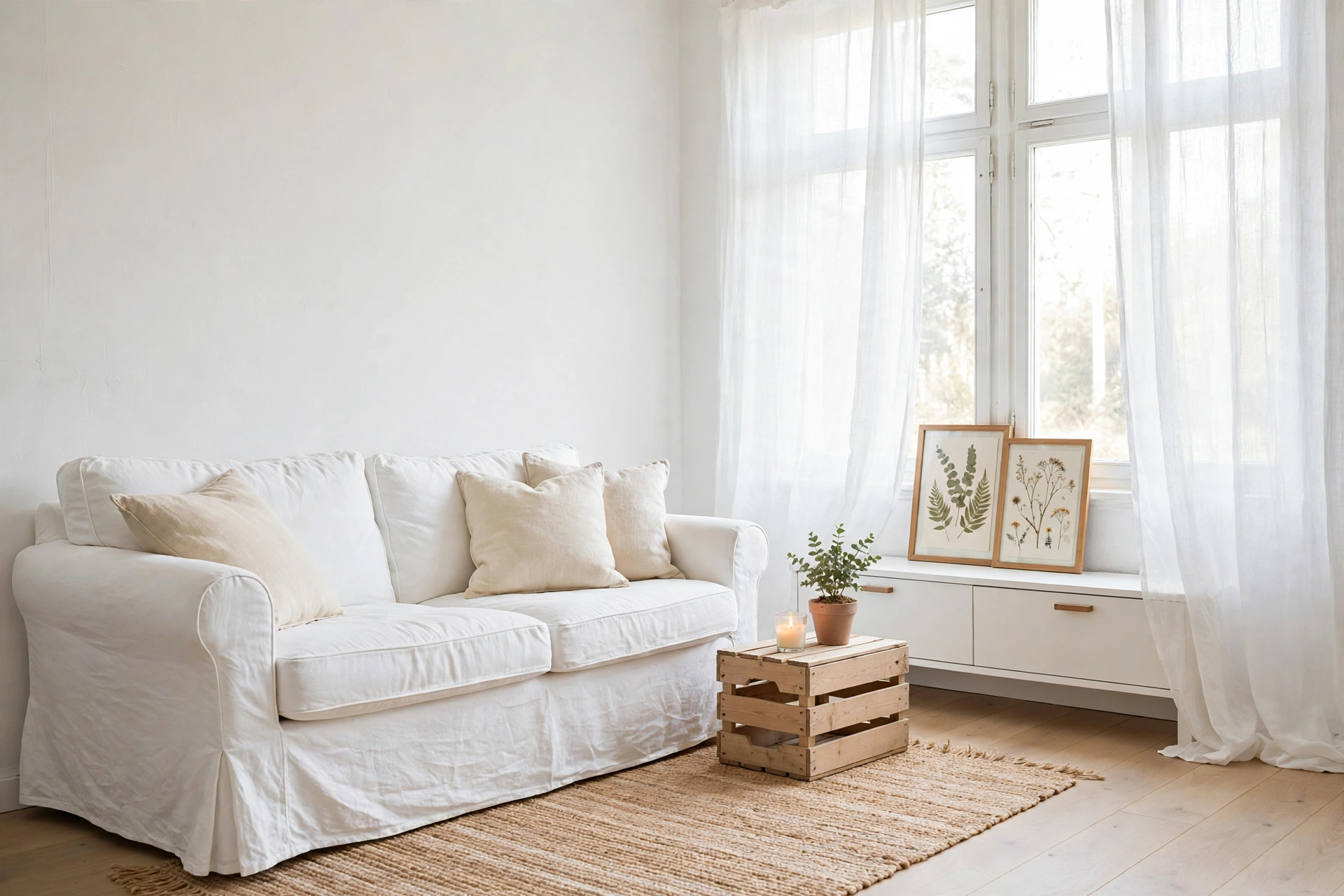
There is a special kind of heartbreak in loving your small home and hating its storage. You open a cupboard and an avalanche greets you. You buy a lovely basket, and now the basket needs a home too. If your rooms feel like they are shrinking, please know: your home is not too small. It is just full of hiding places nobody has put to work yet — the gap beside the fridge, the air above the toilet, the back of every door. These small space storage ideas are the finds that go hunting in exactly those spots.
Nothing here needs a renovation, a landlord’s permission slip, or a big budget — most of these finds are under $30. We will walk room by room, starting where the chaos greets you at the front door.
Small Space Storage Ideas for the Entryway & Living Room
The entryway sets the tone for the whole home, and the living room is where clutter loves to perform. These five finds tame both without eating a single inch of floor you actually walk on.
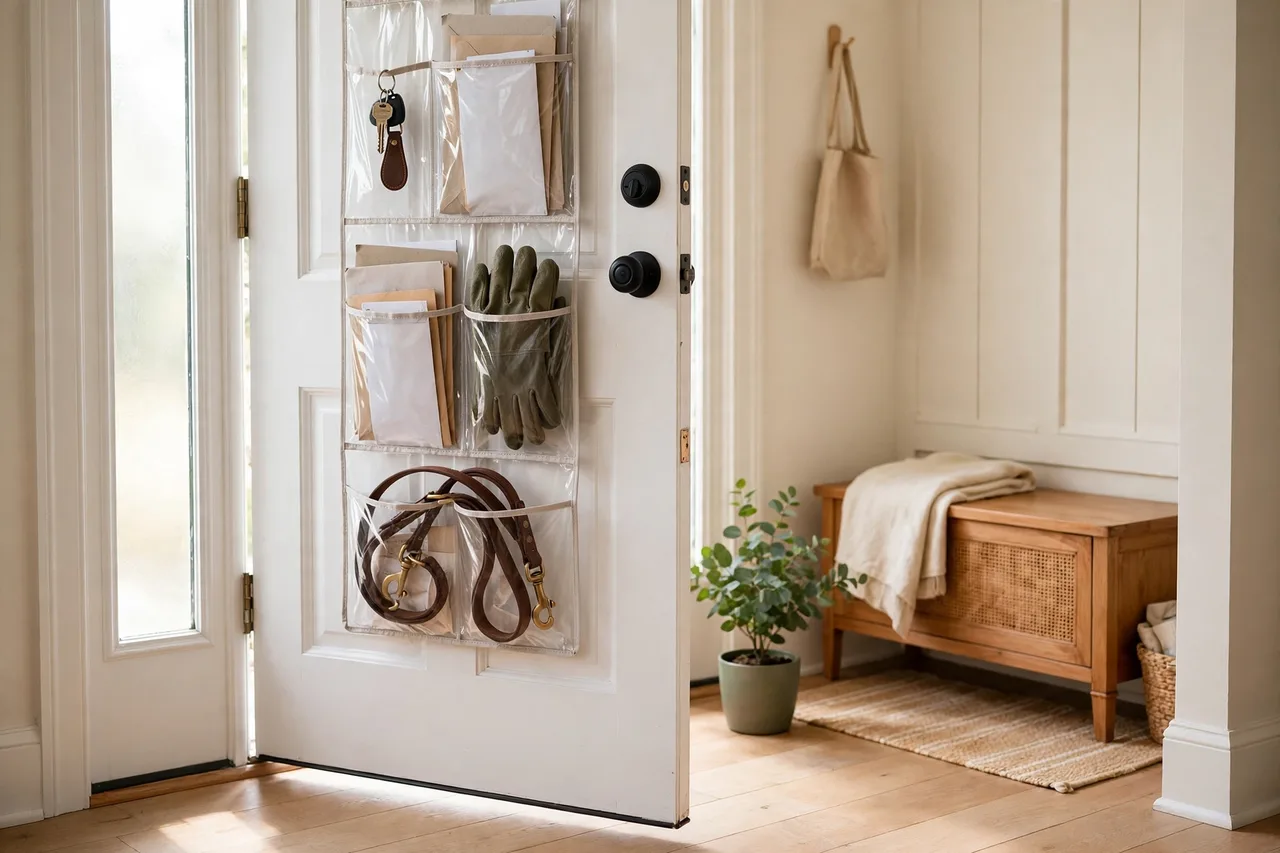
1. An Over-Door Organizer at the Entry
The back of your front door is a storage wall you walk past every day. A clear-pocket or fabric over-door organizer swallows the entryway’s homeless things — keys, mail, gloves, dog leashes, sunglasses — in pockets you can see at a glance. Most cost $15–$25 and hang in a minute with zero tools. Styling tip: give every pocket a job and a label in your head (“top row = out-the-door things”), or it quietly becomes a junk drawer with better lighting.
2. An Ottoman With Hidden Storage
It looks like furniture because it is furniture — that also happens to be a cupboard. A storage ottoman holds the living room’s soft chaos: throw blankets, board games, chargers, the remote collection. Lift the lid, drop everything in, sit down like a person whose life is together. Expect $30–$60 depending on size and fabric. Styling tip: in linen or a soft bouclé, it reads as pure decor — nobody guesses it is hiding three blankets and a tangle of cables.
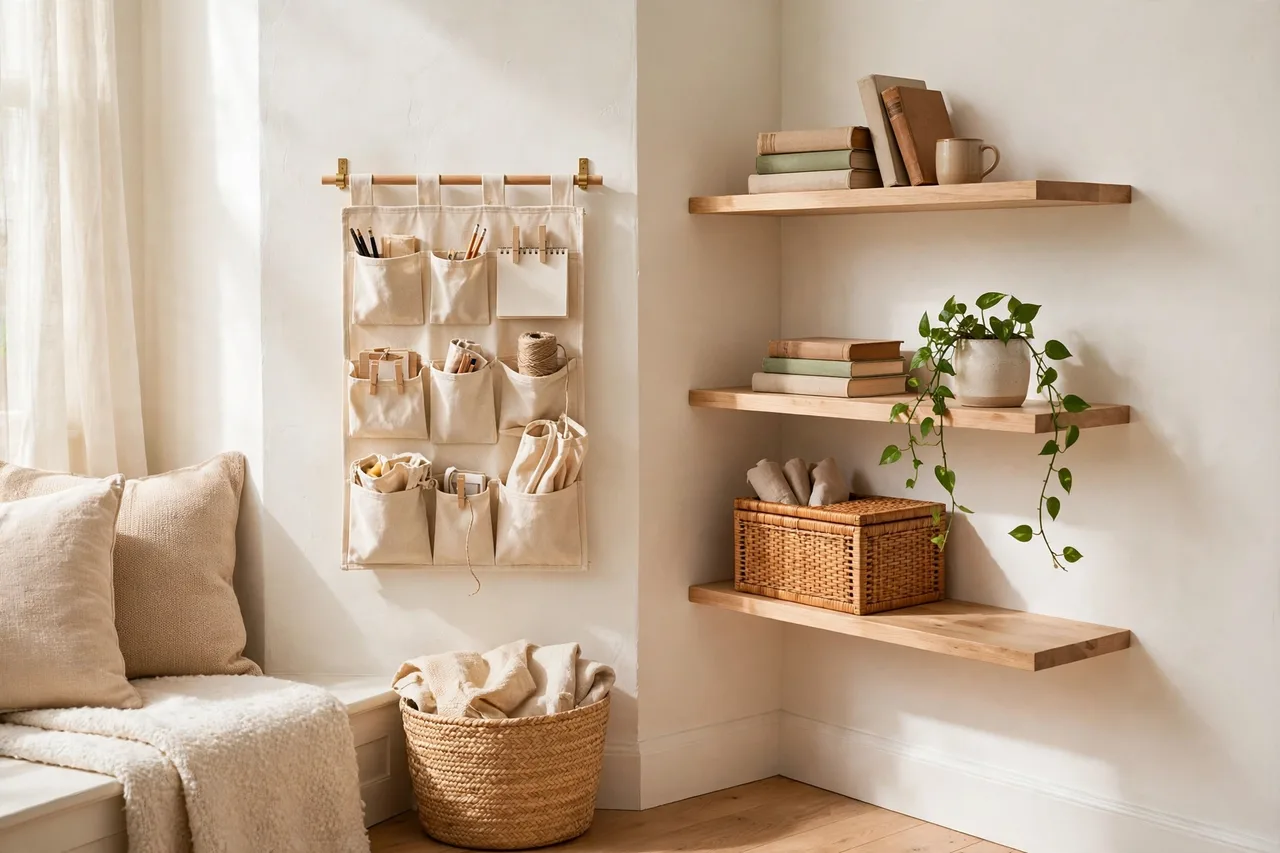
3. Floating Corner Shelves
Every room has a corner doing absolutely nothing. Two or three small floating corner shelves turn that dead angle into a home for books, a plant, the candle you never light, and the pretty box that holds ugly necessities. A set runs $20–$35. Before you buy: corners are rarely perfect right angles, so measure yours first, and keep the lowest shelf at least 60 inches (152 cm) up in walk-through corners — tall guests will thank you.
4. Nesting Baskets That Shrink When Empty
The only storage that stores itself. Nesting baskets — three or four woven baskets that fit inside each other — are the small home’s best friend: in use they corral toys, yarn, magazines and remotes; empty, they collapse into one tidy stack in a cupboard. A set is usually $20–$40. Styling tip: one basket per category, never per room. A “living room basket” becomes a junk magnet; a “blankets basket” stays honest. This is the same trick that keeps the calmest of our small apartment living room ideas from sliding back into chaos.
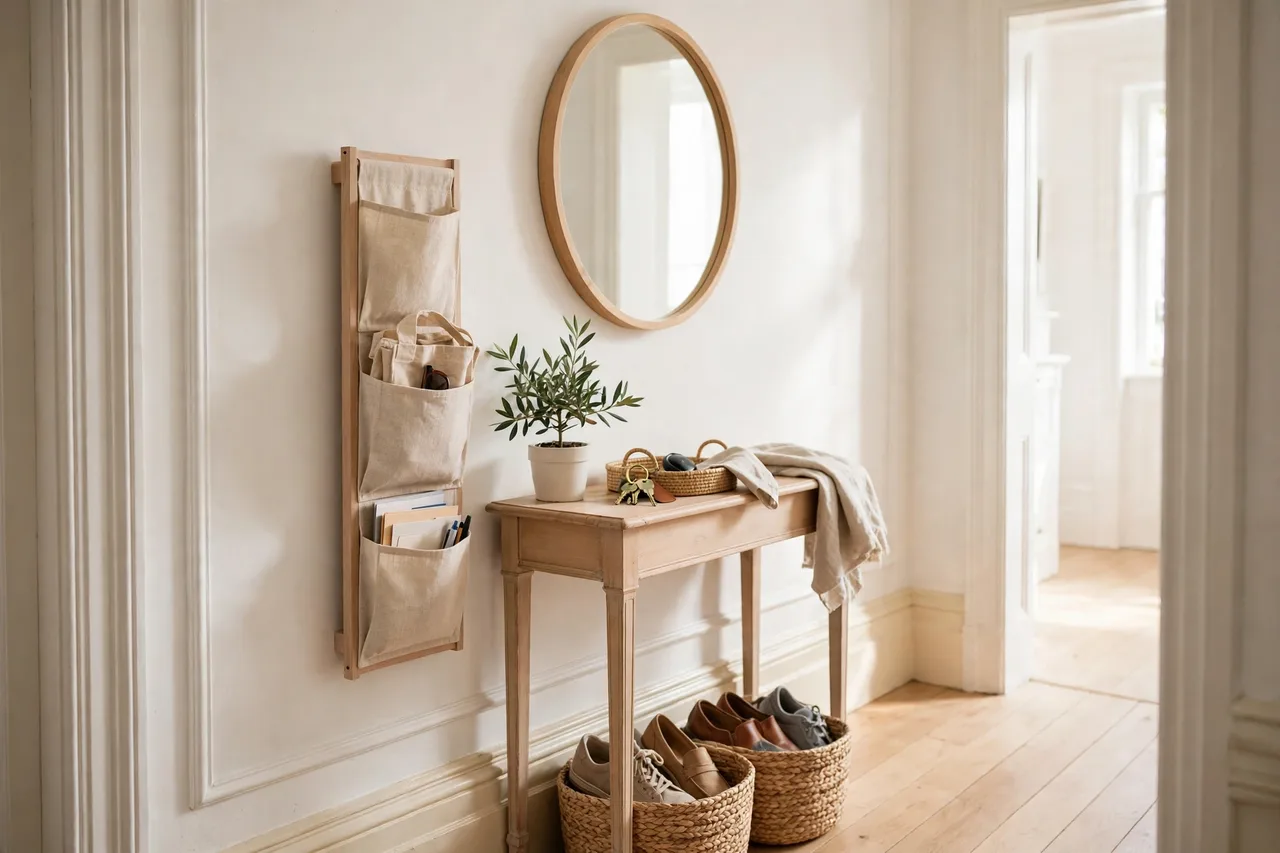
5. A Skinny Entry Console With Baskets Underneath
Twelve inches of depth, a whole entryway of order. A slim console table — the narrow kind, 10–12 inches (25–30 cm) deep — gives keys and mail a landing strip, while two baskets underneath hide shoes, umbrellas and the reusable-bag collection. Tables run $40–$80; the baskets are often already in your home. Styling tip: a small tray on top is the rule — if it is not on the tray, it does not live on the console. One pretty boundary keeps the whole entry honest.
Small Space Storage Ideas for the Bedroom
The bedroom should be the calmest room in the house, and it is usually the one storing the most secrets — under the bed, inside the closet, behind the door. If your room needs a full rethink, start with our small bedroom ideas for the layout, then add these five finds for the storage.
6. Under-Bed Storage Boxes
The biggest cupboard in your home is the one you sleep on top of. The space under a standard bed fits four to six flat storage boxes — off-season clothes, spare bedding, the guest towels. Wheeled boxes glide out without the floor-dragging workout; most are $15–$30 each. Before you buy: measure the clearance under your bed frame first — most frames give you 6–8 inches (15–20 cm), and a box that is half an inch too tall is just a very flat disappointment.
7. A Hanging Closet Organizer
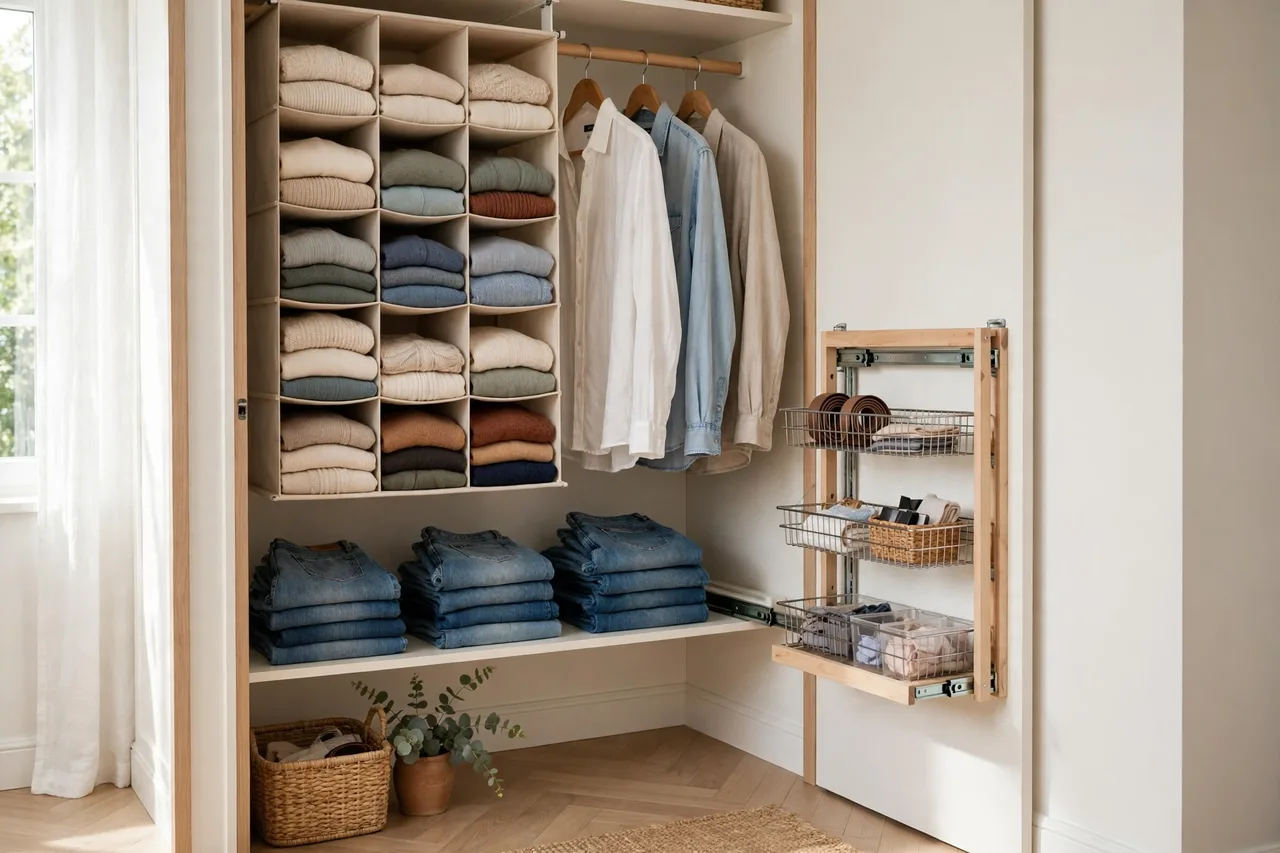
Closets are tall; hanging rails only use the top half. A hanging fabric organizer — the kind with five or six shelves that hooks over the rail — turns dead air under your shirts into folded-clothes storage: sweaters, jeans, pajamas. About $15–$25. Before you buy: be honest about weight. These shelves love folded knits and hate hardcover books; give each shelf one category and it will stay tidy for months.
8. Stackable Clear Drawers
See it, stack it, stop buying duplicates. Small clear stacking drawers turn a shelf, a closet floor, or the top of a dresser into a mini chest of drawers — makeup in one, socks in another, first aid on top. Two or three units cost $20–$35 in total. Styling tip: clear works because your eyes do the inventory for free. The moment you cannot see what you own, you own three of it. Measure the stack’s home first so the top drawer still opens freely.
9. A Clip-On Bedside Shelf
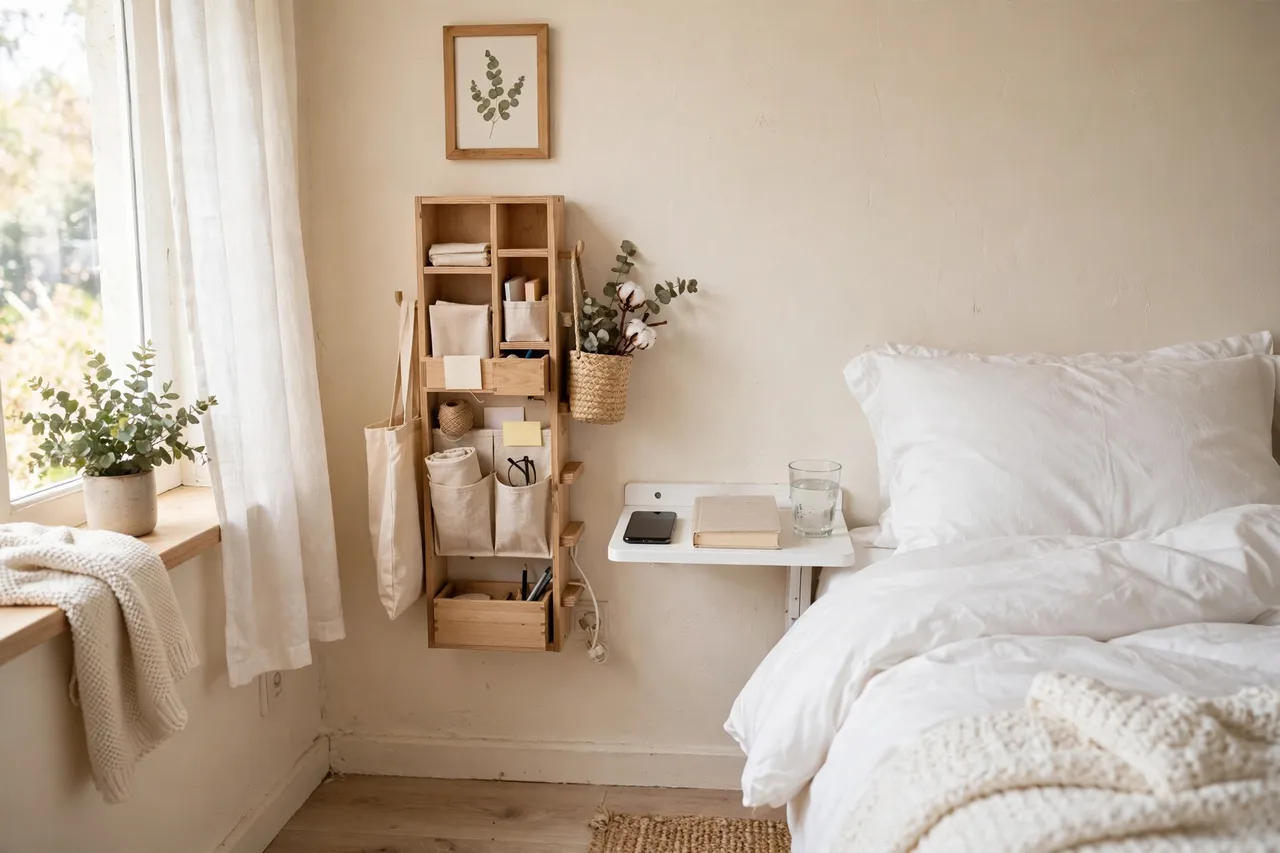
No room for a nightstand? Your bed frame is the nightstand. A small clip-on or slide-in bedside shelf — a flat tray that grips the bed frame or tucks under the mattress — holds your phone, book, glasses and water glass in rooms where a real nightstand simply does not fit. Most are $15–$30. Before you buy: check your frame type first; clip-on styles need a rail to grip, while slide-in styles work with almost any bed. Keep it to the nightly essentials — it is a shelf, not a second wardrobe.
10. A Wall-Mounted Fold-Down Desk
A desk that disappears when work ends. A fold-down desk mounts to the wall, opens into a real workspace with a small shelf for a laptop and notebook, then folds flat — just 4–5 inches (10–13 cm) deep — when the day is done. Expect $50–$90. Styling tip: hang a small picture or plant ledge beside it, not above it, and the folded desk reads as a slim wall cabinet instead of office equipment haunting your bedroom.
Small Space Storage Ideas for the Kitchen & Bathroom
Small kitchens and bathrooms share the same problem: everything is essential, nothing has a shelf. These six finds go after the gaps, the doors, and the deep dark cabinets.
11. A Slim Rolling Cart for the Fridge Gap
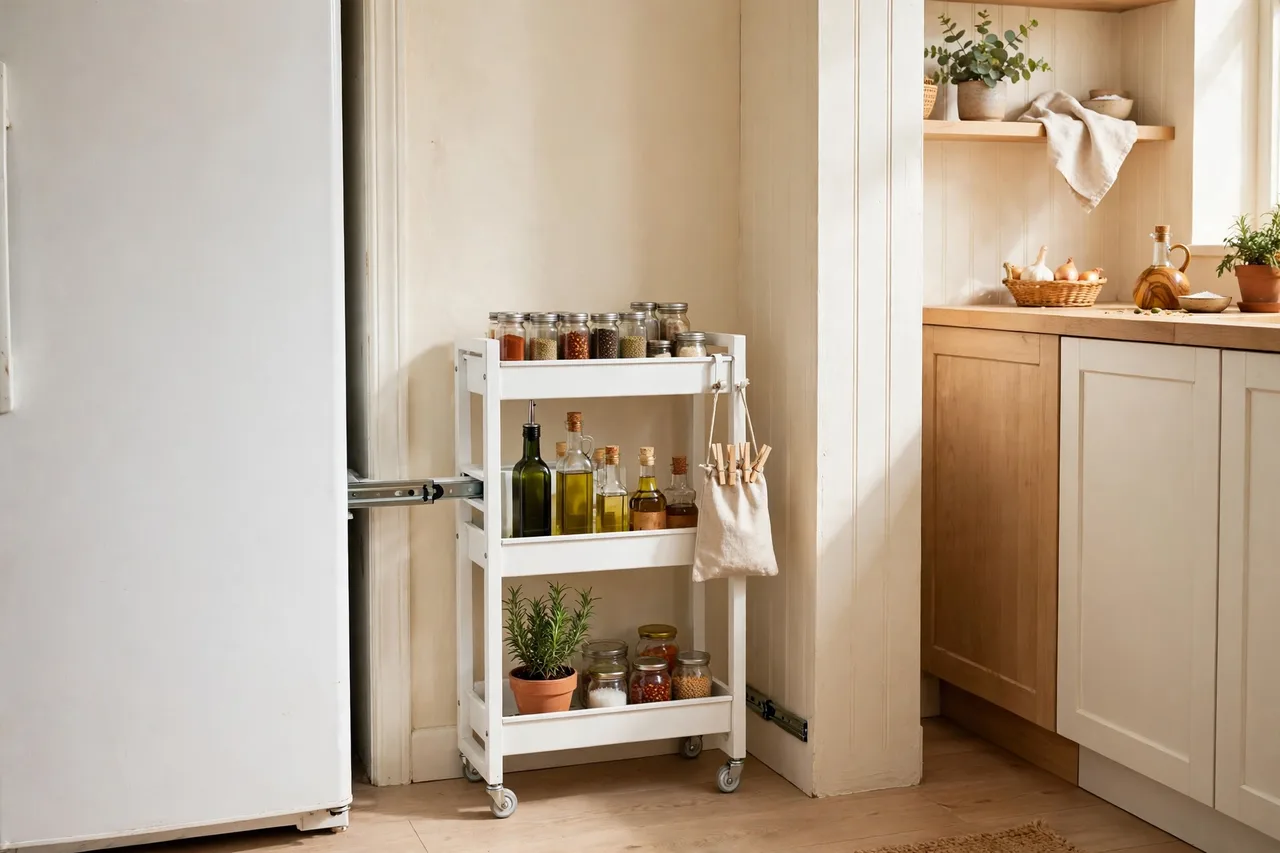
That 6-inch gap beside the fridge is a pantry in disguise. A slim rolling cart — 6 or 7 inches (15–18 cm) wide, three or four tiers — slides into the gap and holds spices, oils, cans and cleaning supplies, then rolls out when you cook. About $20–$30. Before you buy: measure the gap at floor level and at counter height; walls and fridges are rarely perfectly straight, and the narrower number is the truth. For the bathroom version of this trick, our small bathroom storage ideas put the same cart to work beside the toilet.
12. Magnetic Spice Strips
Spice jars belong on a wall, not in a drawer you excavate. A magnetic strip — mounted on a wall or stuck to the side of the fridge — holds small metal-lidded spice tins in one neat, visible row. A strip plus tins runs $20–$35. Styling tip: matching tins are the whole magic here; a uniform row looks like a design choice, while twelve different jars look like a cry for help. Label the lids, and cooking gets faster every single day.
13. Under-Sink Pull-Out Trays
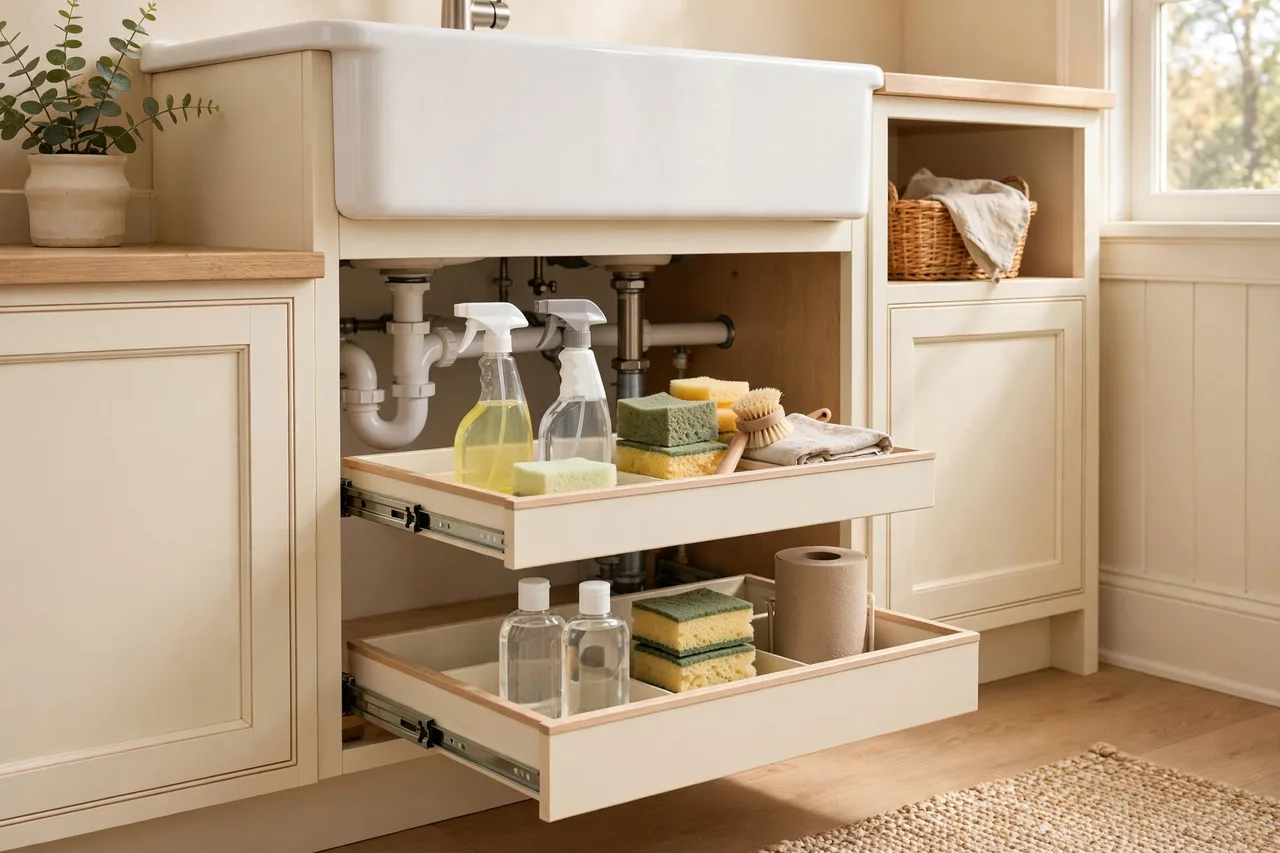
The cabinet under the sink is a cave; make it a drawer instead. A two-tier pull-out tray — the kind shaped to dodge the drain pipe, with baskets that glide toward you — turns cleaning supplies and spare sponges into things you can actually reach. Expect $20–$35. Before you buy: measure around your pipes before ordering, not after. The height from the cabinet floor to the lowest pipe decides which model fits, and it decides absolutely.
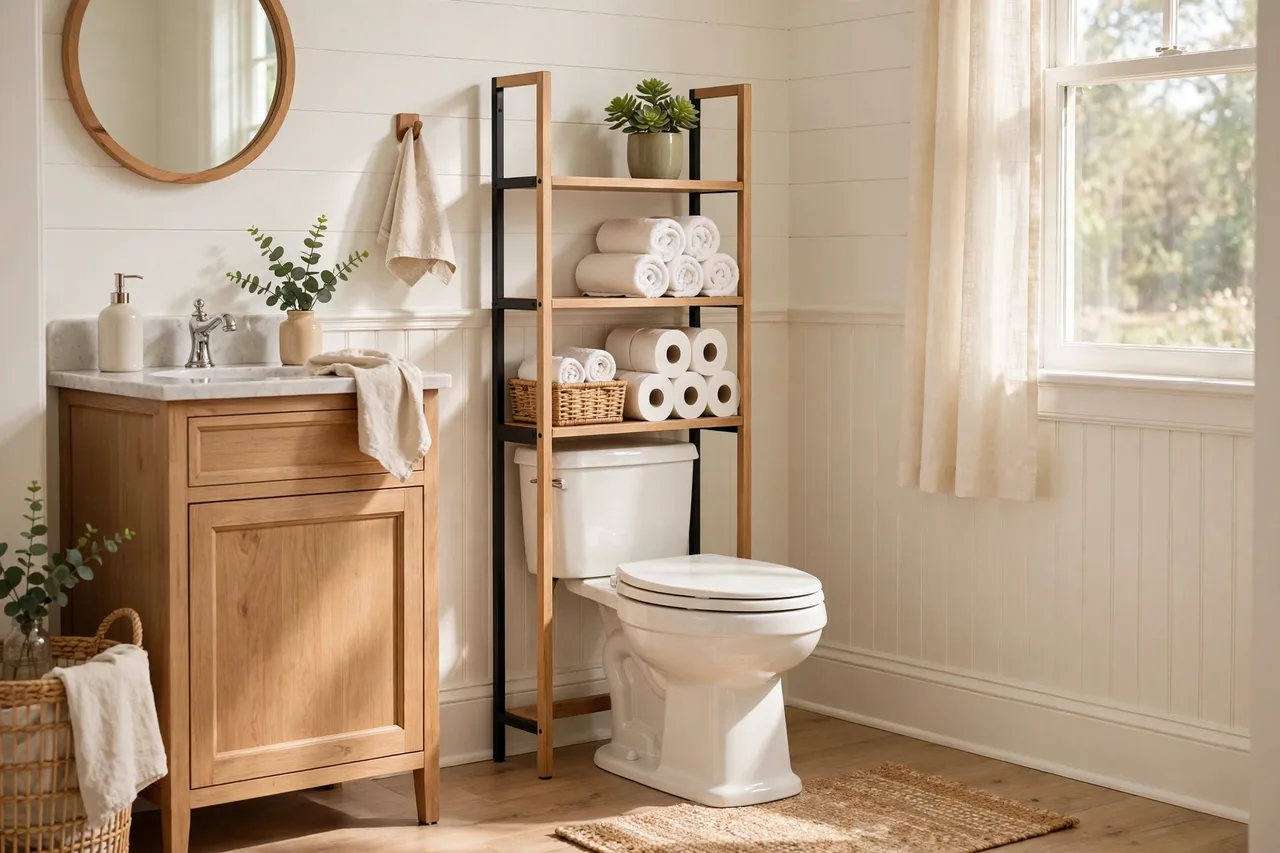
14. An Over-Toilet Storage Rack
The air above the toilet tank is a whole cupboard standing empty. A freestanding over-toilet rack — two or three shelves on a frame — holds spare towels, toilet rolls and the good bottles, and assembles in about twenty minutes with no drilling. Most cost $25–$45. Before you buy: measure the tank height as well as the width; the rack must let you lift the tank lid, or its first maintenance day will also be its last.
15. Over-Cabinet-Door Organizers
Every cabinet door has two sides, and you are using one. Slim racks that hook over the inside of a cabinet door hold the homeless things — plastic wrap and foil boxes in the kitchen, the hair dryer and spare shampoo in the bathroom. About $10–$20 each. Before you buy: keep them shallow and light. A deep, heavy rack stops the door from closing, and a door that will not close is worse than no storage at all.
16. A Turntable for Deep Cabinets
Stop losing jars to the back of the cabinet. A simple turntable — the lazy Susan kind, 10–12 inches (25–30 cm) across — spins sauces, vitamins and jam jars from the dark back row to the front in one flick. Most cost $10–$18. Before you buy: measure the cabinet’s depth and the door opening, and choose a turntable with a small lip; a lipless one sends jars on adventures every time the door closes with enthusiasm.
How to Choose the Right Storage for Your Space
Sixteen finds is a lot of temptation, so here is the honest way to choose. First, find your dead zones — walk your home with fresh eyes and list every gap, door back, corner and under-space doing nothing. Storage should be bought for a named spot, never “just in case.” Second, measure twice, in two places — gaps and corners lie, so take the floor-level and top-level numbers and trust the smaller one. Third, go see-through where you can — clear drawers, clear pockets and open baskets beat closed boxes in small homes, because visible things do not get bought twice. Fourth, spend on the daily pain first — the entryway avalanche and the under-sink cave matter more than the guest towels. Two or three well-chosen finds will change how your home feels more than ten random ones.
FAQ
What are the best small space storage ideas for renters?
Anything that hangs, stands, or sticks — no screws required. Over-door organizers (idea #1), freestanding racks like the over-toilet shelf (idea #14), rolling carts (idea #11) and adhesive-friendly clear drawers (idea #8) all add storage that leaves with you on moving day and leaves no holes behind.
Where should I start if my budget is small?
Start under $25 with the finds you will touch every day: the under-sink pull-out tray (idea #13, about $20–$35), the turntable (idea #16, about $10–$18) and a set of nesting baskets (idea #4, about $20–$40). Around $60 later, your kitchen and entry already feel like different rooms. Add the structural pieces — the over-toilet rack and the under-bed boxes — when you can.
How do I add storage in a studio apartment?
Think in zones and in height. One wall of your “bedroom zone” can hold the fold-down desk (idea #10) and corner shelves (idea #3); the storage ottoman (idea #2) doubles as living-room seating and blanket storage; and the under-bed boxes (idea #6) quietly hold a season’s worth of clothes. In a studio, every piece of furniture should have a second job — if it only does one, it is a guest, not a resident.
What storage mistakes make a small room feel smaller?
Three big ones: bulky closed furniture that eats floor and light, opaque boxes with no labels that turn into mystery storage, and buying organizers before measuring — a cart that fits “almost” fits nowhere. The other classic is storing things you do not use. No basket, however beautiful, can organize a belonging you should have let go of.
How do I keep small-space storage tidy long-term?
Give everything an address and keep the address boring. One category per basket or drawer, labels where other people need them, and a five-minute reset once a week — things walk back to their homes before they form neighborhoods elsewhere. Small spaces stay tidy not through big clean-ups, but through tiny returns.
Small homes are not short on space — they are short on space that is working. Pick two or three of these small space storage ideas for the spots that annoy you most, and watch your tiny rooms start feeling twice as big. Save this list for your next organizing weekend, and follow along on Pinterest for one clever, doable idea every day. 🏡