Christmas Window Decor Ideas: 16 That Still Let the Light In
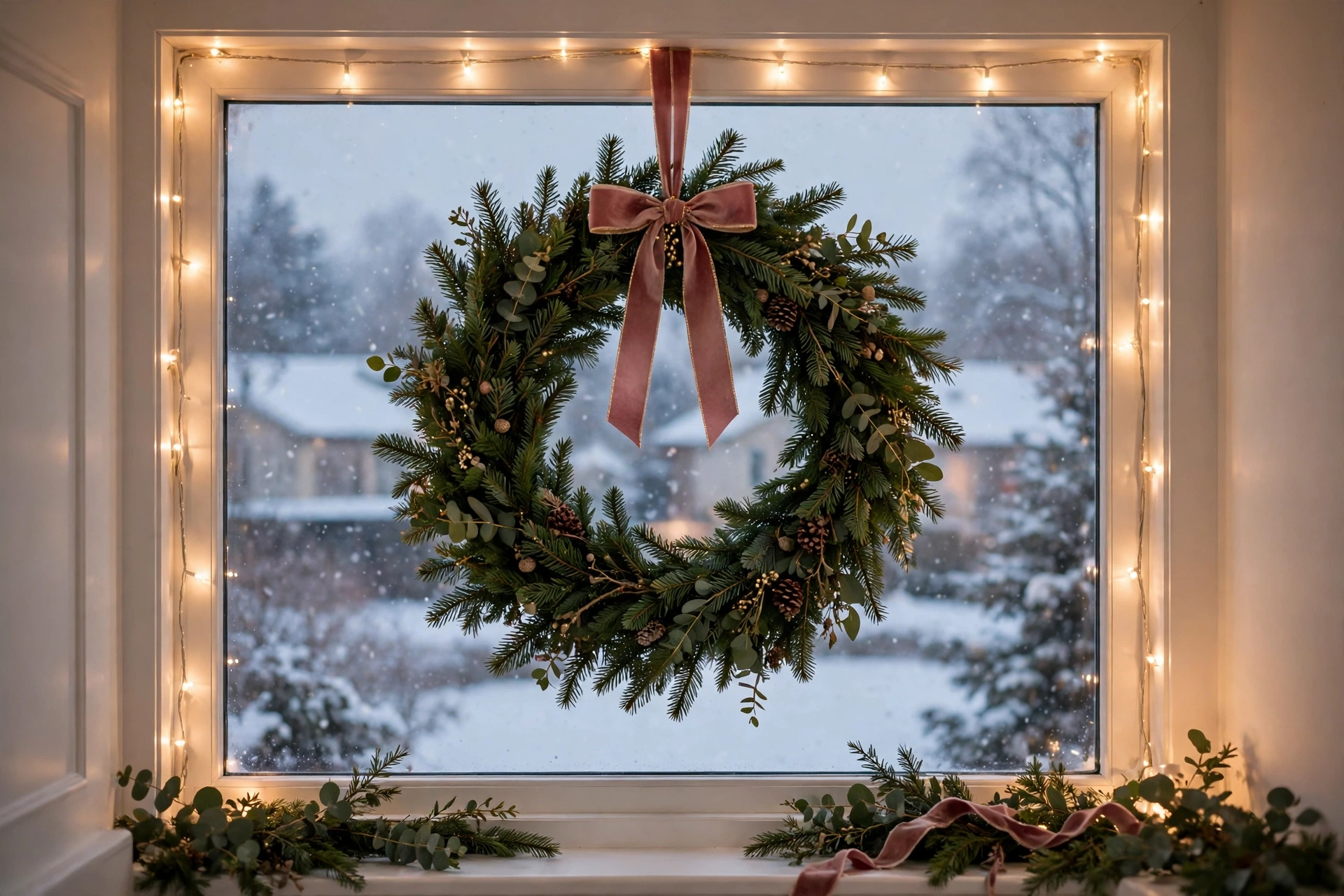
If you’re hunting for christmas window decor ideas that won’t turn your windows into a wall you can’t see through, you’re in the right place. The window is where Christmas glows after dark — the wreath on the glass, the candles on the sill, the fairy lights that make the whole street slow down. It deserves to look magical, just not the kind of magical that blocks the daylight, hides the view, or leaves the room dark at noon.
So here are 16 ideas that actually work on a real window: warm, doable, and built around the HomelyNook way — a white base, plenty of greenery, and just one soft seasonal colour (this year, a light burgundy with a whisper of gold). Nothing here needs a renovation, a big budget, or a window you don’t already have. And every single idea leaves the light coming in, because a Christmas window still has to be a window. Our full Christmas decor ideas pillar has the same thinking for every other room, if you want the whole house to match.
Window rules — read this first, it saves every idea below. Three rules for the whole article: 1. One hero per window. A wreath, a candle row, or a hanging display — never all three competing. Add one glow and one soft layer, then stop. 2. Light stays in, view stays open. Decorate the top third and the edges; keep the middle of the glass clear so daylight still comes in and you can still see out. 3. Nothing damages the glass or frame. Suction hooks, removable dots, ribbon over the top — no tape on paint, no nails in frames, and no real flame near curtains or greenery.
Part 1 — Wreaths and Garlands on the Glass
The wreath is the window’s oldest Christmas outfit, and it still works because it reads clearly from the street and takes twenty minutes per window.
1. One Wreath Centred on Every Window
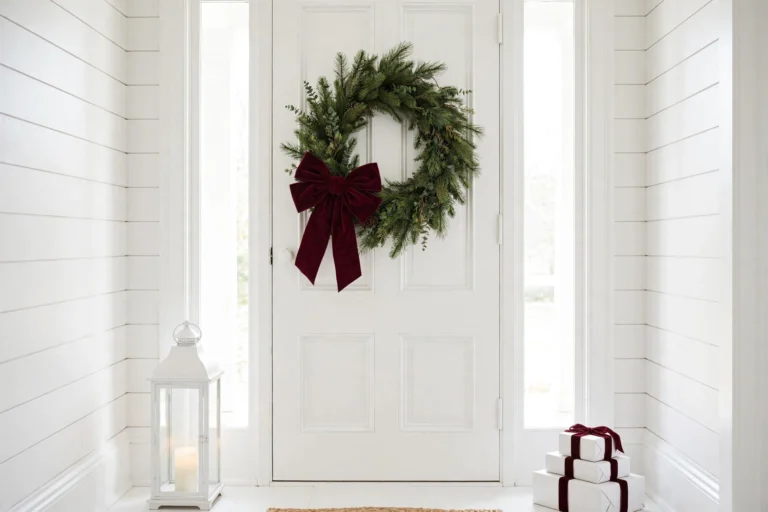
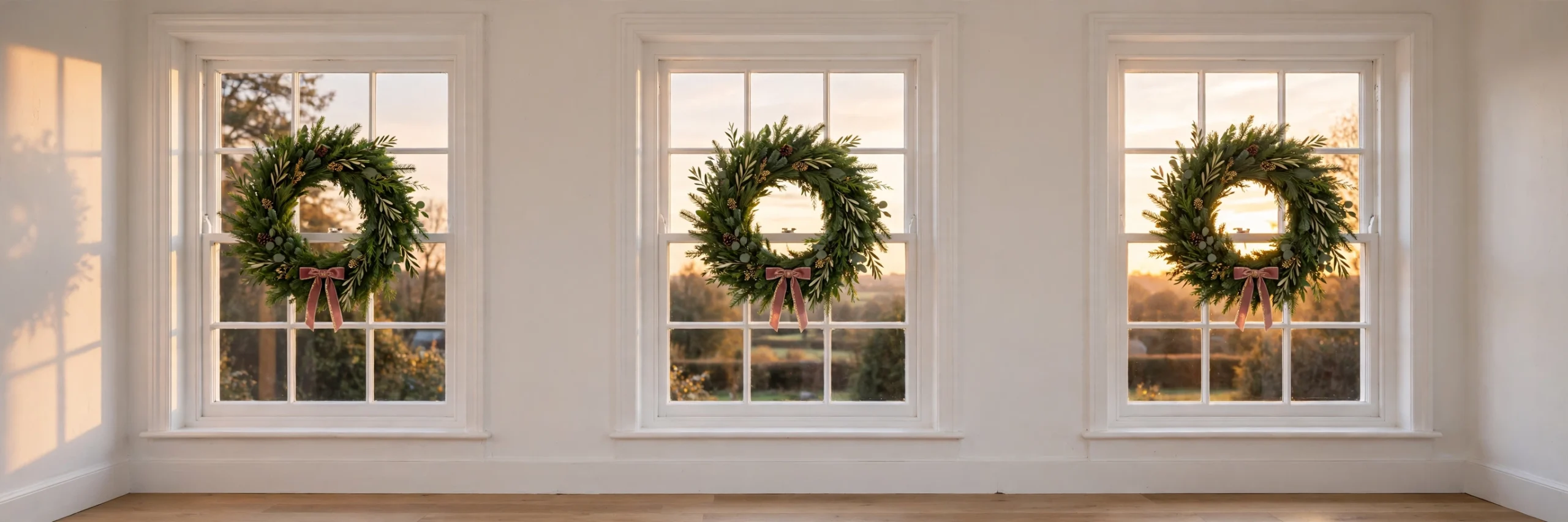
A single evergreen wreath hung dead-centre on each window, all at the same height, is the classic Christmas window look — and the uniformity is the luxury. Pick one wreath size for the whole house (about 24 inches on a picture window, smaller on a narrow one) and hang every one at exactly the same height, so the facade reads as one design instead of a collection of windows. Hang it from a suction-cup hook on the glass, or loop a wide ribbon over the top of the sash and tie it to the wreath — the ribbon becomes part of the look and nothing is damaged. One small light-burgundy bow at the top of each wreath ties them to the rest of the house. For the wreath styles that suit a window best, our Christmas wreath ideas guide has the full range, from full evergreen to slim and simple.
2. A Garland Swag Across the Top
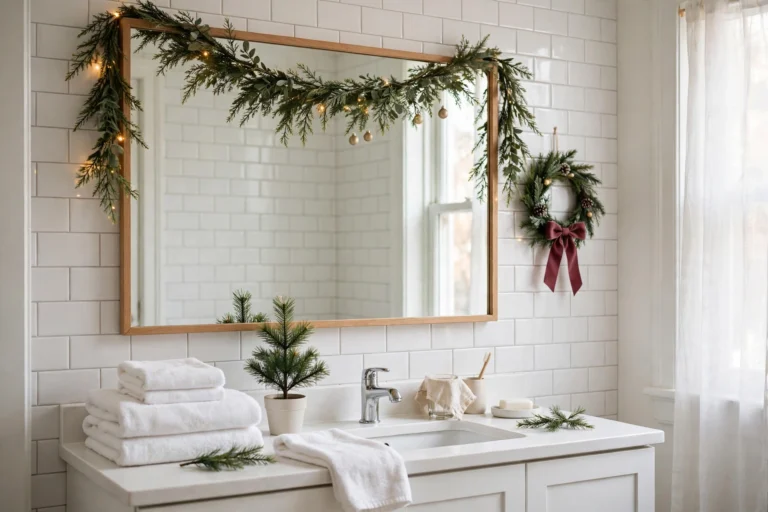
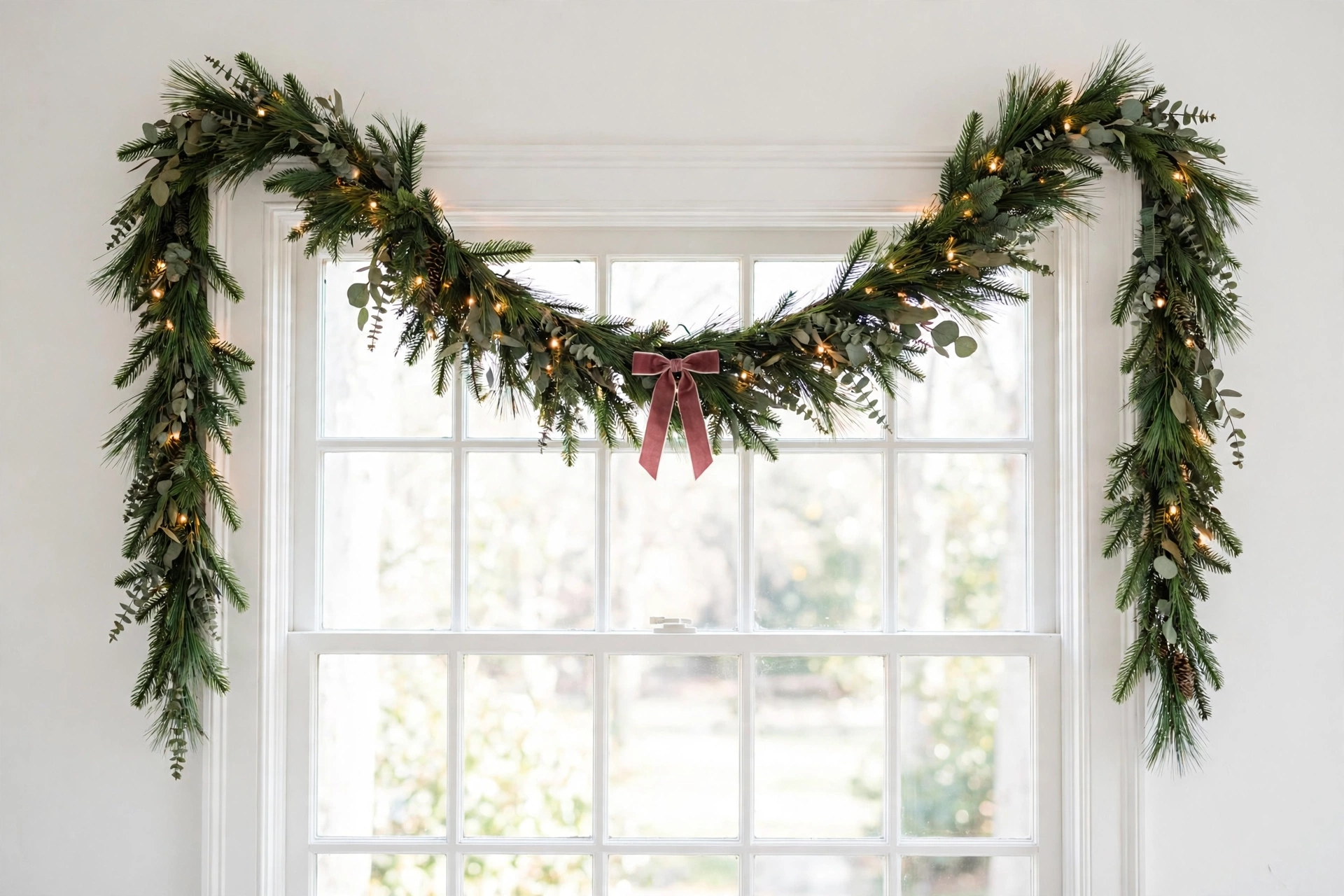
A pine or mixed-greenery garland draped in a single shallow swag across the top of the window frame does what a valance does: it gives the frame a soft top edge and leaves the glass and the sill completely clear. Buy a garland about one and a half times the window’s width, fluff it for ten minutes before you hang it, and let the ends fall 30 to 50 cm down each side. Fix it with small removable hooks on the frame, never tape, and tuck a few warm-white fairy lights into it before you add anything else — the lights make the swag glow after dark without a single extra decoration. One burgundy bow at the centre, where the swag dips lowest, is all the colour it needs.
3. Mini Wreaths on Every Pane
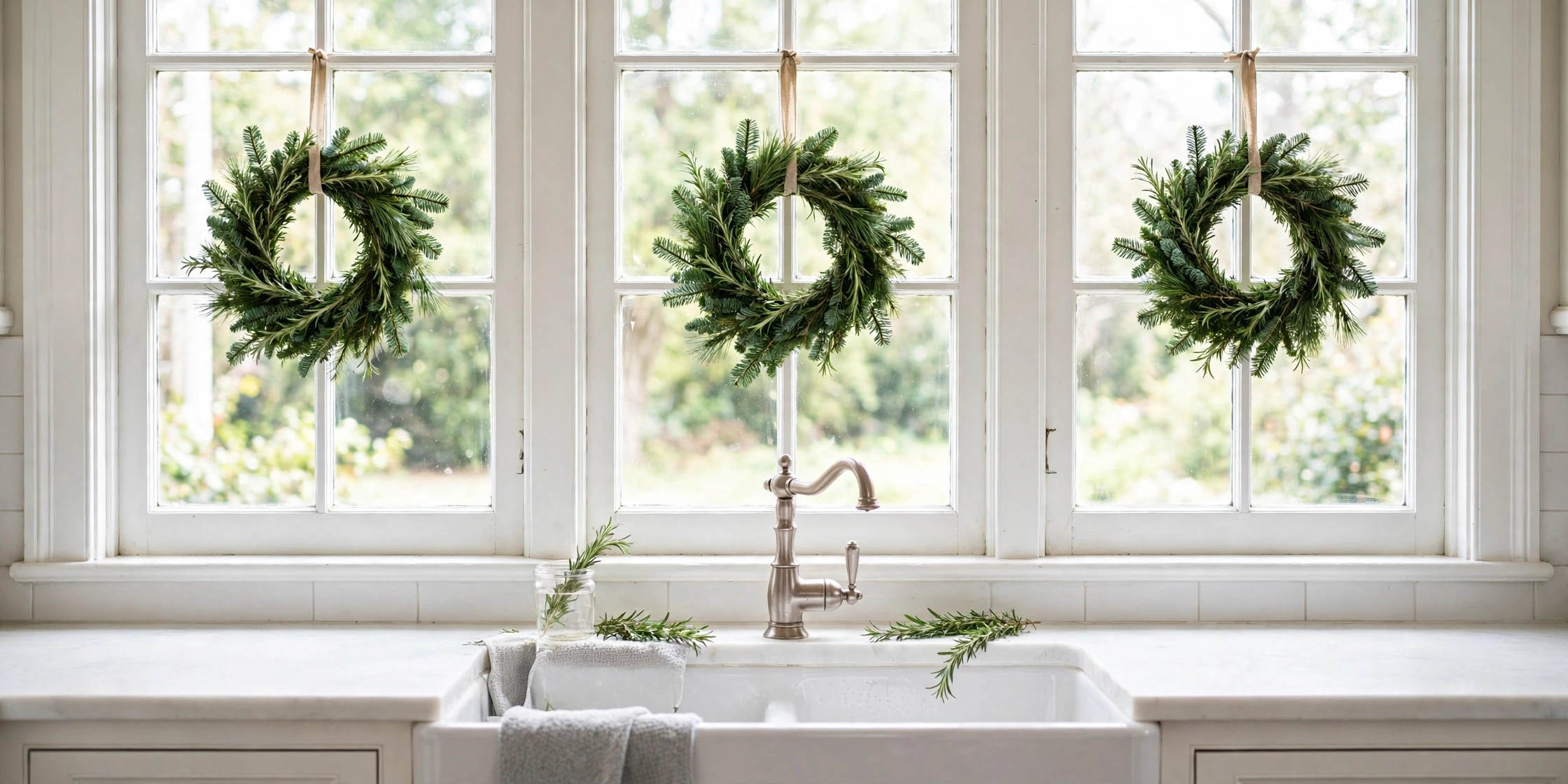
Small wreaths — 20 to 25 cm, rosemary, boxwood, or simple pine — are the window idea for rooms with more than one pane, and the kitchen window over the sink is where they shine. Hang one on each pane from a short ribbon looped over the top of the frame, all at the same height, and the window turns into a neat row of green circles that cost almost nothing. Rosemary wreaths smell wonderful over a sink and can be cooked with afterwards; boxwood stays green for weeks without shedding. Keep them light: a mini wreath should hang from ribbon, not a hook, and if a pane is narrow, one wreath across two panes looks better than two squeezed ones.
4. A Wreath Outside Every Window
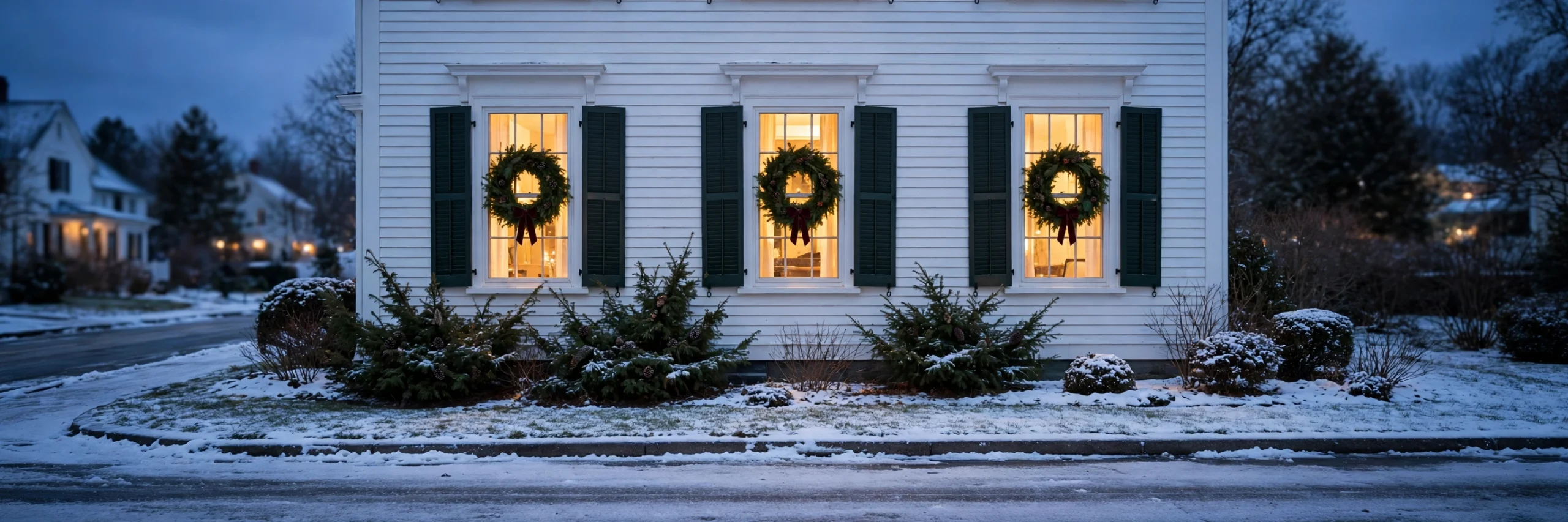
The street side of the window deserves its own wreath — it is the one the neighbours actually see. Use a weatherproof faux-evergreen wreath outside (real greenery dries out fast in wind and rain), hung from a suction hook rated for outdoor use or a ribbon looped through the top of the sash and tied inside. Check it after the first windy night: an outdoor wreath needs a second fixing, a loop of wire around the frame, or it ends up in the garden. Keep the outside wreaths simpler than the inside ones — greenery and one bow, no loose ornaments — because anything small and light blows away, and a bare patch where a bow used to be is worse than no bow at all.
Part 2 — Candles and Glow After Dark
Light is what makes a Christmas window work at night: five candles or one lit paper star can outshine a whole roofline of bulbs.
5. Electric Candles in Every Front Window
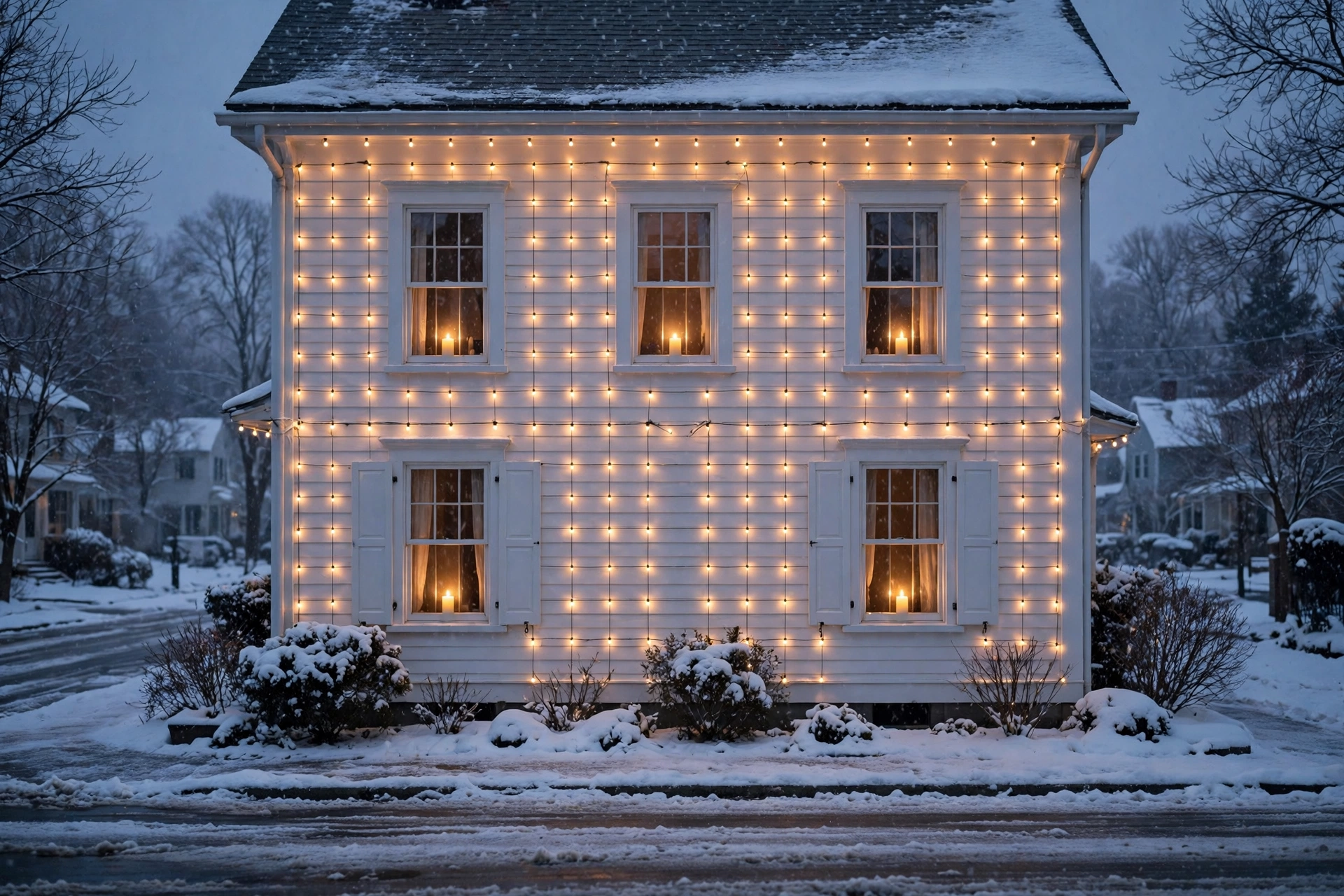
One electric candle on the sill of every front window turns the house into a pattern seen from the street — a grid of small lights across the facade. It is the Scandinavian and colonial classic, and it works because of the repetition, not the candle itself: one window alone looks like a forgotten candle, five in a row look like a tradition. Use battery candles with a built-in timer so they switch on at dusk by themselves, centre each one on its sill, and keep them all the same height and the same warm white. Flameless is the safe choice here — a real flame on a sill next to a curtain is a risk no photograph justifies.
6. A Fairy-Light Curtain Behind a Sheer
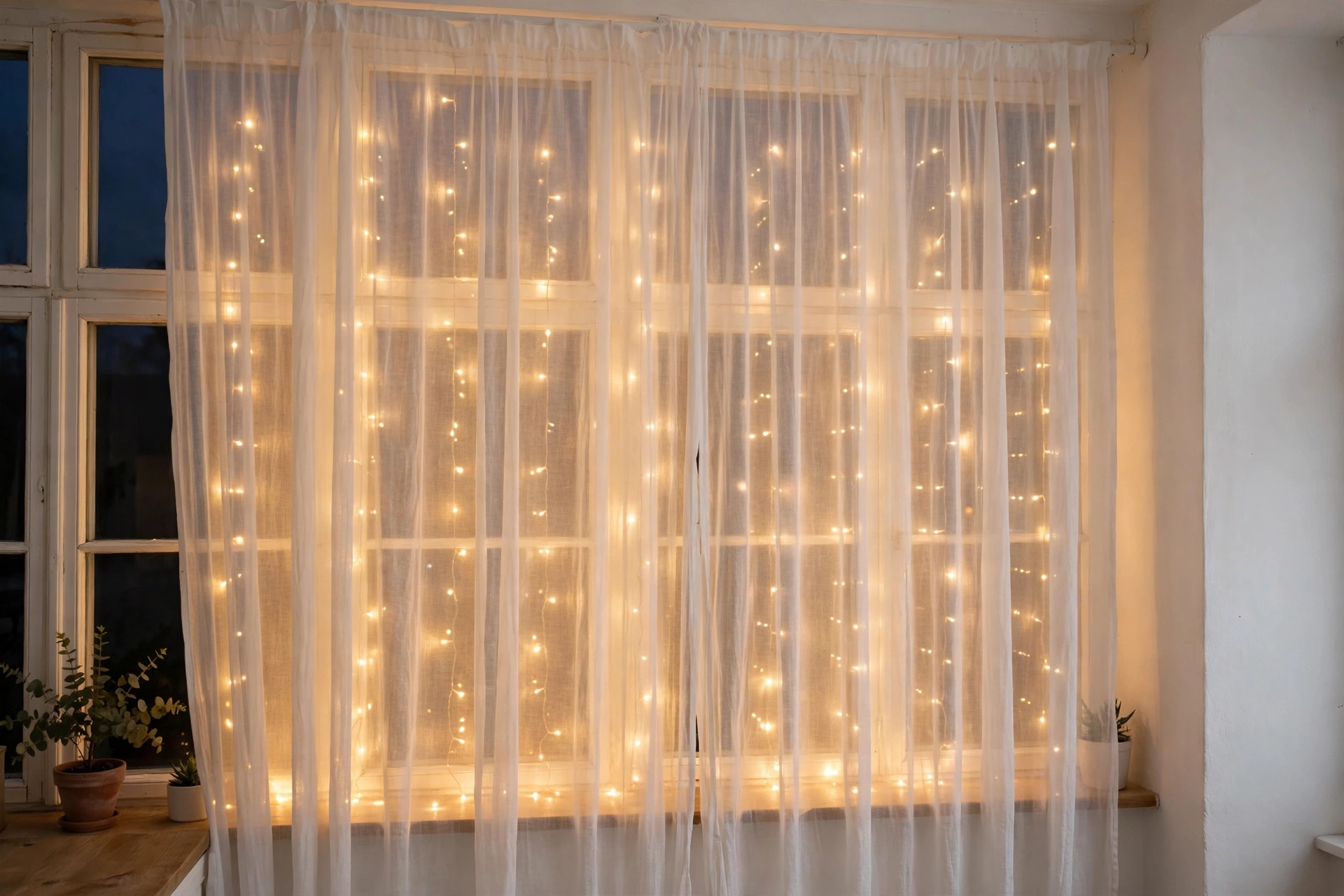
A curtain of tiny warm lights, hung in vertical strands behind a white sheer, turns a whole window into an even glow. Hang the light curtain from the rod first, then the sheer in front of it, so the fabric softens every bulb into one soft sheet of light instead of a row of bright dots. It glows without blocking daylight — the sheer is the whole point — and from the street the window reads as one warm rectangle. Use warm white only, around 2700K, and put the lights on the same timer as the candles so the whole house switches on together at dusk.
7. Paper Star Lanterns at Different Heights
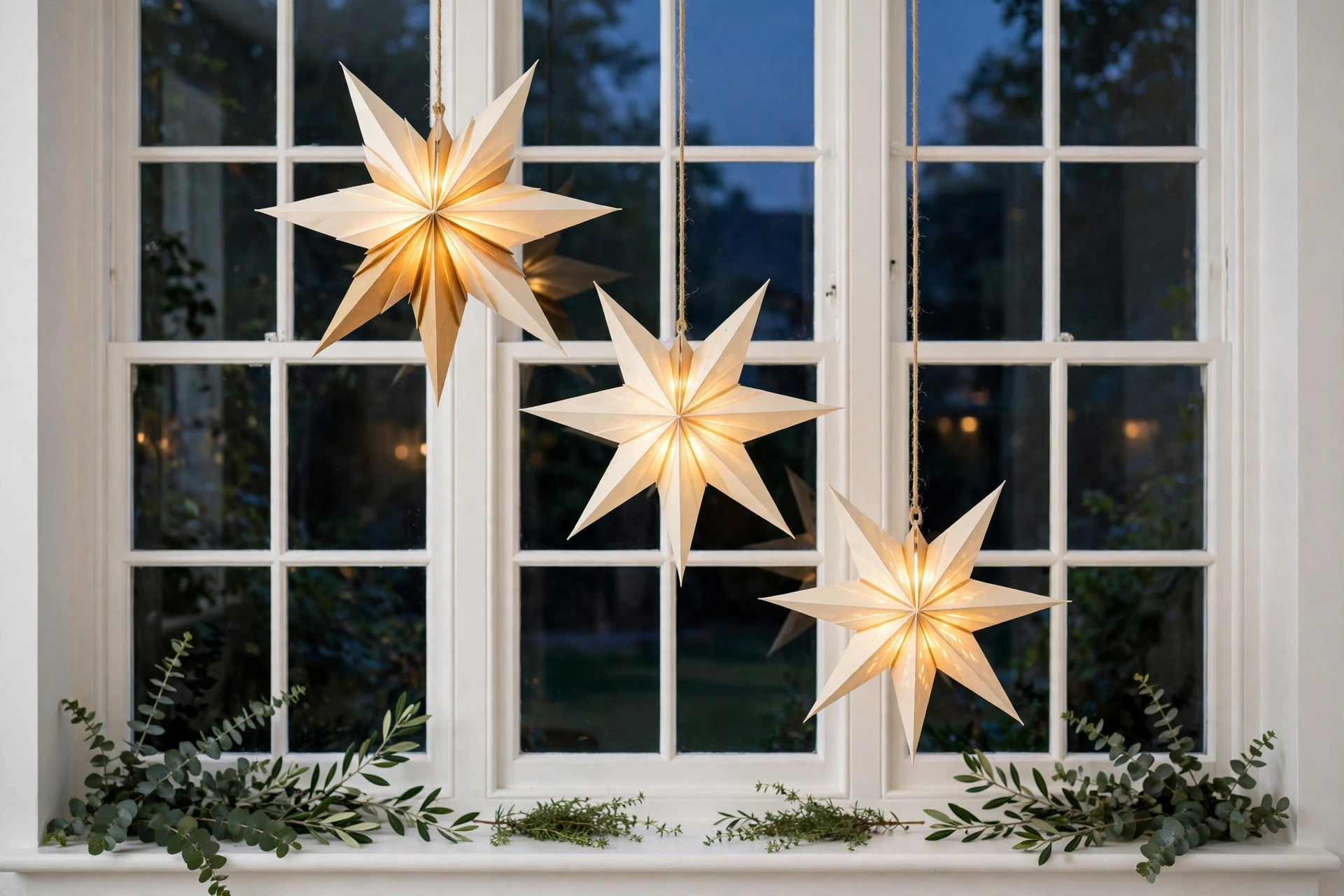
Paper star lanterns are designed to hang in a window, and three of them at different heights fill the glass in a way a single star doesn’t. Hang them from the curtain rod on clear thread or thin ribbon — the tallest at the top, the smallest in the middle, one low — so the eye travels down the window instead of stopping at one bright spot. Put a warm LED tea light inside each one, never a real flame: paper and flame do not mix. Cream and gold stars suit the HomelyNook palette best; anything brightly coloured starts competing with the wreath and the lights instead of joining them.
8. Lanterns on a Deep Sill
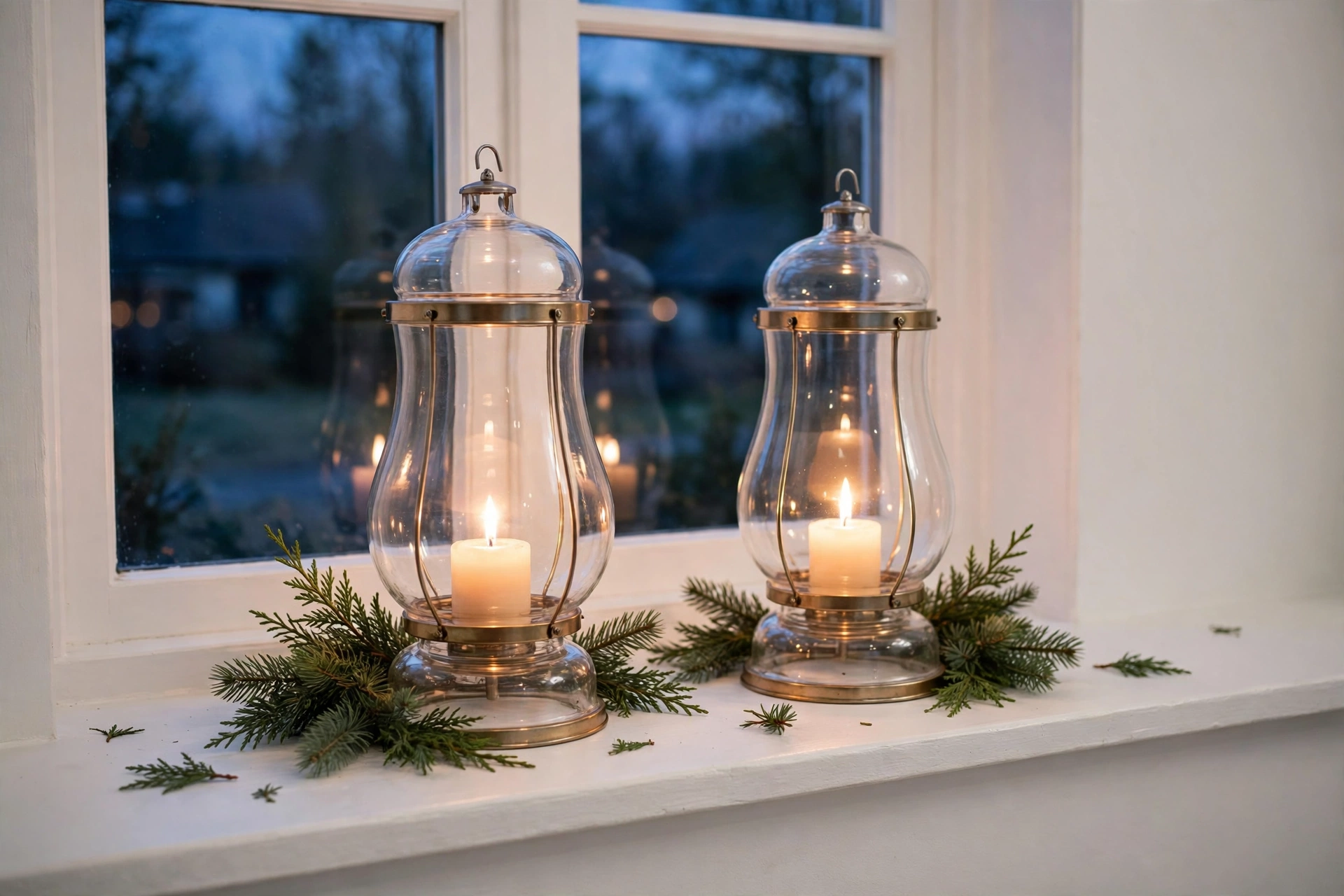
An old house with thick walls has sills deep enough — 6 inches or more — to hold a low bank of lanterns, and a lantern is the sturdiest glow a window can have. Set two glass hurricane lanterns on the sill, one at each end, each holding a flameless pillar candle on a timer, with a little cut greenery around the base. The glass protects the flame (or the LED) from draughts, the lanterns survive a bump from a curtain, and at dusk the whole window glows from the sill up. Keep the lanterns clear of the curtains and keep them low — a tall lantern on a sill blocks the view the way a tall centrepiece blocks a table.
Part 3 — Hanging Things and Paper Magic
The playful window ideas are the ones children can help build, and they all go up with no hooks, no glue, and no damage to paint or glass.
9. Baubles on Ribbons at Different Heights
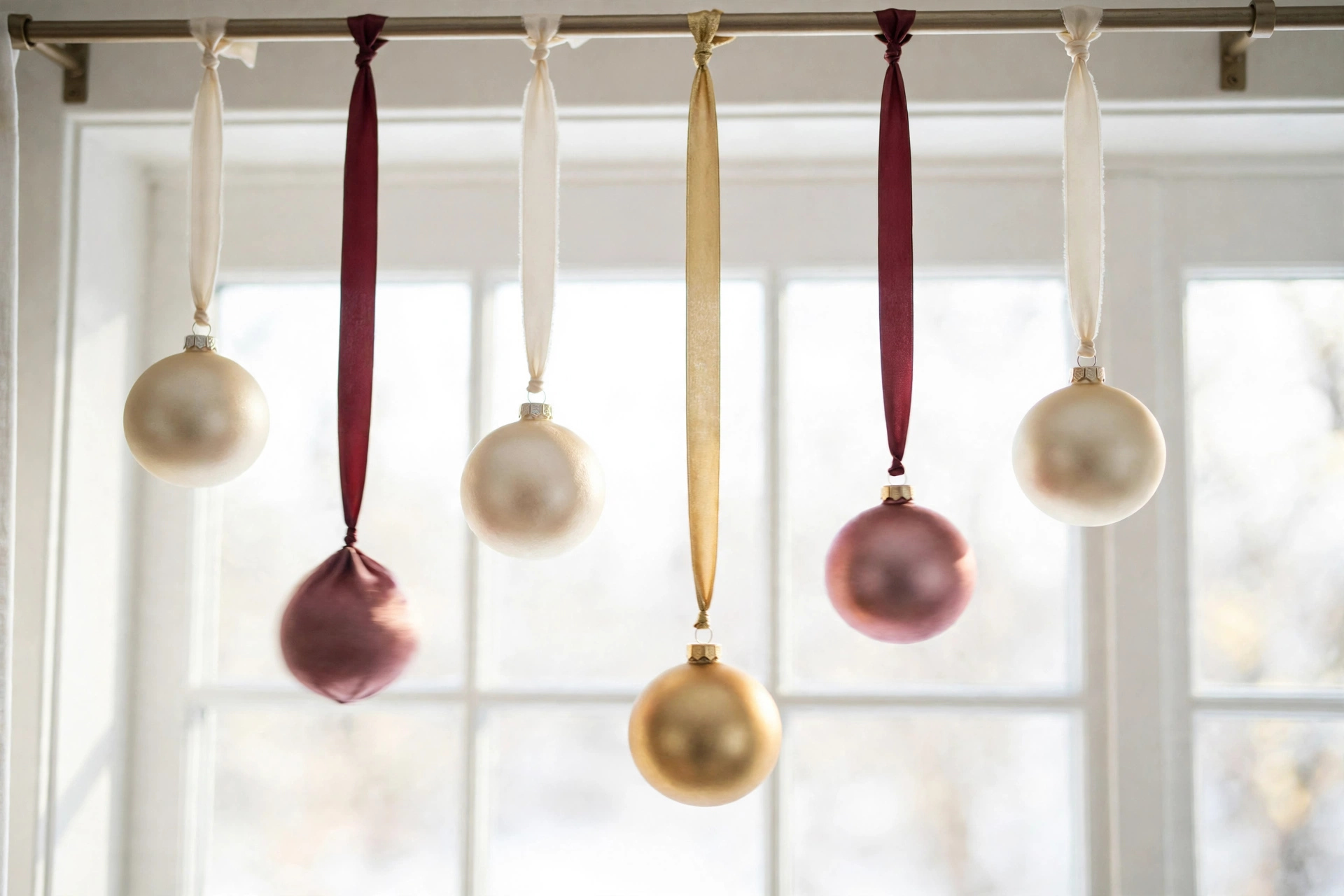
Hang baubles on ribbons at different heights from the curtain rod and the window gets a chandelier made of Christmas. Use lightweight baubles — matte cream, light burgundy, and one gold — tied with ribbon in the room’s one seasonal colour, hung at three different lengths so they turn slowly in the warm air and catch the light from the room and the street. Hang them inside the glass, not outside it, and keep the longest ribbon clear of the sill so nothing rests on a candle or a lantern. Six to eight baubles are plenty on one window; more than that and the glass disappears behind the display.
10. Paper Snowflakes on the Glass
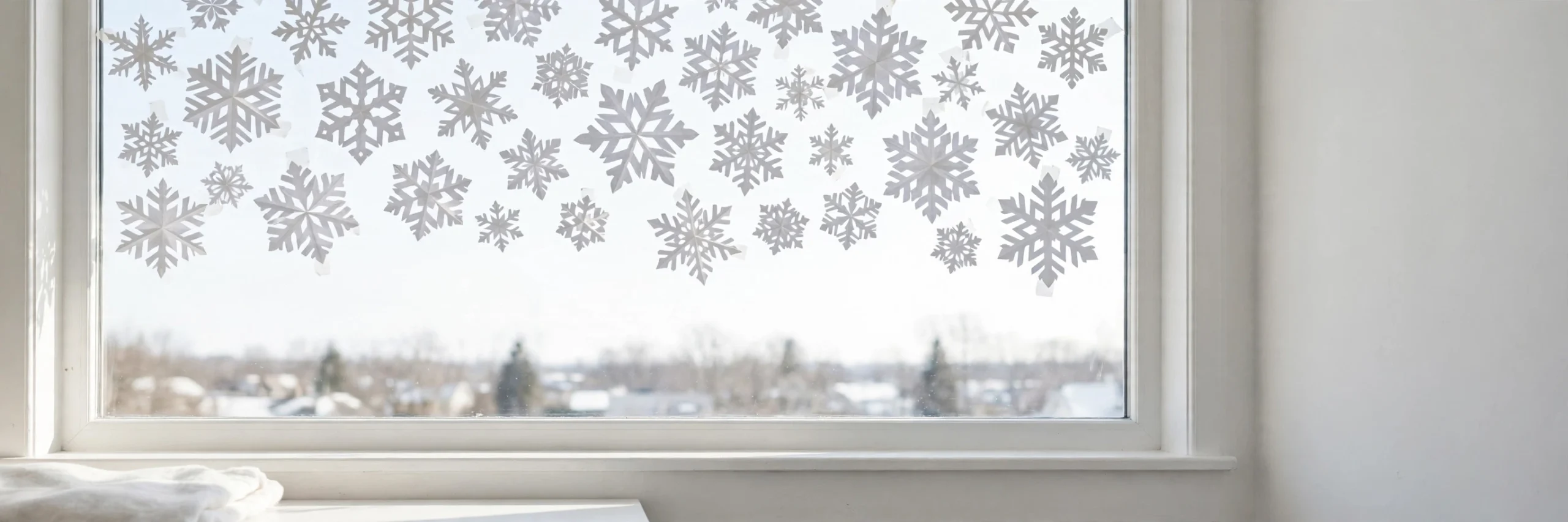
White paper snowflakes, cut from folded squares, cost almost nothing, and a few minutes with scissors makes a pane’s worth. Stick them on the upper half of the glass with removable adhesive dots — never tape, and test one dot in a corner first — and leave gaps so the window still feels open and the daylight still comes through. Three sizes look better than one: a few large flakes, several medium ones, and a scatter of small ones, arranged loosely rather than in rows. It is the most renter-friendly idea in this article, and the same no-damage thinking behind our rental-friendly Christmas decor guide: everything here peels off in January without a mark.
11. A Dried Orange Garland in the Light
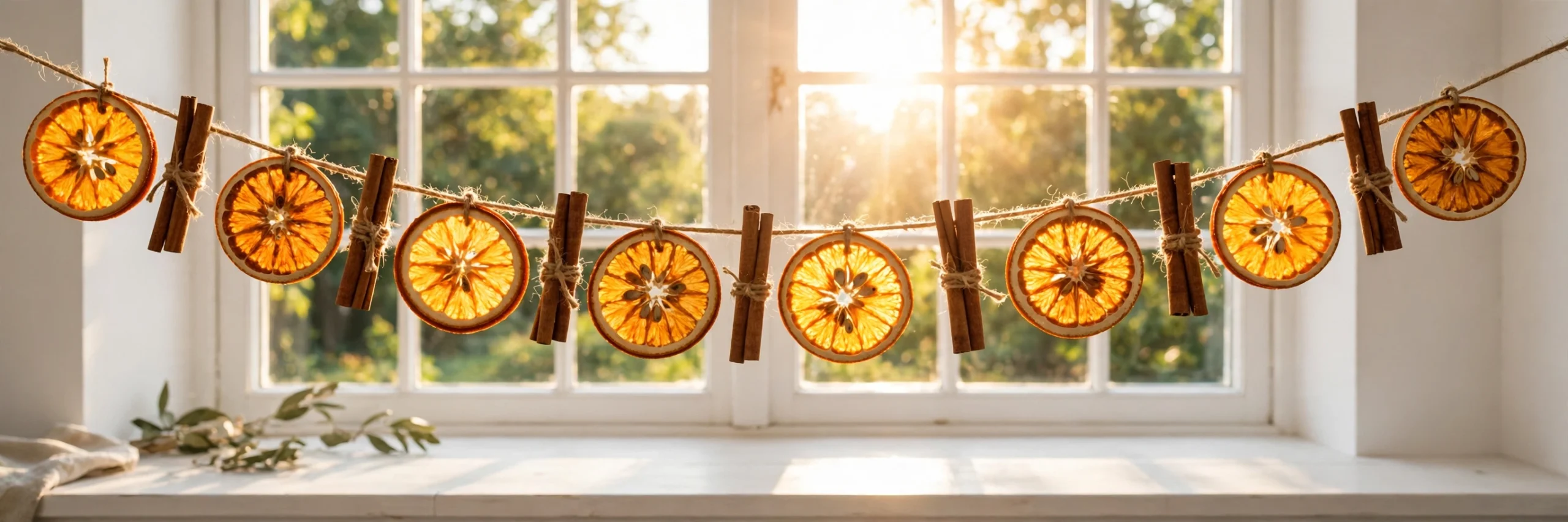
Dried orange slices strung across a window glow when the sun is behind them — they are translucent, so a low winter sun turns each slice into a little amber lantern. String the slices on twine with a few cinnamon sticks and pinecones between them, and hang the garland across the middle of the window where the light hits it, not at the top where it hides behind the curtain. It is the cheapest glowing decoration in this article: a bag of dried orange slices and an afternoon’s threading. Keep the slices thin and dry, or they curl and go limp on a damp morning — and take the garland down before January damp spoils it.
12. A Paper Silhouette Lit From Behind
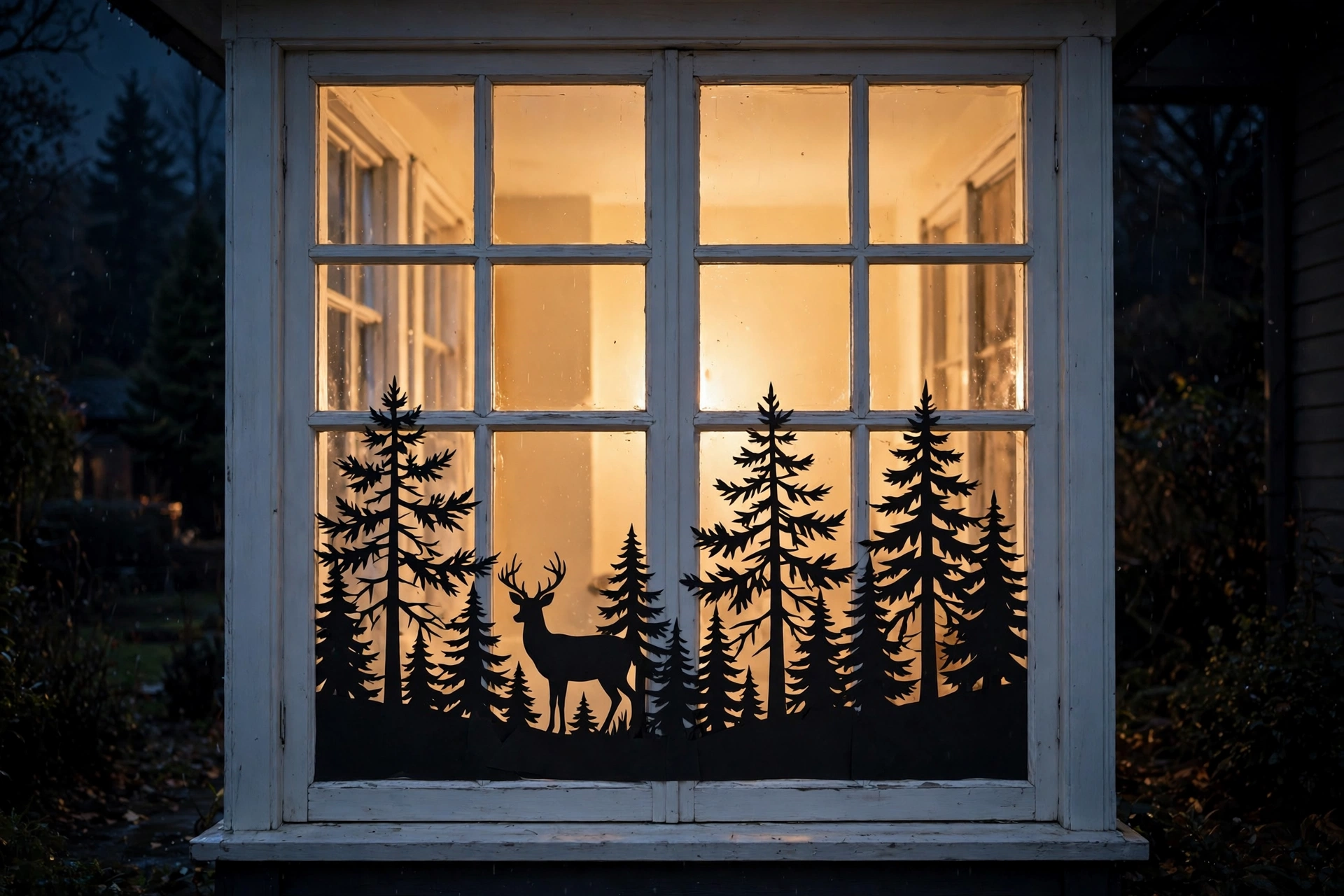
A silhouette cut from black paper — fir trees and a deer, a little village, a row of rooftops — fixed inside the lower half of a window, becomes a scene from the street after dark: black against the lit room. Cut it from one sheet of black card so the scene reads as a single picture, stick it to the glass with removable dots, and let the room’s own warm light do the backlighting — no extra lights needed. It works best on the front windows, the ones the street sees, and it is the only idea in this article that looks better at night than in the day, which makes it the perfect partner for the candle row on the sill above it.
Part 4 — Sills, Boxes and the Rooms Behind the Glass
The last four ideas are about the surfaces around the window — the sill, the box outside, and the two rooms whose windows need special handling.
13. A Miniature Winter Scene on the Sill
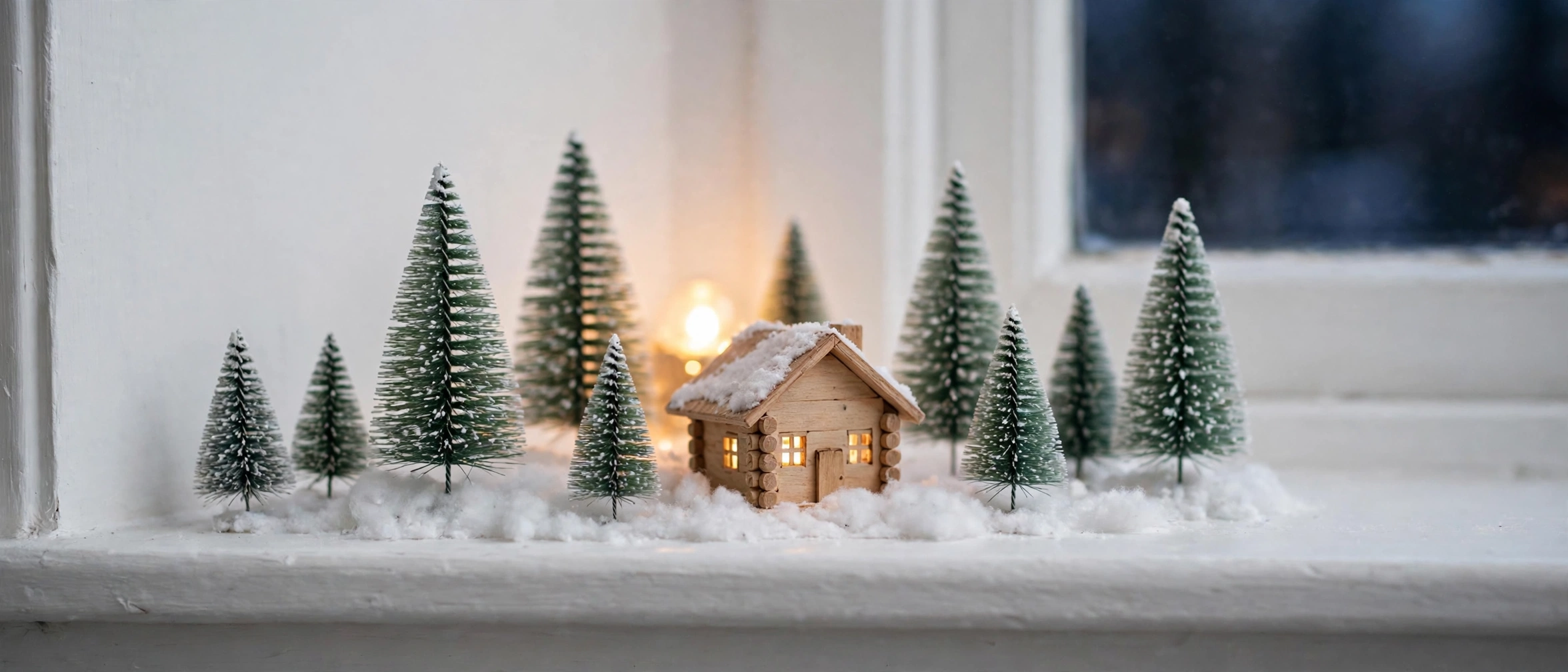
Build a miniature winter scene on the sill and the window gets a story, not just a decoration. Arrange a few small bottle-brush trees, a wooden house, and a soft strip of cotton or fabric as snow along a deep sill, with one warm LED tea light tucked behind the house so the windows glow. Keep it low — nothing taller than the water glasses rule applies here too — and keep it to one end of the sill if the window still needs to open. Children love building this one, and it is the only idea in this article that gets rearranged every week by small hands, which is exactly the point.
14. An Evergreen Window Box Outside
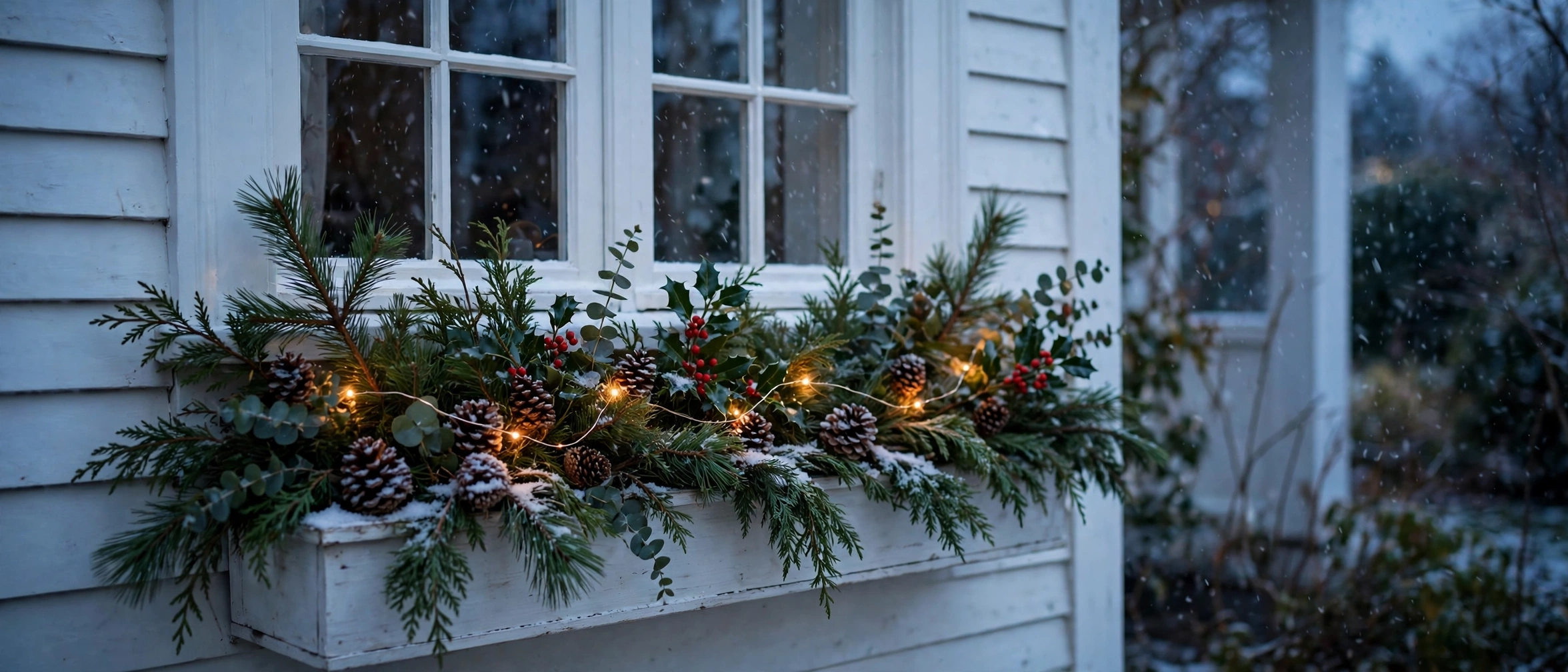
For the street side, one filled window box beats any single hanging piece: one box gives a full 24 to 36 inch run of greenery, berries, and light. Fill a window box with cut evergreen, tuck in pinecones and red berries, and weave one short strand of warm-white fairy lights through it on a battery timer. Fix the box firmly to the wall or the sill — a falling window box is the one window decoration that can actually hurt someone — and water the greenery once a week so it stays fresh into January. It is the window idea that makes the whole house look finished from the pavement, even before anyone sees the tree inside.
15. The Kitchen Window: Herbs, Berries and a Rosemary Tree
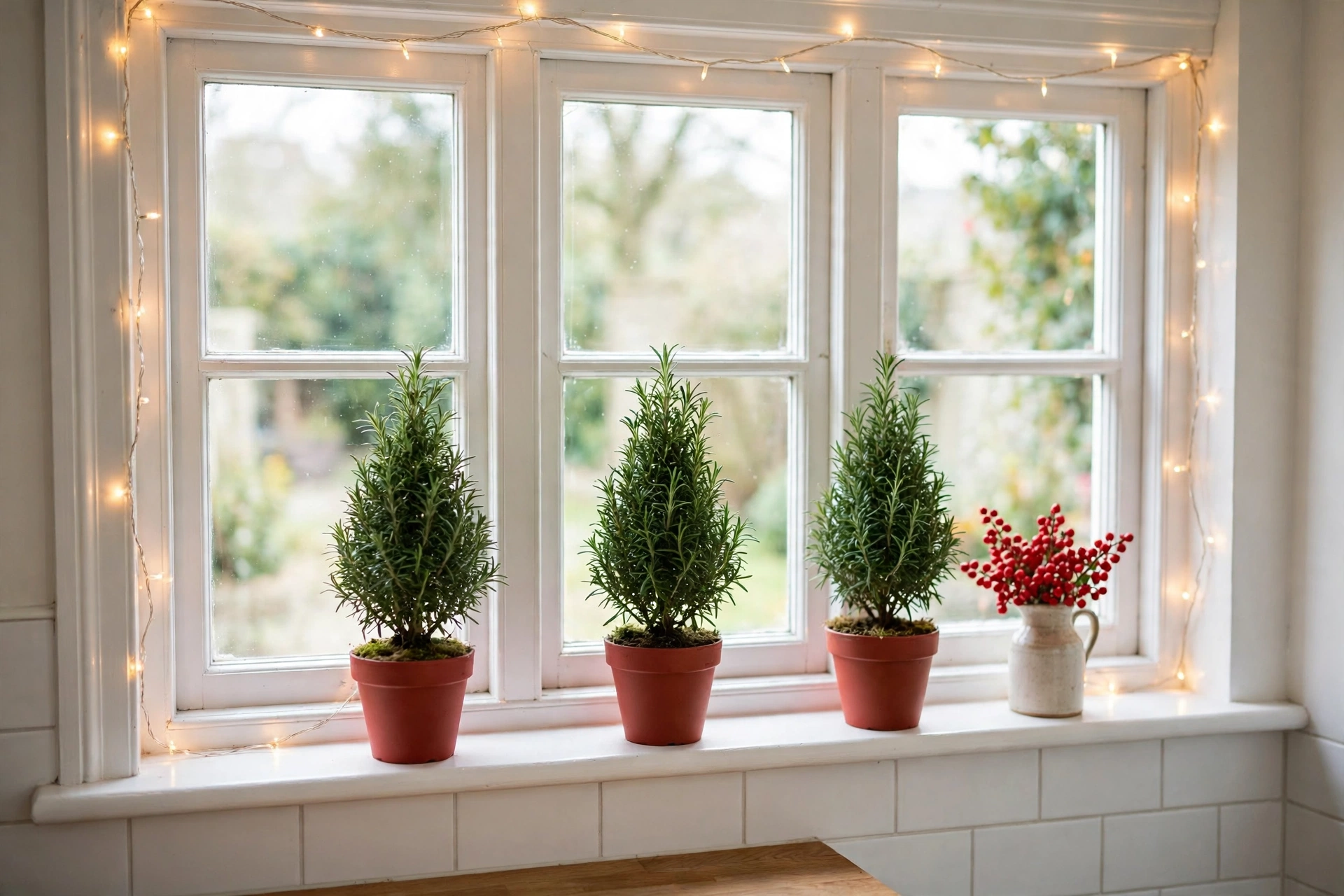
The kitchen window is the one you look through while you cook, so dress it with things you can use. Set three small rosemary plants clipped into cone shapes in red pots along the sill — they look like miniature Christmas trees, and on a kitchen sill they are also cooked with. Add a few red berries in a small jug and a short strand of fairy lights around the frame, and the window smells like dinner and looks like December at the same time. Our Christmas kitchen decor ideas guide has the same thinking for the rest of the room, if the window makes you want to dress the whole kitchen.
16. A Small Tree in the Bay Window
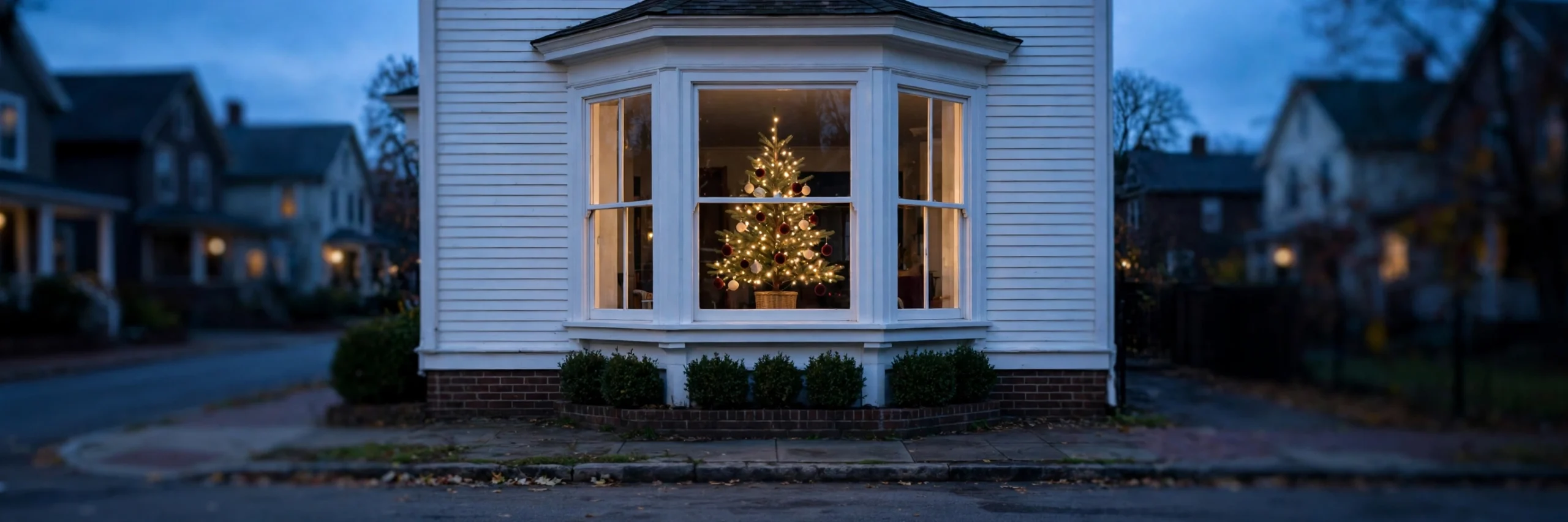
A bay window turns a Christmas tree into a display for the street. Set a small tree — three feet, no more — in the centre of the bay, dressed in the room’s palette with warm-white lights and a few ornaments, and let the bay’s own shape frame it like a shop window. Keep the tree small on purpose: a full-size tree in a bay blocks the light and the view, while a small one glows without crowding anything. One tree, one string of lights, one star on top — the bay does the rest. It is the last idea because it is the biggest gesture in this article, and the one the neighbours will remember.
Christmas Window Budget: What Each Idea Costs
Most of these ideas cost less than a takeaway dinner. Here’s the honest maths, idea by idea — prices are typical US store and online prices, and almost everything here can be reused next December.
| Idea | Cost |
|---|---|
| 1. Wreaths, set of 3 (faux evergreen) | $18–$30 |
| 2. Garland swag, 6 ft | $12–$20 |
| 3. Mini wreaths, set of 4 | $10–$16 |
| 4. Outdoor wreaths, set of 2 (weatherproof) | $15–$25 |
| 5. Electric candles, set of 4 (timer) | $12–$18 |
| 6. Fairy-light curtain (1 strand + sheer) | $10–$16 |
| 7. Paper star lanterns, set of 3 | $8–$14 |
| 8. Lanterns on the sill, set of 2 | $12–$20 |
| 9. Baubles and ribbon | $6–$12 |
| 10. Paper snowflakes (paper + dots) | $2–$5 |
| 11. Dried orange garland | $5–$9 |
| 12. Paper silhouette (black card) | $3–$6 |
| 13. Mini winter scene (trees + house + cotton) | $10–$16 |
| 14. Window box and greenery | $15–$25 |
| 15. Rosemary trees and red pots, set of 3 | $10–$15 |
| 16. Small bay-window tree, 3 ft | $18–$30 |
Do all sixteen and you’re looking at roughly $165–$280 — and most of it comes back out of the cupboard next year. Pick your favourite five and you’re under $60. Start with the wreath, the candles, and the fairy lights: those three alone make the windows glow.
Christmas Window Decor Ideas: Your Questions, Answered
How do you decorate windows for Christmas?
Pick one hero per window — a wreath, a candle row, or a hanging display — then add one glow (fairy lights or electric candles) and one soft layer (a garland or a ribbon). Decorate the top third and the edges and keep the middle of the glass clear, so the light still comes in. Start with the front windows, the ones the street sees, and spread the rest across the rooms.
How do you hang a wreath on a window?
A suction-cup hook on the glass holds a light wreath, or loop a wide ribbon over the top of the sash and tie it to the wreath — the ribbon becomes part of the look and nothing is damaged. Hang every wreath at the same height for the classic look, centre it on the glass, and keep it under 24 inches on a standard window so it doesn’t crowd the frame.
How do you decorate a window for Christmas without blocking the light?
Keep the middle of the glass clear and decorate the top third, the frame, and the sill. A garland swag across the top, paper snowflakes on the upper half, and a candle row on the sill all leave the centre open. Sheer curtains with fairy lights behind them glow without blocking daylight, and anything translucent — dried orange slices, paper stars — lets the sun through.
How do you stick decorations to a window without damage?
Suction-cup hooks for wreaths and garlands, removable adhesive dots for paper snowflakes and clings, and static-cling decorations that peel off clean. Never use tape on a painted frame — it lifts the finish in January — and never nail into a frame. Test one dot in a corner first, and take paper decorations down before a damp morning makes them limp.
What do you put on a windowsill for Christmas?
On a deep sill (6 inches or more), a row of electric candles, a miniature winter scene of small trees and a wooden house on cotton snow, or two glass lanterns with flameless candles. Keep everything low and stable, away from curtains, and leave room at the ends so the sill still works as a sill.
When should I decorate windows for Christmas?
Late November, about a month before Christmas, at the same time as the tree — the windows and the tree should look like one design. Put the lights on a timer so they switch on at dusk by themselves, and take paper and cling decorations down first in January, before damp weather spoils them; wreaths and garlands come down with the tree.