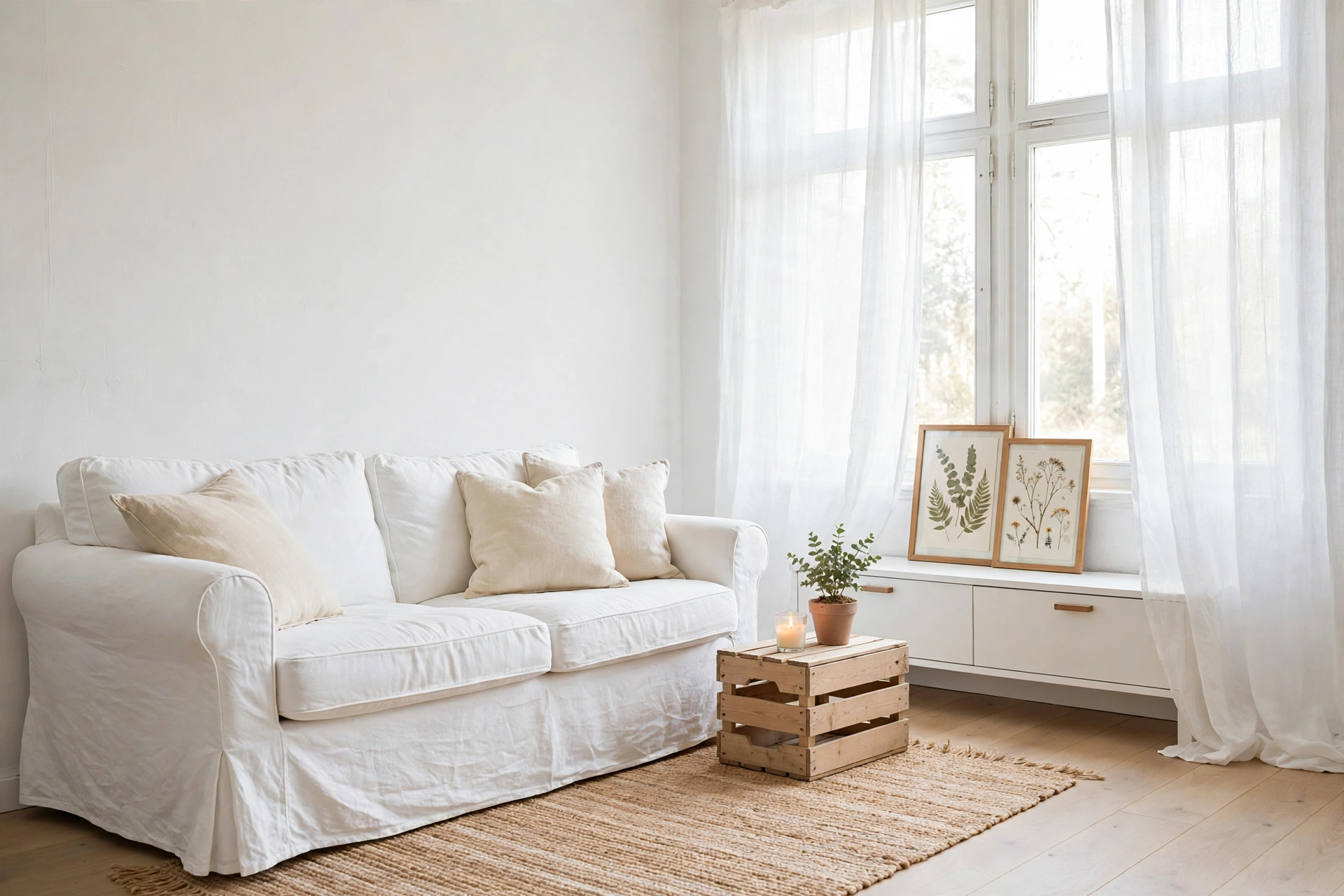
A tiny bedroom has a way of making you feel like your life does not fit your life. The wardrobe is full by Tuesday, the chair has become a clothes mountain with a chair somewhere underneath, and every drawer closes only if you lean on it with feeling. If you have ever searched how to organize a small bedroom at 1 a.m., welcome — you are exactly who this guide is for.
Here is the hopeful truth about small bedroom storage ideas: a small room rarely needs new furniture. It needs its hidden zones put to work, in the right order. We will go zone by zone — under the bed, up the walls, behind the door, then the closet (or the corner pretending to be one). Most of these bedroom storage ideas for small rooms cost under $30, nearly all are renter-friendly with no drilling, and every one is chosen to look like decor, not storage. If your room’s layout itself needs love first, our small bedroom ideas are the place to start — then come back here and give everything a home.
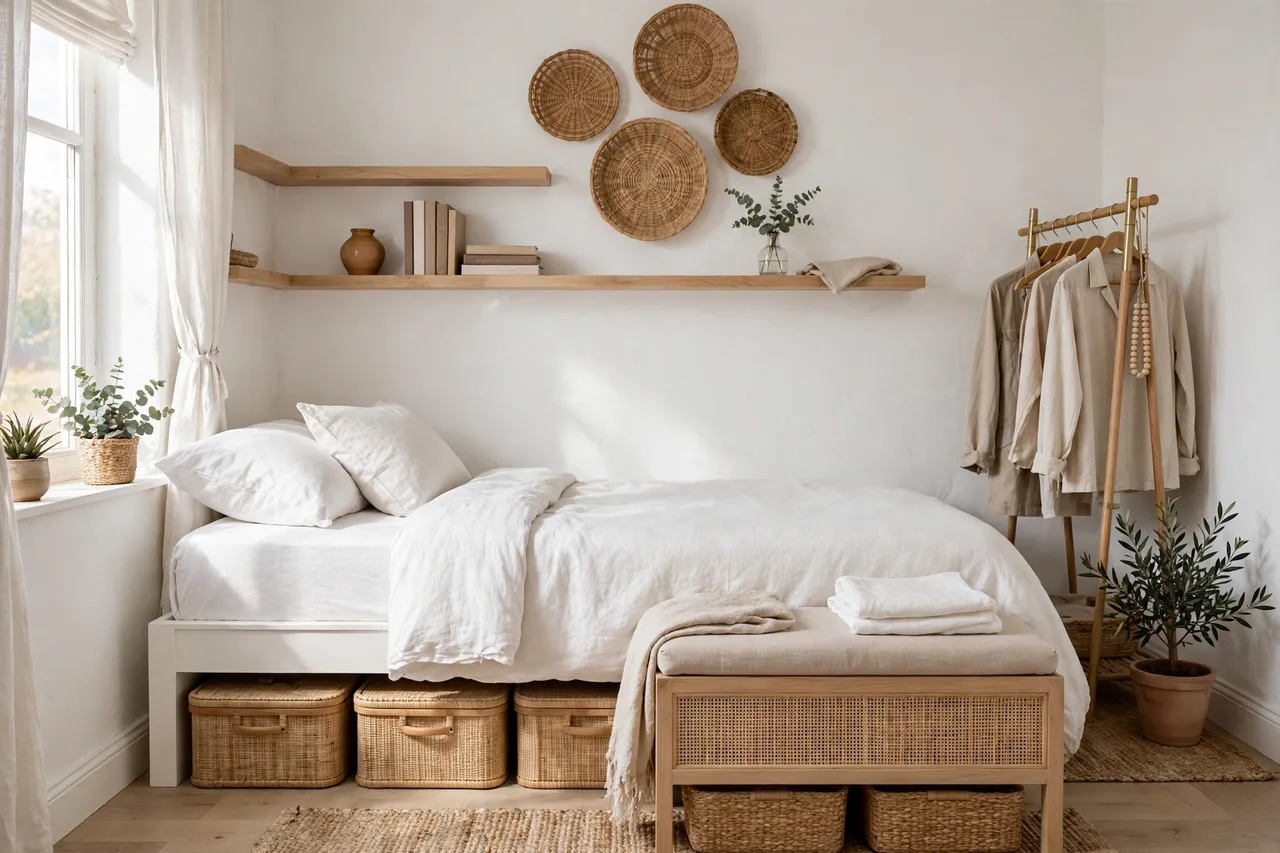
Under the Bed: The Room’s Hidden Half
The floor space your bed already occupies is the largest storage zone in the room — roughly the size of a small closet, lying there doing nothing. These under bed storage ideas claim it in order, from the things you touch twice a year to the things you reach for every week.
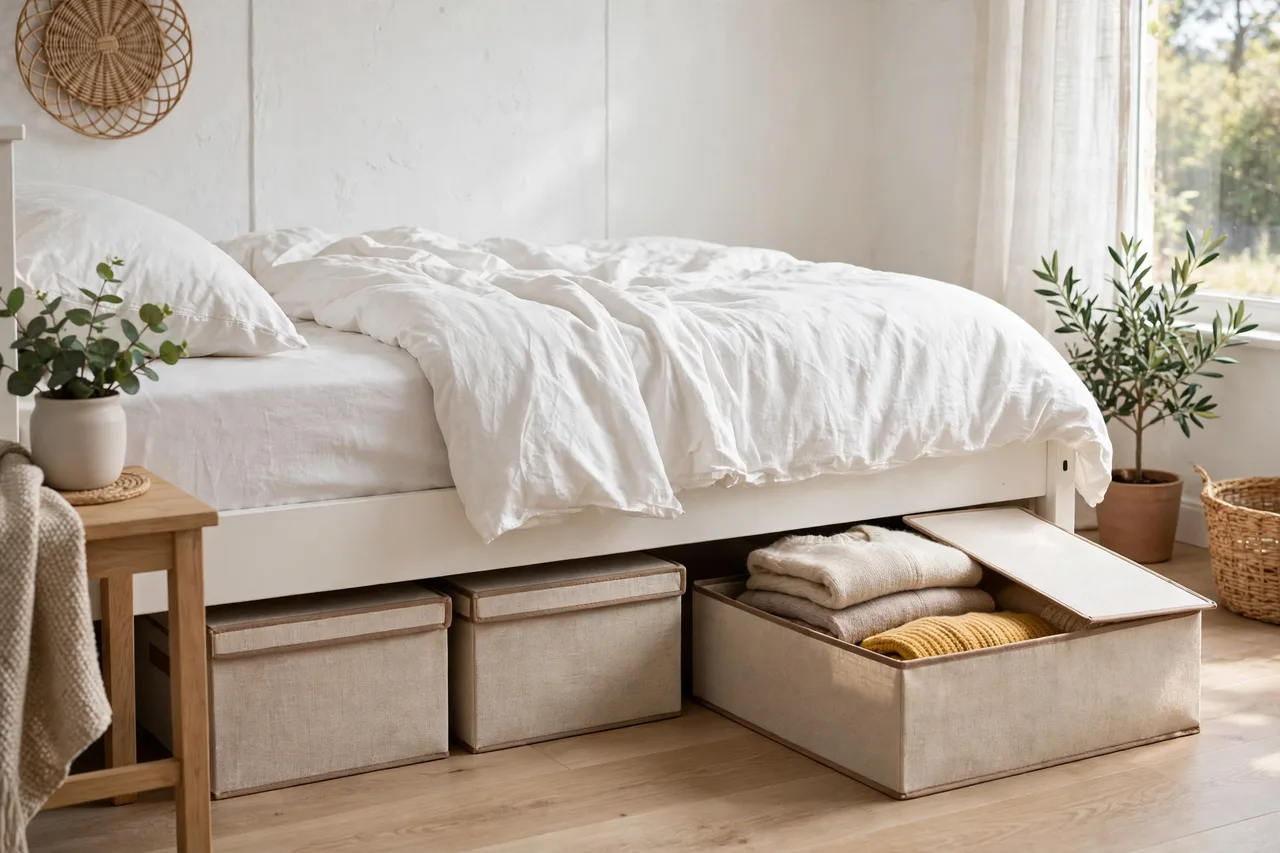
1. Low-Profile Boxes for the Off-Season Layer
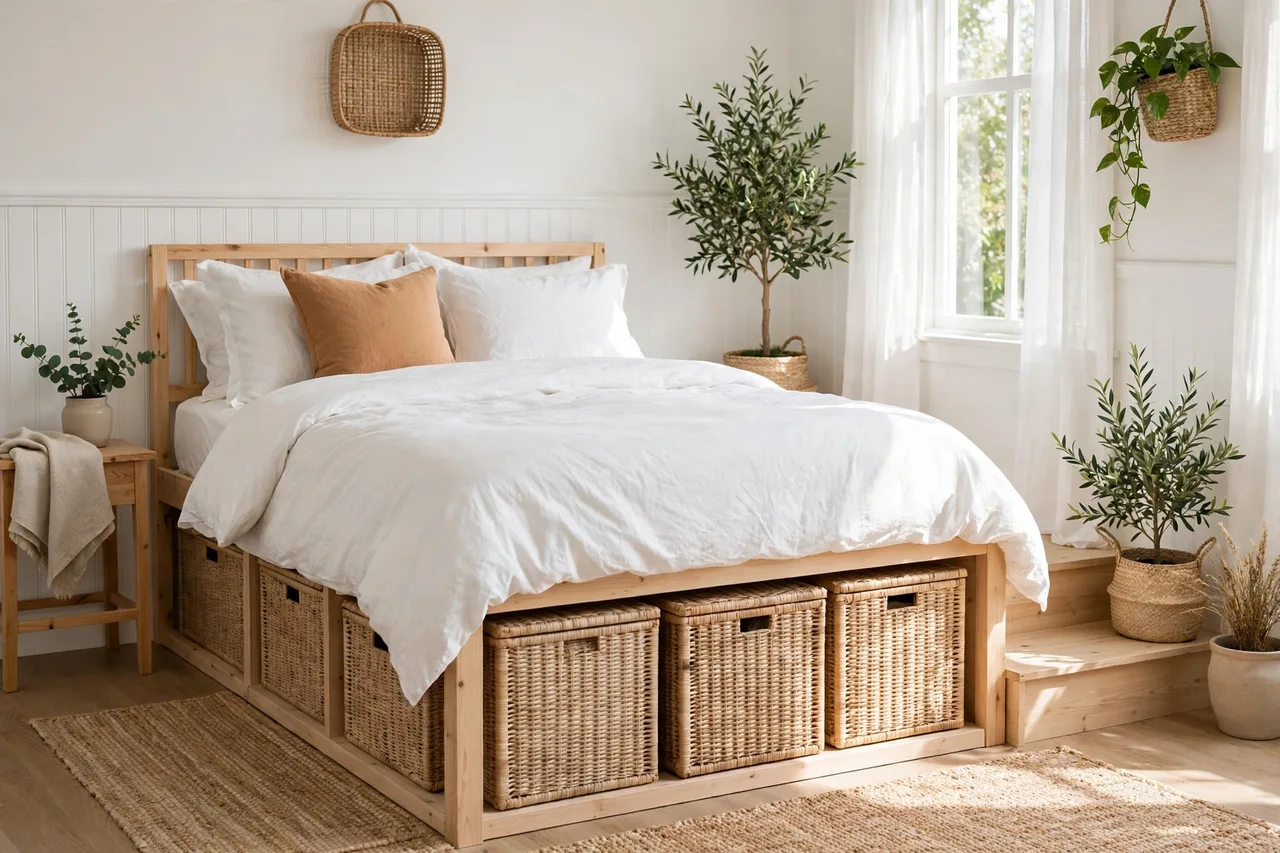
The under-bed box is the first trick because it asks nothing of you but a lid. Flat, lidded boxes — fabric or clear — slide into the 6–7 inches (15–18 cm) most bed frames offer and swallow the off-season layer: winter sweaters in June, beach things in January, the spare duvet. A set of two to four usually runs $15–$30. Styling tip: label every box on the short end that faces out. Future you, crouched on the floor in December, deserves to find the gloves without opening all four.
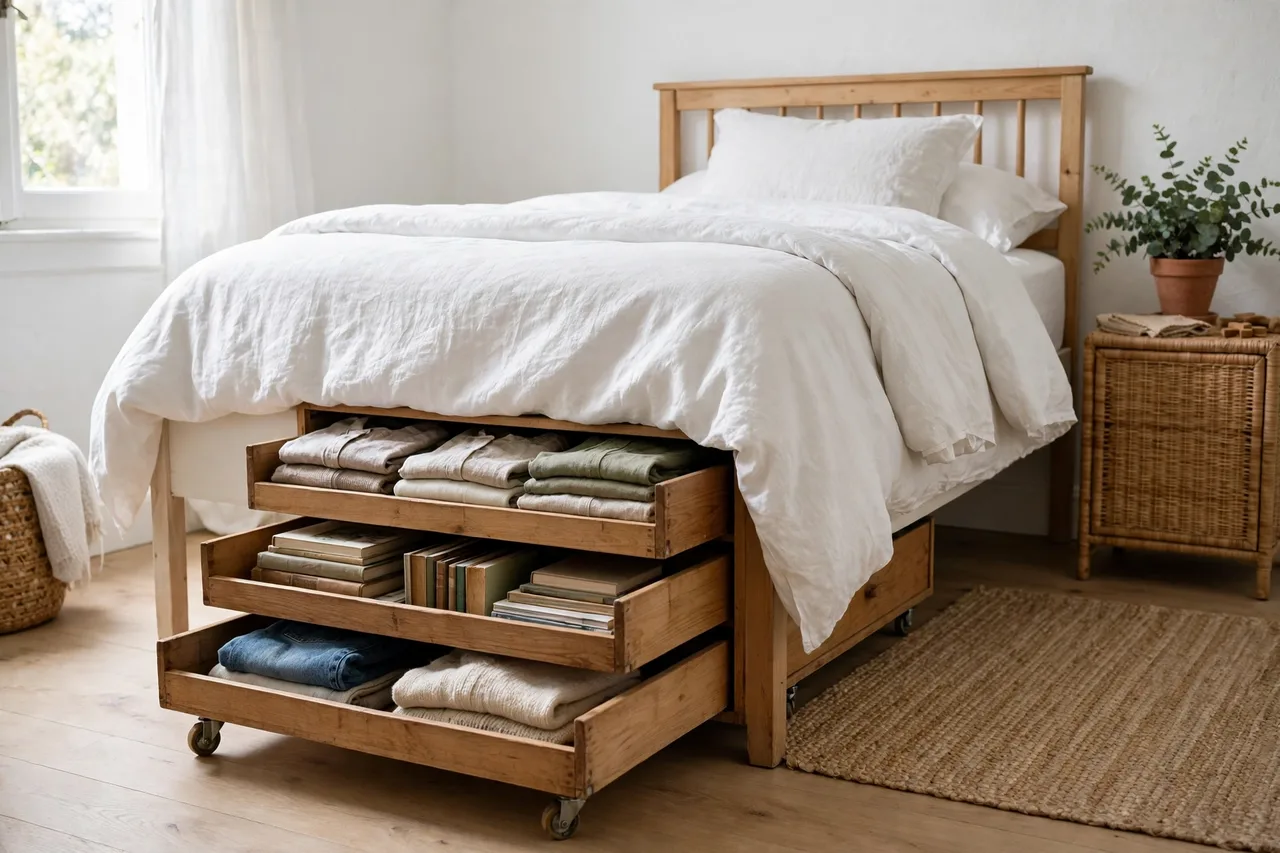
2. Rolling Drawers for the Weekly Things
Anything you reach for every week deserves wheels. Rolling under-bed drawers and low carts on casters glide out with one finger — no dragging, no floor scratches, no sighing. They are perfect for shoes, gym clothes and the everyday layer that boxes bury too deep. Expect $25–$45 each. Before you buy: measure your clearance honestly, wheel height included. Handy? An old drawer or vintage suitcase on casters does the same job with twice the charm.
3. Vacuum Bags for the Bulky and Puffy
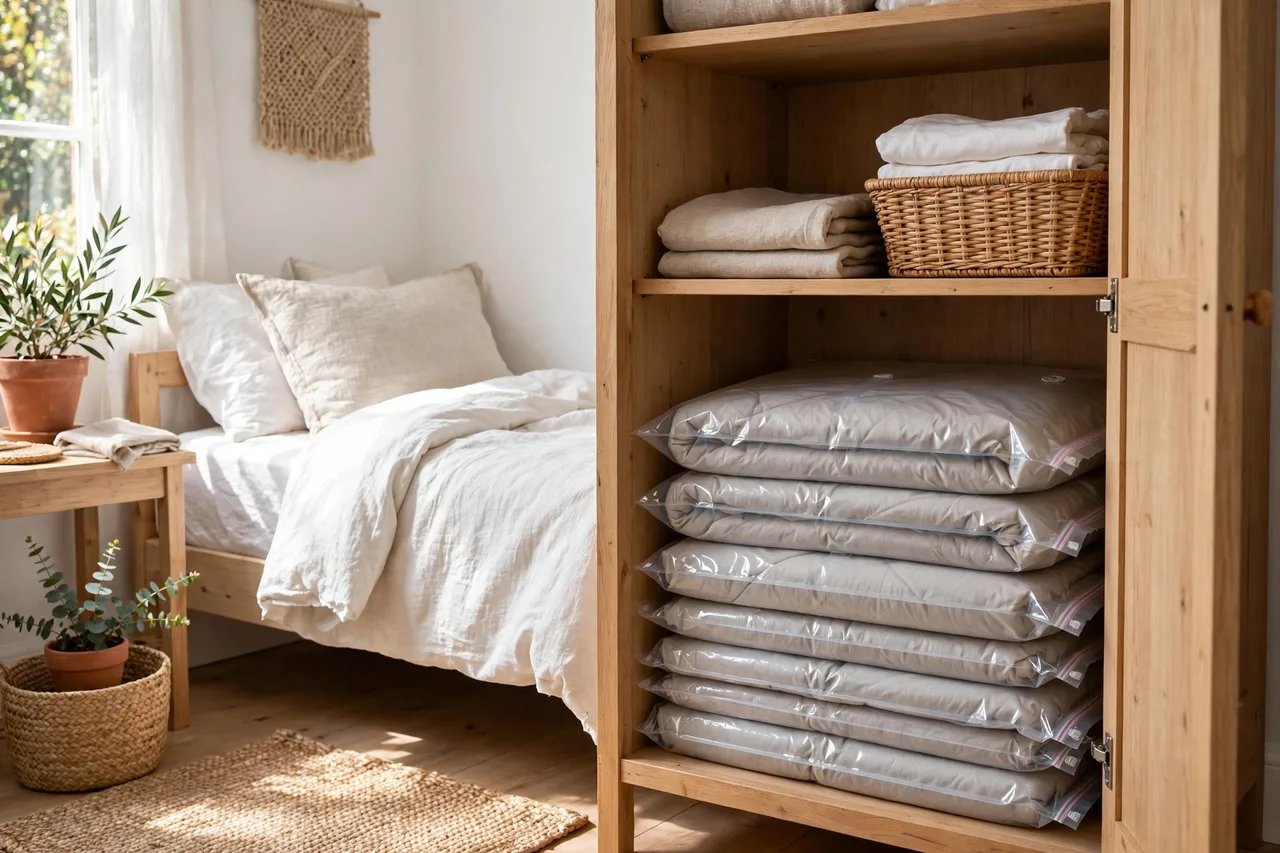
Some things are mostly air wearing a costume. Duvets, winter coats and spare pillows shrink by more than half — bulky bedding by up to 80 percent — inside vacuum storage bags, turning one impossible shelf-load into a flat packet that slides under the bed or on top of the wardrobe. A multipack costs $15–$30. Styling tip: vacuum bags are for the truly off-season. Anything wanted within the month will punish you with a full re-seal ceremony — keep the weekly layer in the rolling drawers instead.
4. Bed Risers to Unlock Taller Storage
If your boxes almost fit, raise the bed, not your hopes. Bed risers lift the frame by 3–5 inches (8–13 cm), turning a 6-inch (15 cm) gap into nearly 12 inches (30 cm) — enough for taller bins, shoe boxes stacked two deep, even a small suitcase. A sturdy set runs $10–$20. Before you buy: measure the clearance first, then the height of the boxes you actually want to store, and choose the riser that bridges the two numbers. One solid lift is steadier than stacked risers.
Up the Walls: Vertical Storage
When the floor is full, the only way is up. This is where small bedroom organization gets dramatic: walls hold a surprising amount of your life if you ask them politely. Work from the bed outward, and keep everything light in color, so the room gains storage without gaining visual weight. It is also the honest way to maximize storage in a bedroom you cannot make any bigger.
5. Floating Shelves Above the Bed
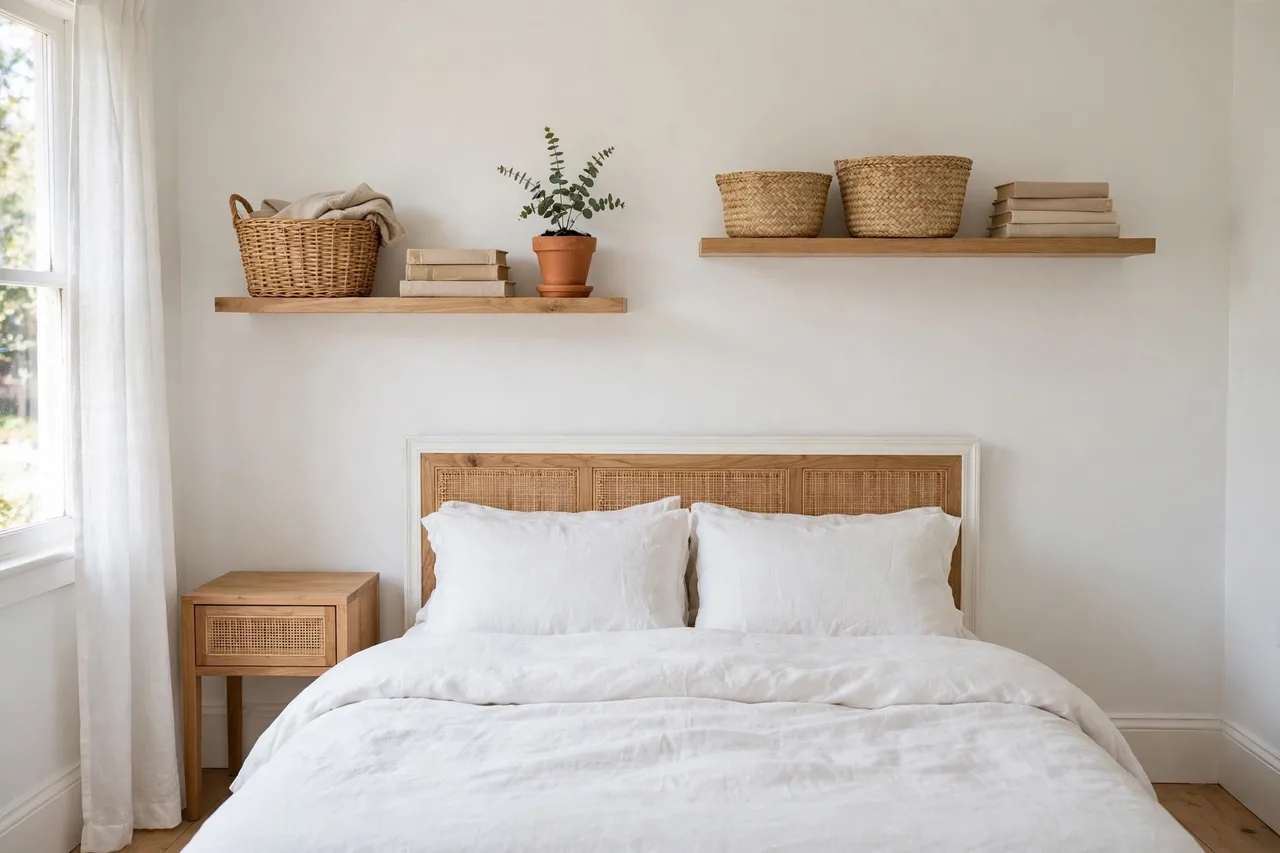
The wall above your headboard is a bookshelf waiting to happen. One or two floating shelves hold the bedtime library, a small plant, a pretty box for the not-pretty things, and free the floor a bookcase would have eaten. A pair usually costs $20–$40. Before you buy: above a bed, light things only, and anchor shelves into studs or proper wall plugs — this is the one spot in the room where “probably fine” is not a fixing standard.
6. A High Shelf Line and the Above-Door Shelf
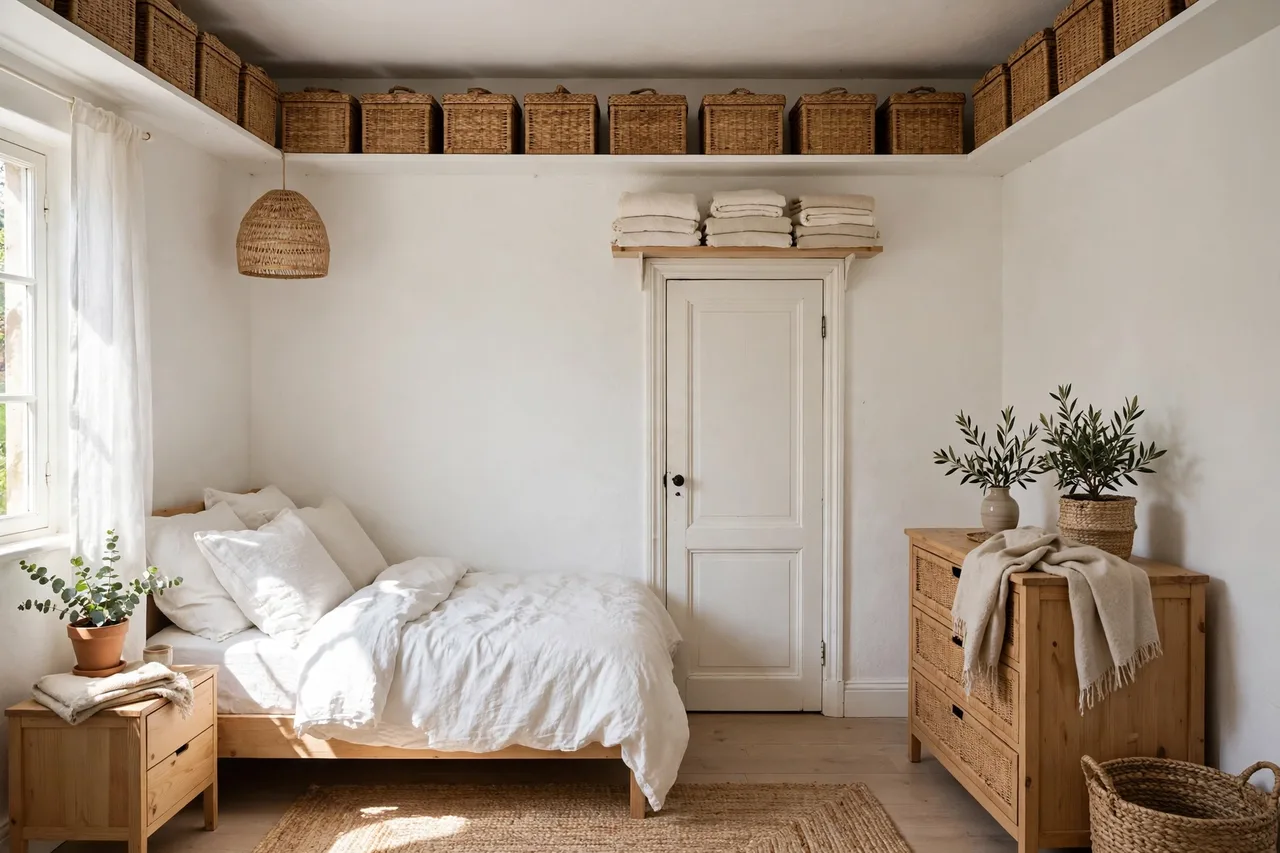
The last 12 inches (30 cm) below the ceiling is a dead zone in almost every home. A simple shelf line up there — boards on brackets, or one long shelf — stores the rarely touched: memory boxes, off-season hats, the fan that only works summers. The same trick fits above the door, a spot so forgotten it feels like cheating. Boards and brackets run $25–$50; a single above-door shelf, $15–$30. Styling tip: keep this high storage calm and matching — same-color boxes or baskets — because at that height, tidiness is the decor.
7. A Pegboard or Peg Rail for Bags and Jewelry
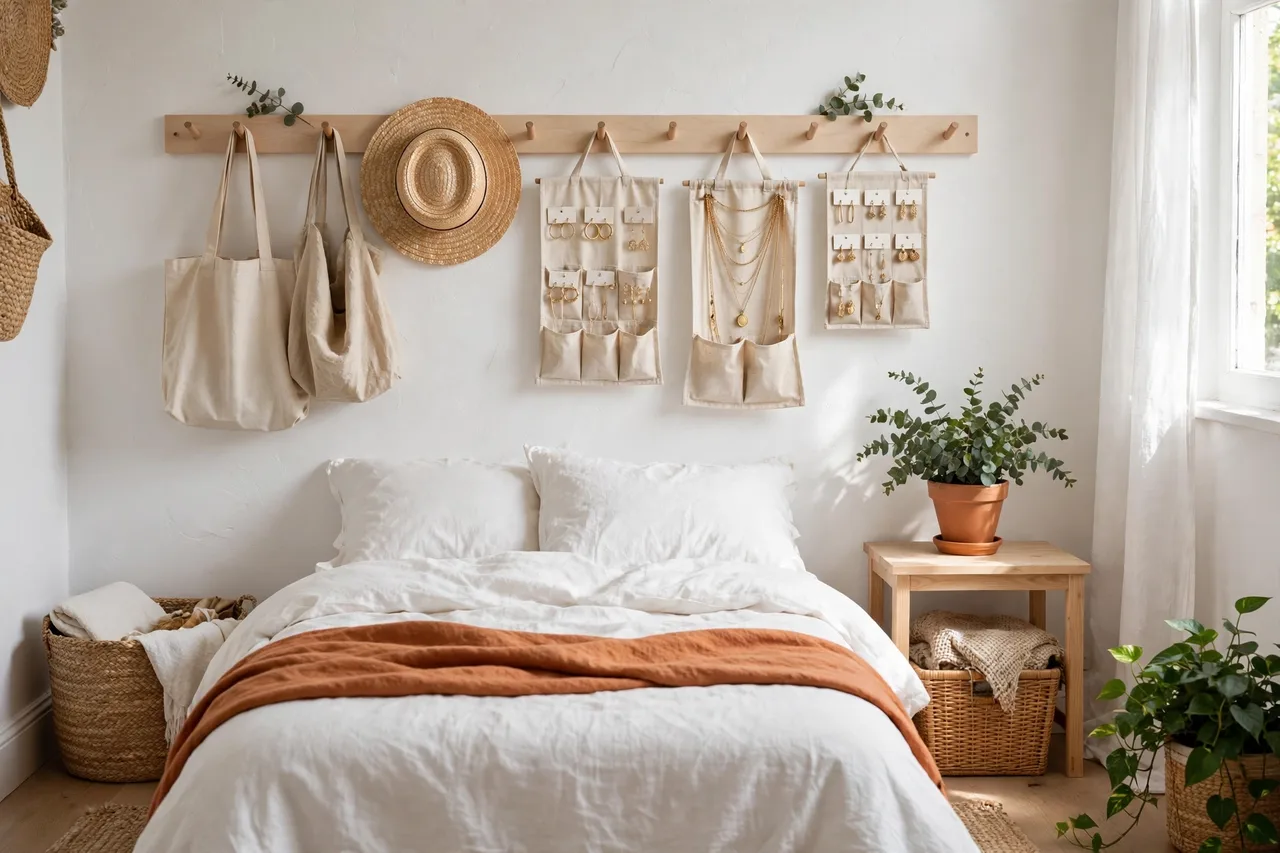
The things that tangle in drawers behave beautifully on hooks. A pegboard or a simple peg rail turns one patch of wall into flexible storage for bags, scarves, necklaces and tomorrow’s outfit — move the hooks as your life changes, no new holes needed. Board or rail plus hooks: $15–$35. Styling tip: give it a border in your head — one rail, one category family. A peg rail that holds bags and jewelry looks like a boutique wall; one that holds everything looks like a yard sale.
8. Corner Floating Shelves
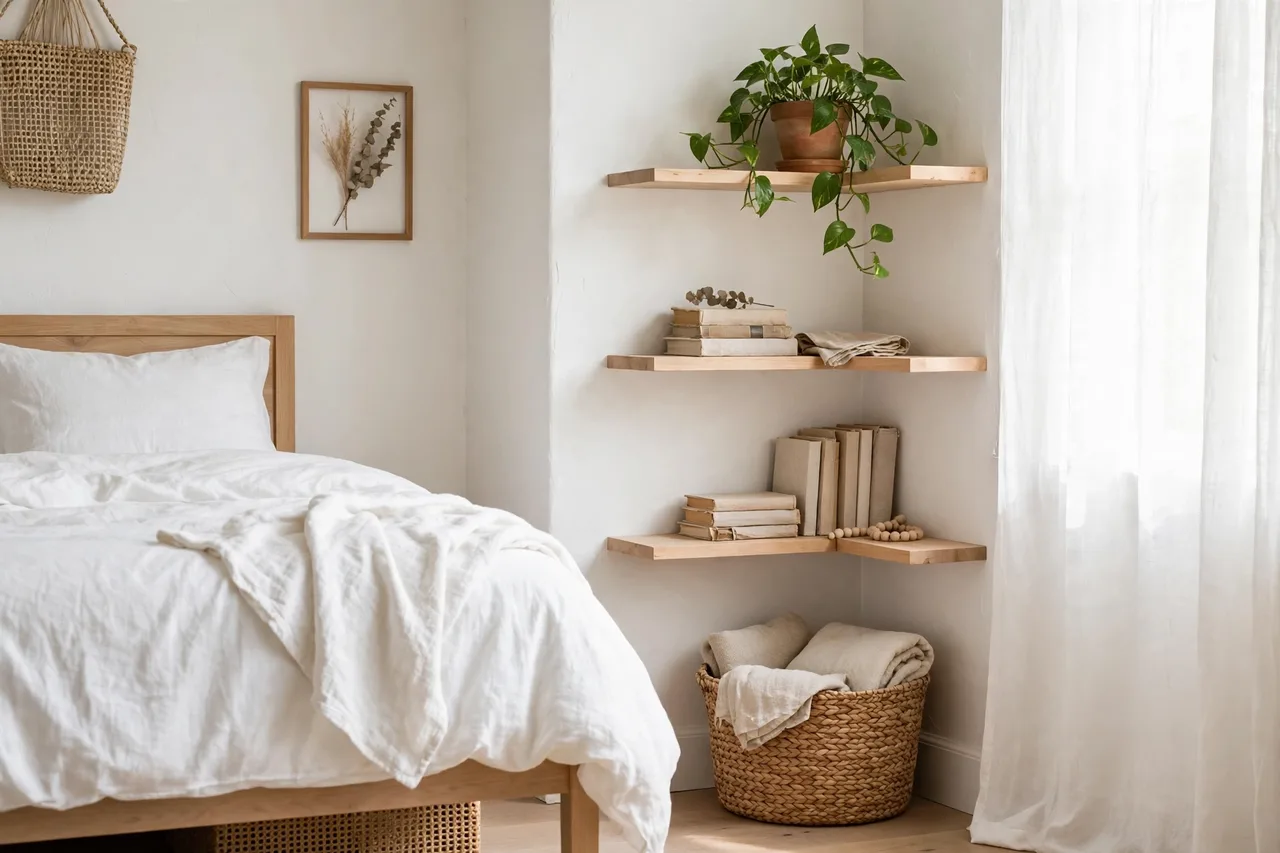
Corners are where small rooms hide their spare capacity. Two or three small corner shelves rescue the dead angle beside the wardrobe or above the nightstand zone — a charging corner, a glasses-and-book corner, a plant corner. A set runs $18–$35. Before you buy: corners are rarely perfect right angles, so measure yours, and keep the lowest shelf at head-clearing height where people walk or sit up.
9. Wall-Mounted Baskets
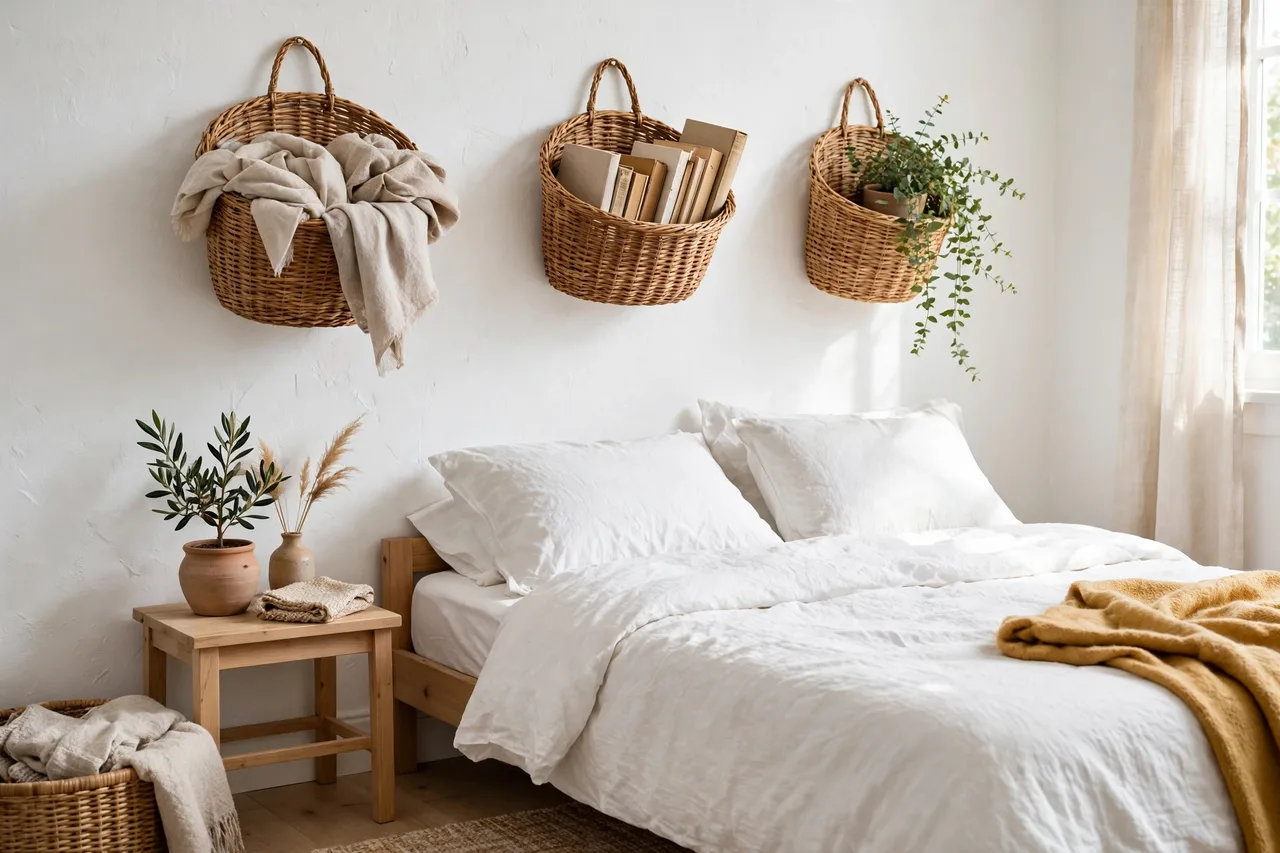
The prettiest storage move in this whole guide. Woven baskets mounted on the wall hold bedside clutter, scarves, mail, the book you are definitely finishing this week — and because they are baskets, they read as texture and decor first, storage second. Most cost $10–$25 each. Styling tip: this is the white-classic secret — matching natural baskets in a neat row make open storage look intentional. Three identical baskets say “styled”; three random ones say “stuff.” Choose the story you prefer.
The Door & the Nightstand Problem
Every bedroom door is a storage wall you use a dozen times a day, and the nightstand is the piece of furniture small rooms most often cannot fit at all. This zone fixes both. It is also where renters win biggest, because almost everything here hangs — the same door-first thinking that powers our small bathroom storage ideas works just as hard in the bedroom.
10. An Over-Door Pocket Organizer — Not Just for Shoes
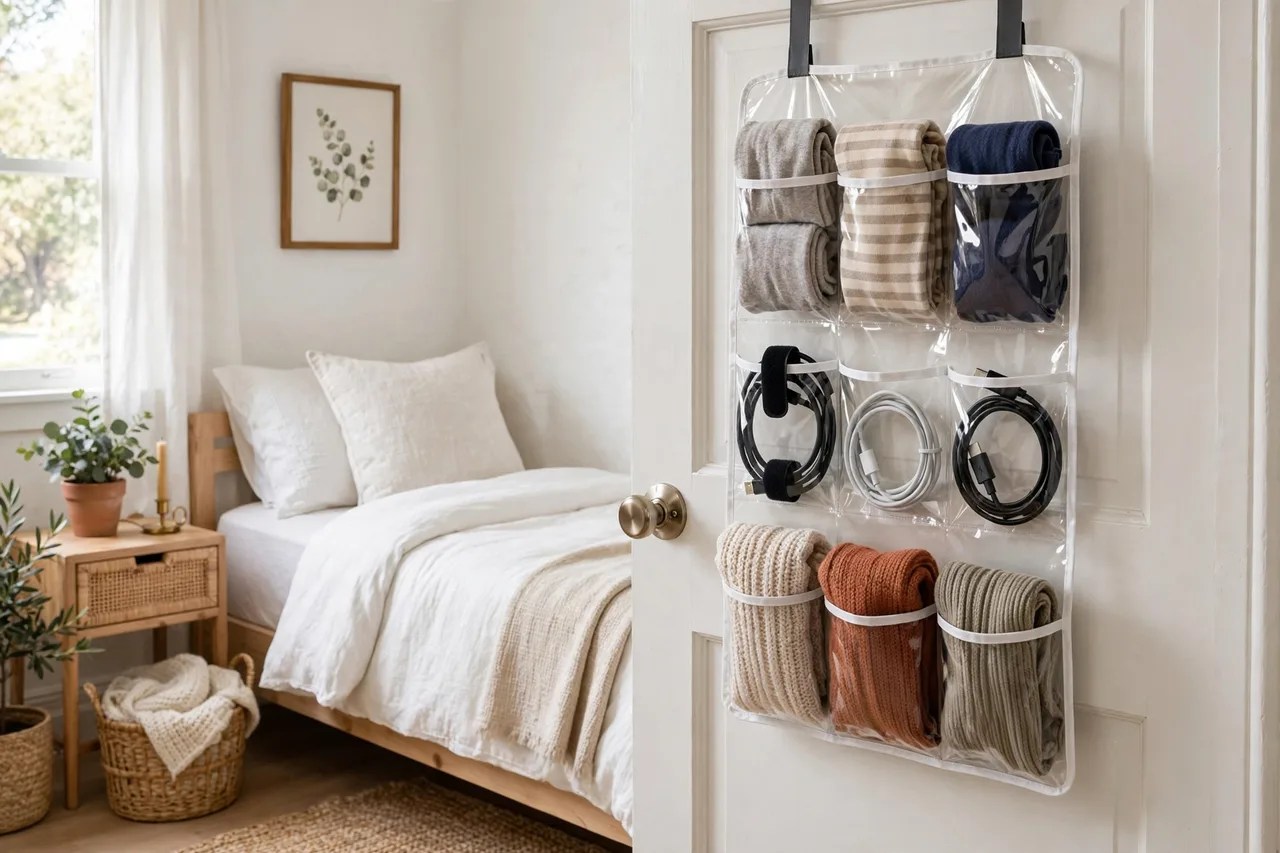
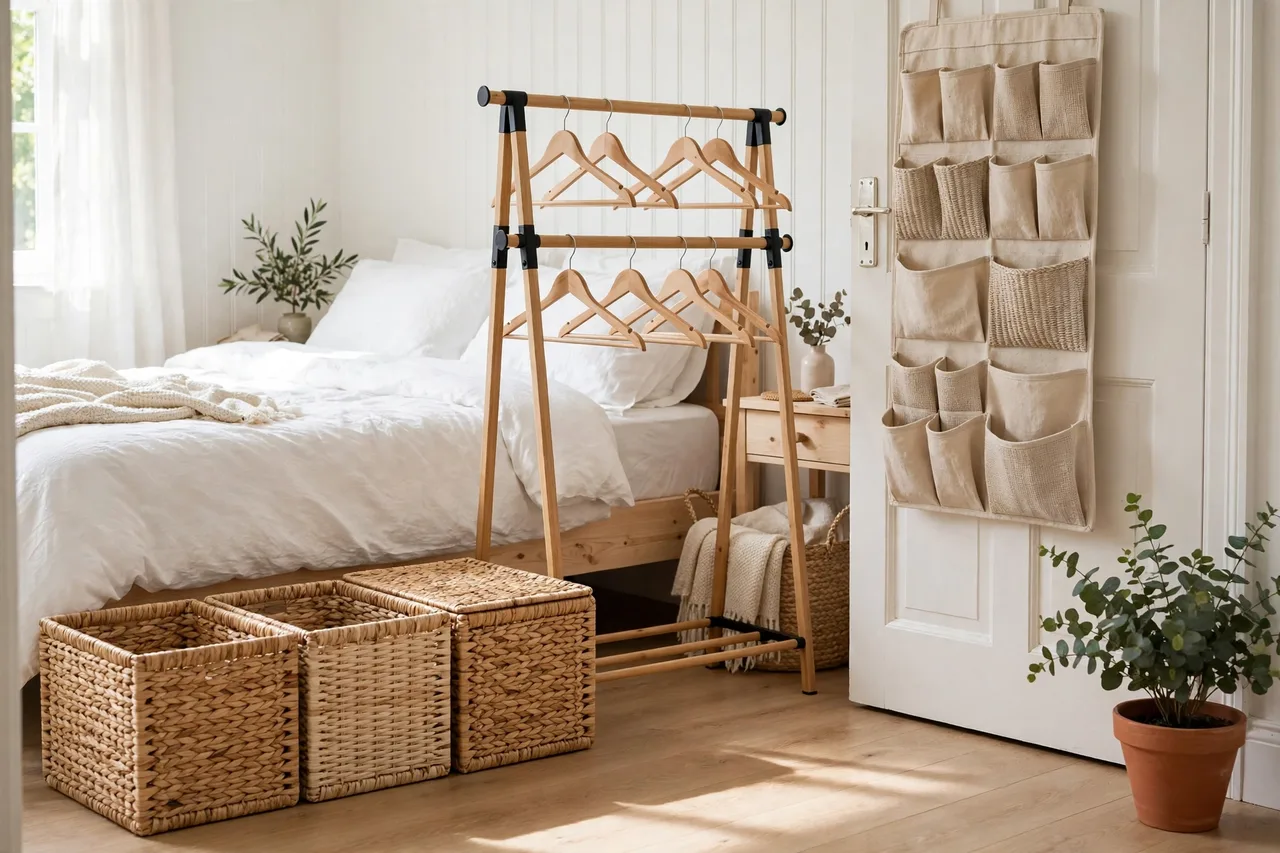
The clear-pocket organizer is wasted on shoes alone. Hang one on the bedroom or closet door and its 24 see-through pockets become homes for socks, underwear, hair ties, charging cables, scarves and every small thing that migrates around the room. Seeing everything at a glance is the whole magic. Most cost $10–$20 and hang in a minute. Styling tip: one pocket, one job. The day a pocket becomes “miscellaneous,” the organizer starts its slow slide into junk-drawer territory.
11. Over-Door Hooks for the Daily Layer
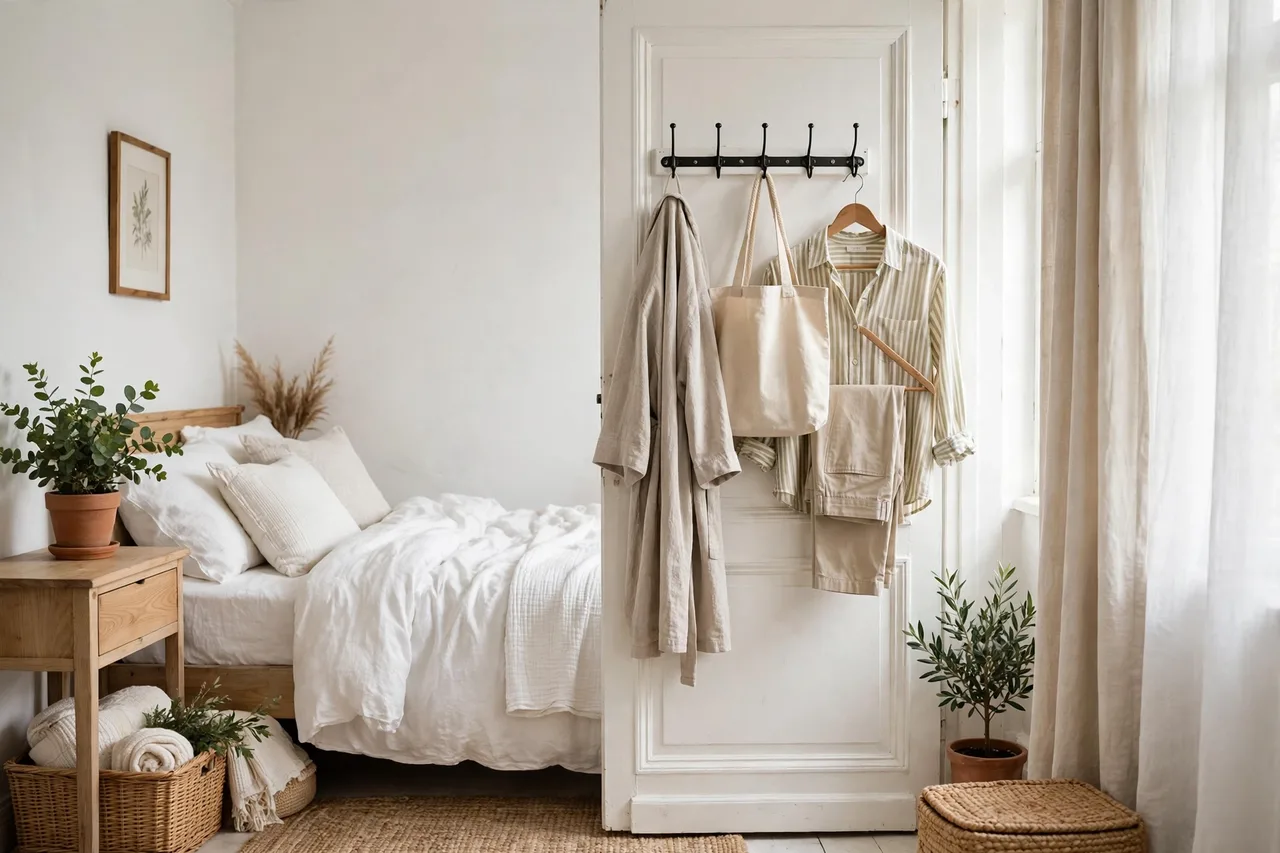
Robes, bags and tomorrow’s outfit need a landing strip that is not the floor. An over-door hook rack gives them one in seconds — no screws, no tools, and it leaves with you on moving day. Expect $12–$25. Before you buy: check the gap between your door and its frame first — a rack that stops the door closing properly is worse than no rack at all. Felt pads on the hooks keep the door’s paint — and your deposit — safe.
12. A Floating Ledge Instead of a Nightstand
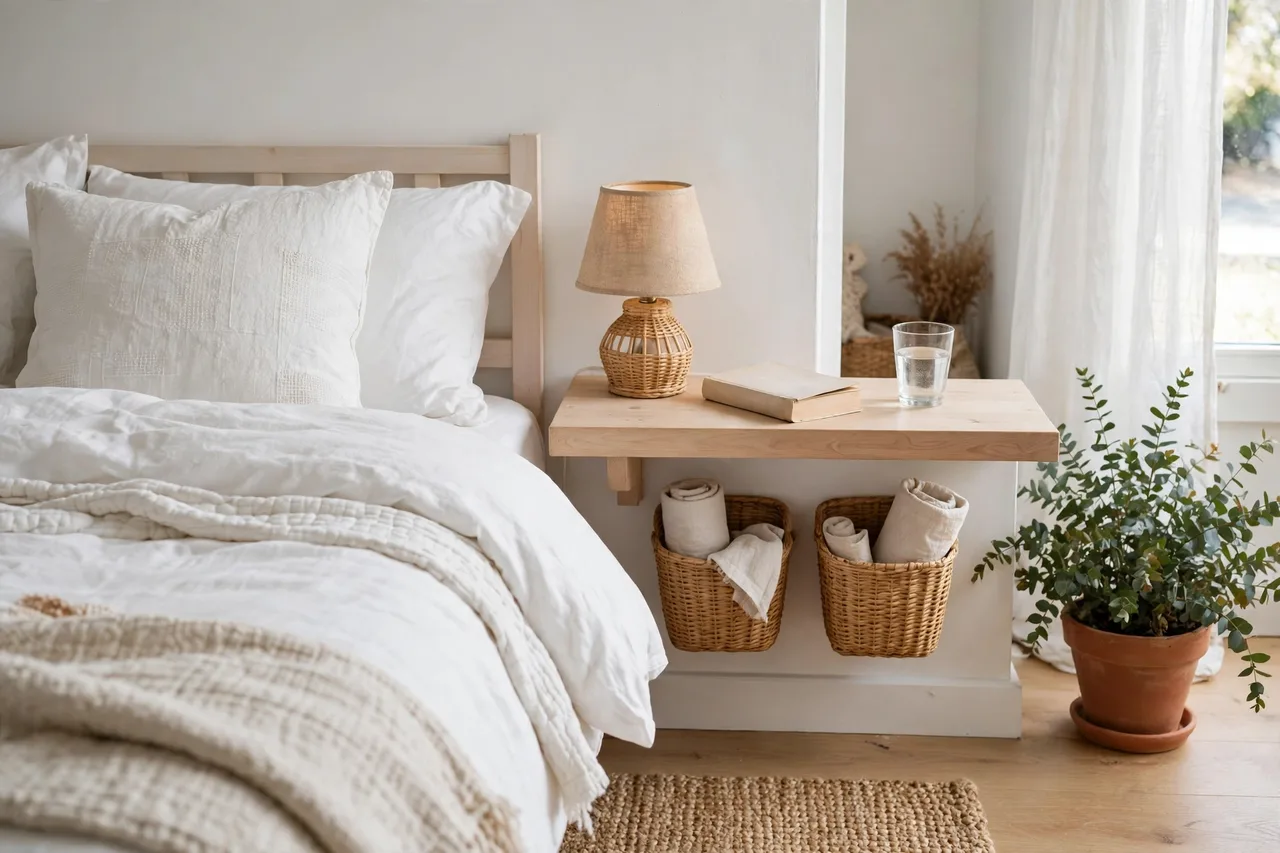
No floor for a nightstand? The wall will lend you some. A floating shelf or picture ledge — about 10–12 inches (25–30 cm) deep, often slimmer — beside the bed holds the nightly essentials: phone, book, glasses, water glass, done. Most ledges cost $15–$30. Styling tip: add a small wall-mounted or clip-on lamp above it and the ledge stops looking like a compromise and starts looking like a boutique hotel choice. Keep the surface edited — a ledge shows everything.
13. A Bedside Caddy or Slim Rolling Cart
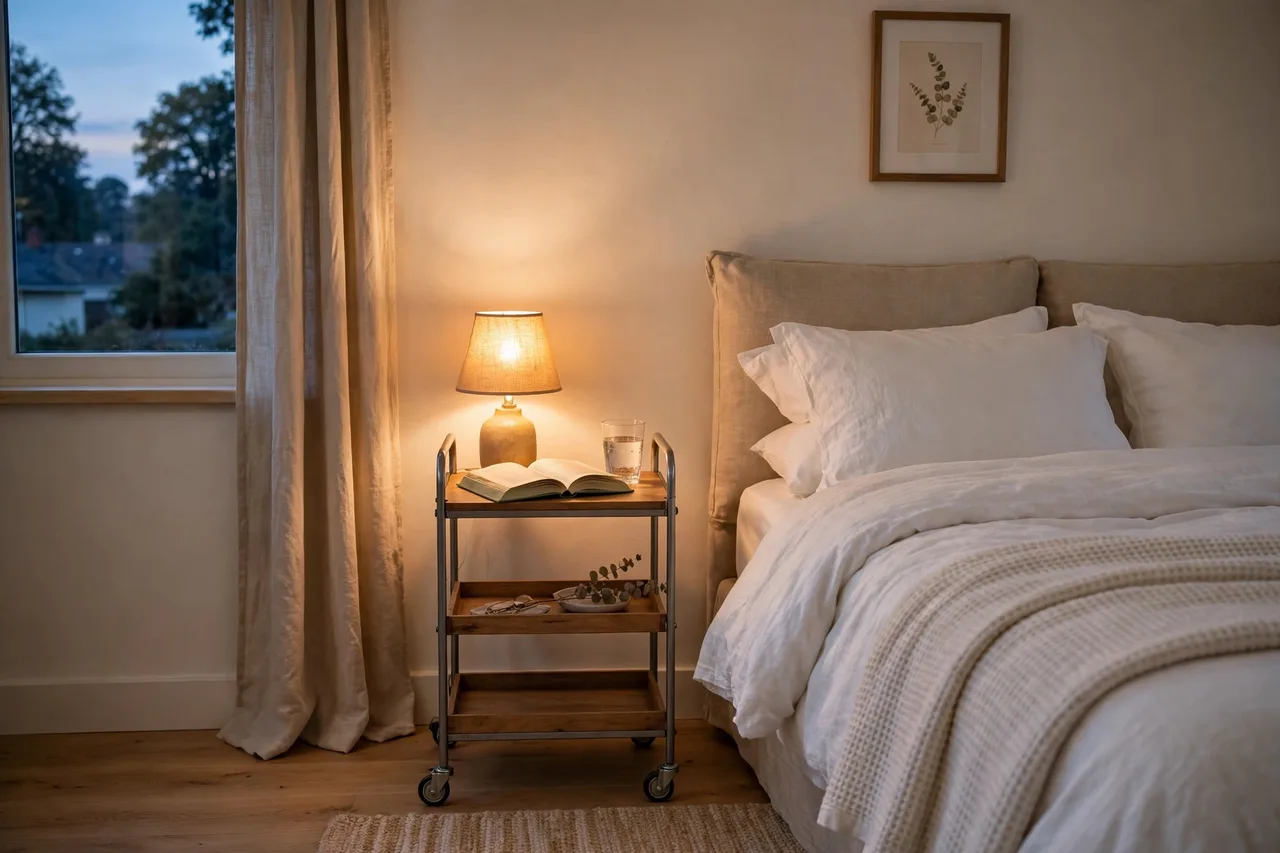
When even a ledge will not fit, hang the nightstand on the bed itself. A fabric bedside caddy tucks under the mattress and hangs pockets beside you for the phone, remote, book and tissues — about $10–$20. Or slide a slim rolling cart into the gap between bed and wall: tiers for water, books and the charger, rolling out when you need it, for $20–$35. Before you buy: measure that bed-to-wall gap at its narrowest point; carts, like cats, only fit where they truly fit.
The Closet — or the No-Closet Corner
If you have a closet, it is probably using half its height and a third of its sense. If you do not have one, you are not out of options — you are out of doors to close, which is different, and fixable. These are the no closet storage ideas and closet upgrades that make one small wardrobe do the work of two.
14. A Double-Hang Rod to Double Your Hanging Space
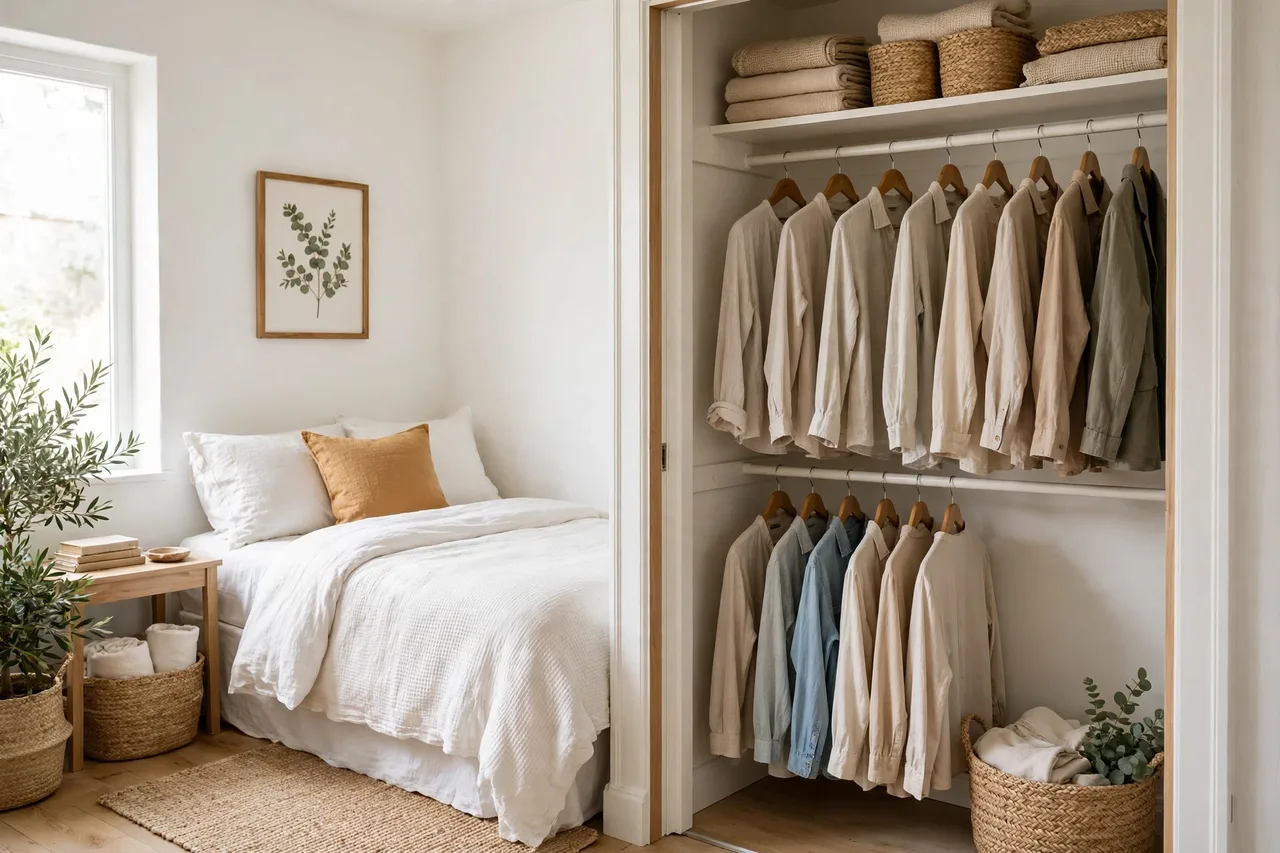
Most closets hang clothes in the top half and store air in the bottom half. A second rod — a hanging rod that hooks over the existing rail, hung about 36 inches (91 cm) below it — turns that air into a second tier for shirts, blouses and folded-over trousers. Your hanging space roughly doubles for $10–$20, with no tools at all. Styling tip: keep longer pieces on one side only and let the double-hang section handle the short things — mixed lengths are what made the bottom half unusable in the first place.
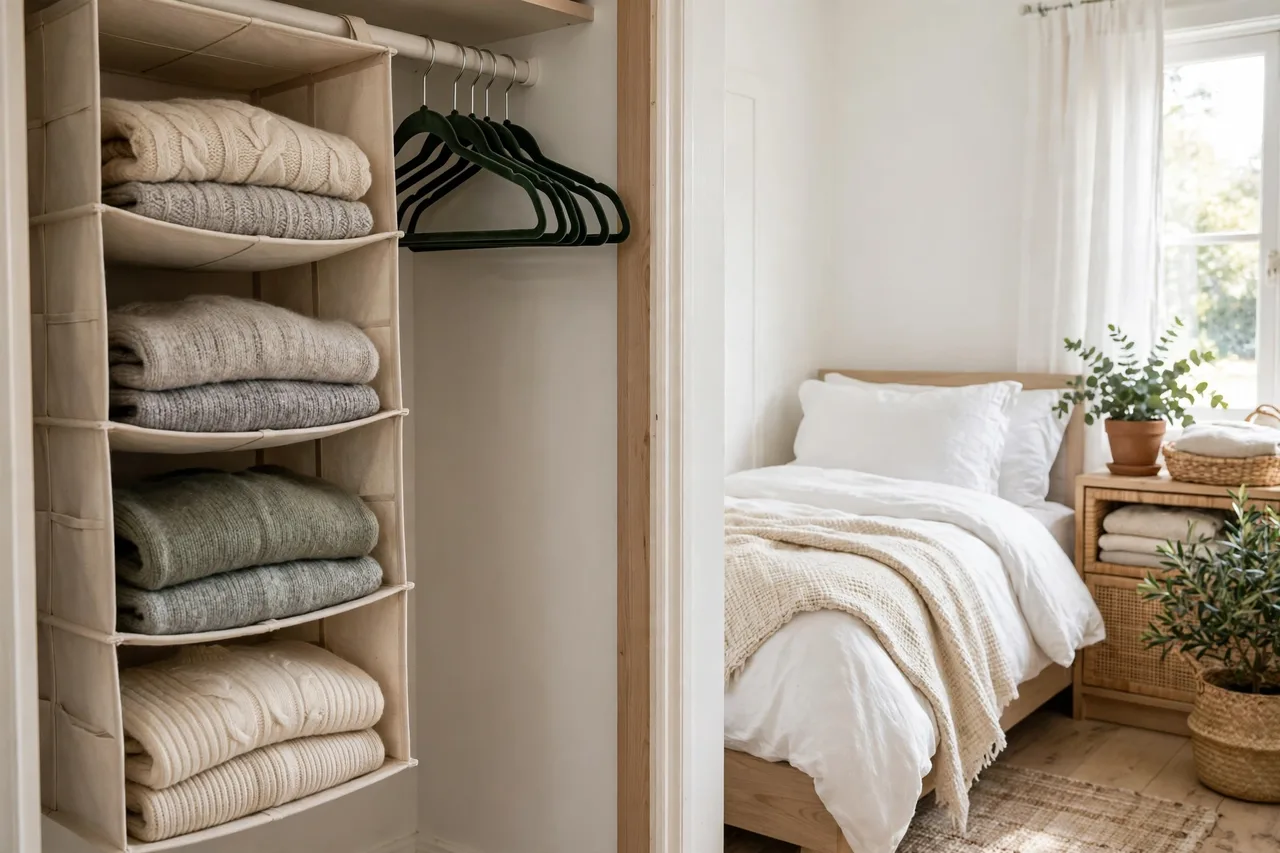
15. Hanging Sweater Shelves and Slim Hangers
Bulky hangers are silent space thieves. Swap them for slim hangers — the thin velvet kind — and a row of clothes takes two-thirds of the rail it used to. Then hang a fabric shelf unit in the freed space for sweaters, jeans and pajamas: folded clothes, using vertical air. Shelves run $15–$25; a generous pack of slim hangers, $10–$20. Before you buy: hanging shelves love folded knits and hate heavy books and boots; give each cubby one category and it will stay honest for months.
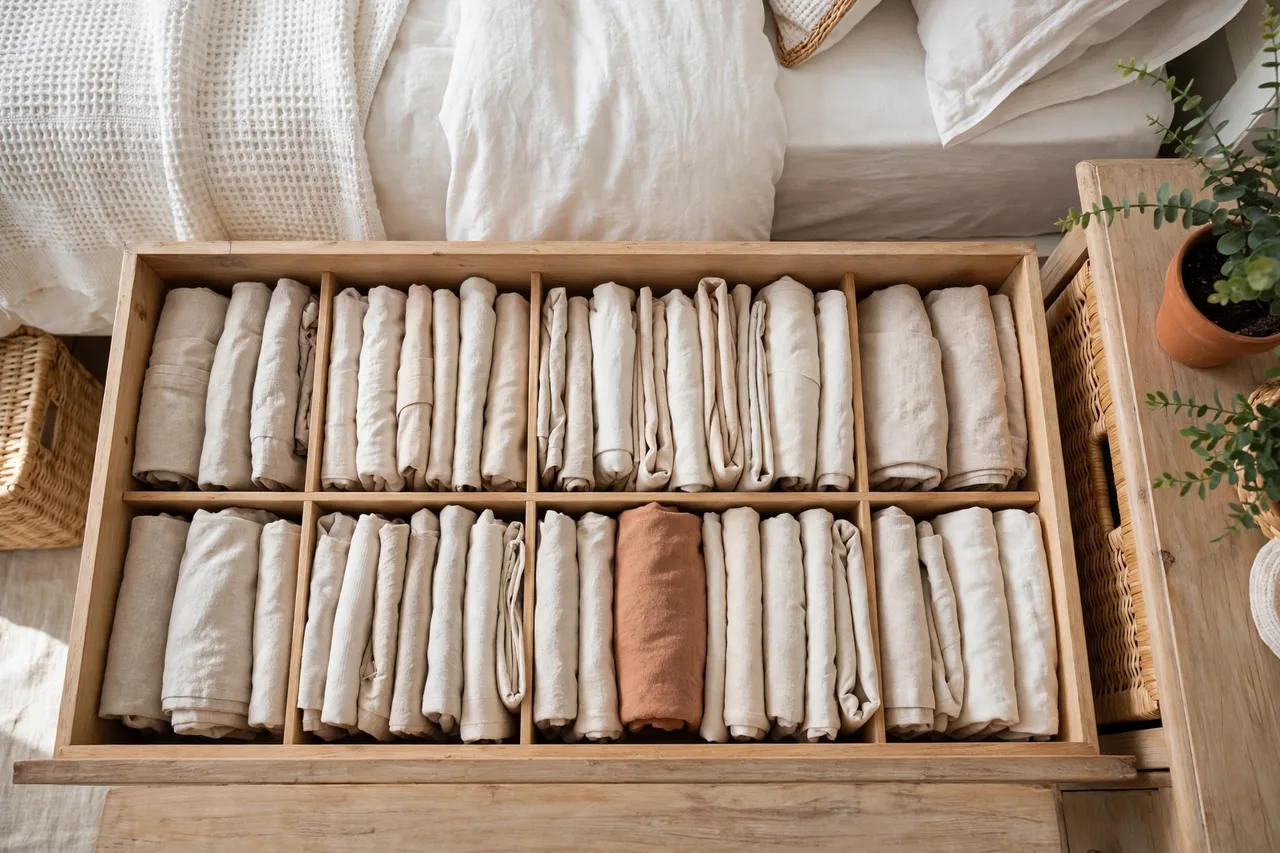
16. Drawer Dividers and File Folding
A drawer without dividers is just a box you shake daily. Simple dividers — a set for $10–$20 — split drawers into neighborhoods: socks here, underwear there, tees in their own lane. Pair them with file folding, where t-shirts and sweaters stand upright in rows like files in a cabinet, and you can see every single one at a glance instead of excavating from the top. Styling tip: file folding works best in a drawer or box with sides to lean on. Fold once, stand everything up, and the morning dig ends forever.
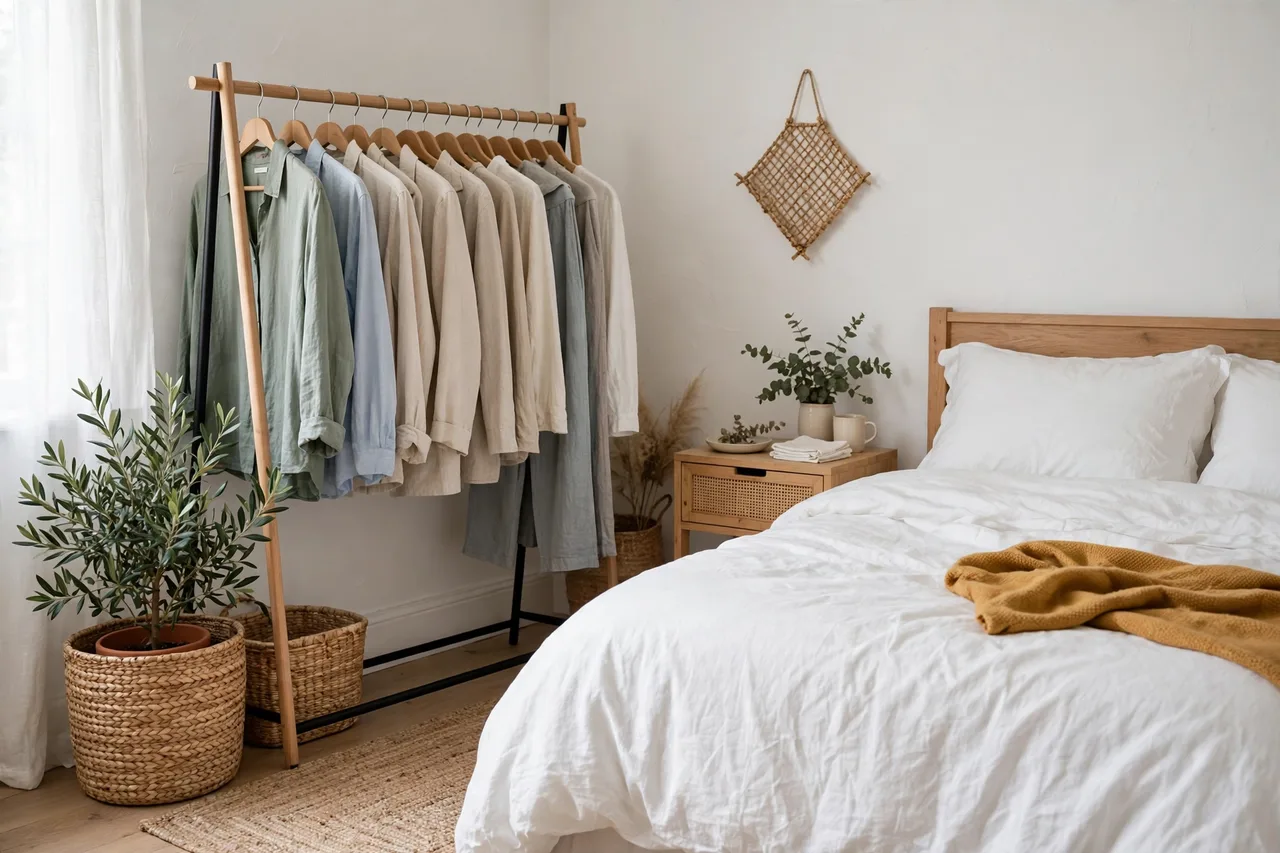
17. The No-Closet Corner: An Edited Garment Rack
No closet? Build one that looks like it belongs in a boutique. A simple garment rack — $30–$80 — holds your edited best rotation in the open, and open is the key word: a rack you can see must stay curated, so hang one color family, leave breathing room between pieces, and put a basket or shoe row underneath. Prefer hidden? A curtain on a tension rod across an alcove or corner makes a soft wardrobe wall for $15–$30. Styling tip: this is tiny bedroom storage that doubles as decor only if you edit first. The rack displays your wardrobe; it cannot also store your regrets.
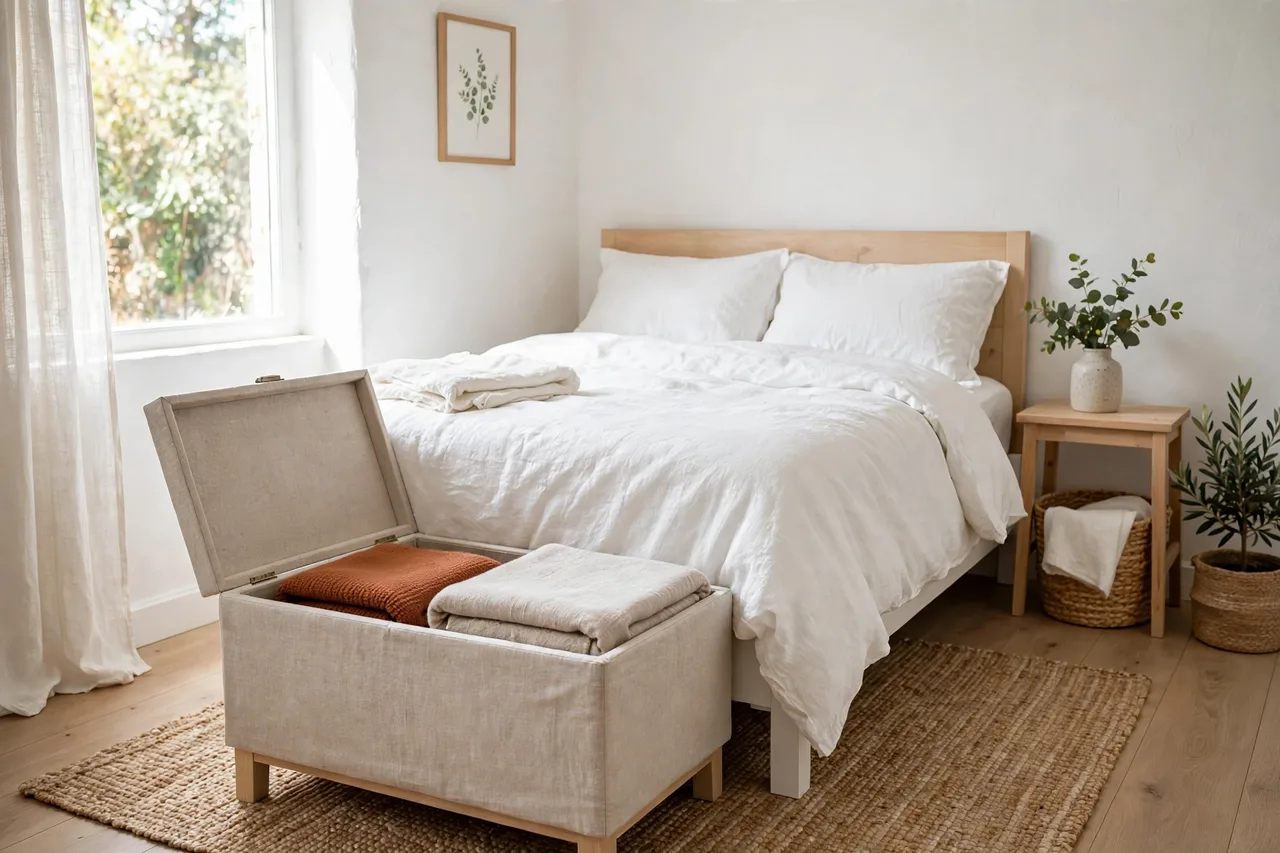
18. A Storage Ottoman or Bench at the Foot of the Bed
The hardest-working piece of space-saving bedroom furniture you can buy. A storage ottoman or bench at the foot of the bed hides the spare bedding, the guest towels or the entire off-season shoe collection — and gives you somewhere to sit while putting on the shoes it stores. Ottomans run $30–$60; a proper bench, $60–$150. Styling tip: in linen or soft bouclé with light wood legs, it reads as pure decor. Guests will compliment your bench; only you will know it is a cupboard wearing a very good disguise.
The Budget Ladder: Start With the $30 Trio
Eighteen ideas is a feast, so here is the order that matters. If you do only three things, do the $30 trio: a set of under-bed boxes (idea #1), a double-hang rod (idea #14) and an over-door pocket organizer (idea #10). Bought carefully, the three together land around $30–$50 — and they deliver roughly half of the capacity this guide creates, because they claim the three biggest dead zones: under the bed, the closet’s lower half, and the back of the door. That is the honest heart of small bedroom storage ideas on a budget: zones first, gadgets later.
The middle rung (about $30–$100 total) adds motion and walls: rolling under-bed drawers, a vacuum bag multipack, the peg rail and corner shelves. Buy these one zone at a time, measuring as you go.
The one bigger buy is worth saving for: a storage bench for the foot of the bed, or — when a bed replacement is genuinely due — a storage bed frame with drawers or a lift-up base. It can add a dresser’s worth of space in one move, so it earns its price slowly and surely rather than on impulse.
Renters, one last note: nearly everything here is drill-free. Tension rods, over-door hangers, adhesive hooks and strips, freestanding racks and anything on casters all move out with you and leave the walls exactly as you found them. Where a shelf does need screws, it is small, standard, and — in most rentals — a five-minute fill-and-paint on moving day. And if this little room also has to welcome overnight guests sometimes, our guest bedroom ideas show how to keep it kind for visitors too. For the rest of the home, the room-by-room finds in our small space storage ideas use this exact same zone-by-zone logic.
FAQ
How do I maximise storage in a bedroom?
Work the zones in order: under the bed first, then up the walls, then the back of the door, then inside the closet. Most bedrooms are only using the middle layer of themselves — the floor and the furniture tops — while the space above, below and behind sits empty. Claim those three dead zones and you will usually double your working storage without adding one piece of floor furniture.
What are some small bedroom storage ideas that actually work?
The unglamorous ones, done properly: lidded under-bed boxes with labels, a second hanging rod in the closet, and an over-door organizer whose pockets each have one job. They work because they match storage to real behavior — flat things flat, hanging things hung, small things visible. The ideas that fail are usually beautiful boxes bought before measuring, filled with things nobody could name a week later.
How do you store clothes in a small bedroom?
Split them by how often they are worn. The daily rotation hangs on the rail — doubled with a second rod and slimmed with slim hangers. Folded knits live in hanging shelves and divided, file-folded drawers. The off-season layer goes under the bed in labeled boxes, and the bulky pieces shrink into vacuum bags. If there is no closet, an edited garment rack holds the current season in the open and the rest rotates out of sight.
What can I use instead of a nightstand in a small bedroom?
Four kind options: a floating ledge on the wall beside the bed, a fabric caddy that hangs from the mattress, a slim rolling cart in the bed-to-wall gap, or a chair or stool borrowed from elsewhere in the home. All four hold the true nightly essentials — phone, book, glasses, water. A ledge plus a clip-on lamp looks the most like a deliberate design choice.
How do you double your closet space?
Hang a second rod about 36 inches (91 cm) below the first so shirts and trousers stack in two tiers, swap bulky hangers for slim ones to slim the whole rail, and give the freed width to a hanging shelf unit for folded clothes. Add dividers and file folding in any closet drawers, and store the off-season layer under the bed instead of in prime hanging territory. Most small closets hold twice as much as their owners believe — they are just arranged for one tier and one season.
Your bedroom is not too small. It is a whole closet’s worth of space wearing a disguise — under the bed, up the walls, behind the door. Pick one zone this weekend, start with the $30 trio, and watch the room quietly double itself. Save this guide for your next organizing afternoon, and follow along on Pinterest for one clever, doable idea every day. 🏡